


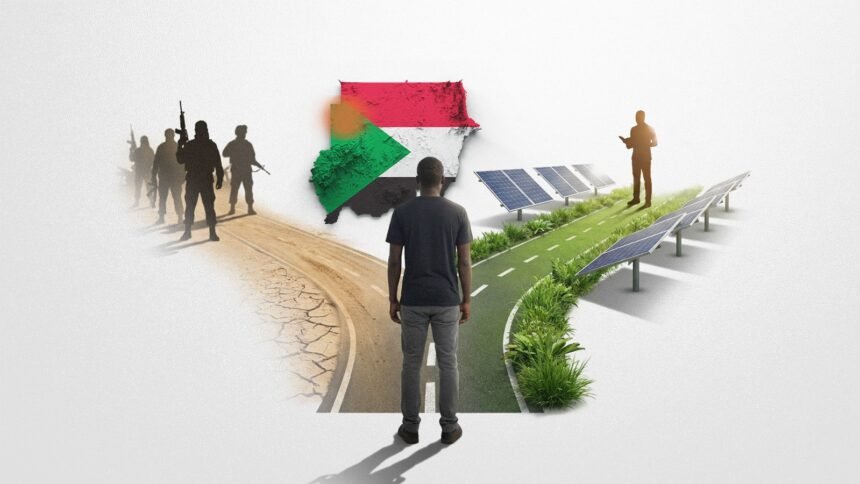
In the shadow of renewed conflict and escalating climate vulnerability, young Sudanese activists continue building resilience at the intersection of peacebuilding and environmental action. Essam Adam Abdelmwla1, Climate Program Manager at Darfur Youth Center for Peace and Development (DYC2), spoke with Africalix about navigating a humanitarian crisis while advancing climate adaptation in one of Africa’s most challenging contexts.
From Displacement to Climate Leadership
Essam’s journey reflects the intimate connection between conflict and environmental degradation that defines modern Darfur. Born and raised in Kutum’s Fataburno3 internally displaced persons camp, located 120 kilometers from El Fasher4, his formative years were shaped by the civil war that erupted in 2003 and the changing precipitation patterns that undermined rain-fed agriculture.
“I was a third-year pupil in primary school when the war (Drafur war, 2003 – 2020) started,” he recalls, explaining how these twin crises steered him toward climate activism and eventually to his current role at DYC, which he joined in August 2025.
The DYC he now helps lead emerged around 2019 with a mission to spread awareness of fundamental rights, peace culture, and tolerance as pillars of the Sustainable Development Goals (SDGs5). Despite operating in a region under siege, DYC has established itself as a reference point in humanitarian programming, conducting workshops on gender-based violence, collaborating with emergency response rooms and communal kitchens, and distributing food packages to vulnerable populations.
Climate as Conflict Driver
Essam articulates a clear understanding of the climate’s role in perpetuating violence across Darfur.
“I think climate issues were the reason behind the ongoing conflicts of the state, especially during rainy seasons,” he explains, pointing to disputes between farmers and pastoralists that regularly escalate into tribal warfare.
This observation aligns with broader research linking resource scarcity to intercommunal violence6 across the Sahel region. DYC’s response integrates awareness-raising with economic alternatives. The organization conducts workshops on climate topics while encouraging youth to acquire technical skills for alternative livelihoods rather than following traditional pastoralist or agricultural pathways that increasingly put communities in conflict. This approach recognizes that sustainable peace requires both changed attitudes and viable economic opportunities.
Youth Voices in National Dialogue
At the Sudan Local Conference of Youth7 (LCOY Sudan Virtual 2025), Essam delivered a panel presentation on peacebuilding and human security. His message was unambiguous:
“Youth have to fight literacy, poverty, and tribalism, and focus on education and environmental conservation.”
This framing positions education and environmental stewardship as direct counters to the forces driving conflict. Yet Essam acknowledges significant barriers to youth participation in climate governance. DYC was unable to attend COP308 in Belém, Brazil, citing “logistical and bureaucratic challenges with the competent authorities in Sudan.”
“There’s no clear vision from the government on youth inclusion in development, and bureaucratic and logistical challenges are the main issues behind the lack of Sudanese youth representation at regional and international conferences.”
Despite these obstacles, Essam sees progress in global climate negotiations, particularly regarding Least Developed Countries (LDCs9). He notes that Egypt hosted COP2710 in Sharm el-Sheikh and Ethiopia will host COP3211, viewing this as evidence of “African governments’ commitment to addressing climate change.”
Operating in a Governance Vacuum
The current conflict has effectively dismantled environmental governance structures across Sudan. Essam describes the situation bluntly:
“The current situation is a crisis across all aspects, and most climate projects have stopped due to the war. The government today is not facing all the challenges of the war and does not prioritize humanitarian and environmental issues.”
In this vacuum, non-state actors have become essential. DYC has established partnerships with international agencies to address emerging community needs, effectively serving as a bridge between global resources and local populations. When asked about accessing international climate finance mechanisms such as the Green Climate Fund (GCF12), Adaptation Fund13, and Global Environment Facility (GEF14), Essam proposes a practical strategy: creating advocacy platforms to elevate national issues to regional prominence, then building relationships with African NGOs to facilitate access to these funds.
Linking Peace and Resources
Essam offers concrete examples of how failures in resource governance perpetuate conflict. He points to the shift from traditional pastoralism to gold mining15, often conducted without adequate government oversight or safety measures, leading to health problems and resource mismanagement.
“I think we need good governance for the resources and to reflect that in community services, including schools, hospitals, and tarmac roads.”
This analysis extends to DYC’s practical programming. The organization partners with Daraga16, a specialist in weather forecasting and community outreach, to conduct youth environmental protection initiatives, including tree-planting campaigns. Even while operating communal kitchens and distributing food aid in Tawila17 displacement camp, DYC maintains focus on long-term climate resilience.
The Challenge of Disarmament
When asked about the African Union’s “Silencing the Guns18” initiative under Agenda 206319, Essam describes the complexity of Sudan’s security landscape.
“The Sudanese situation is very complicated when it comes to disarming guns in Africa because of the dramatic increase in paramilitary forces,” he notes, observing that armed groups proliferated from approximately ten before April 2023 to far more distributed across the country today.
He sees a crucial role for the Intergovernmental Authority on Development (IGAD20) in “bringing all groups together and facilitating negotiations so that a unified national armed force can be established, enabling the country to experience peace and stability.” This perspective emphasizes institutional mediation and security sector reform as prerequisites for sustainable peace.
A Message to Sudan’s Youth
Essam’s closing message reflects both urgency and hope:
“We live the life once, let’s live it peacefully. I encourage all to focus on peace, education, technology, and entrepreneurship; only then can we thrive and build the country we all dream of.”
This call to action positions youth as central to breaking the cycle of conflict through education, innovation, and economic development. His work with DYC demonstrates how organizations can maintain focus on long-term resilience even as they respond to immediate humanitarian needs.
As Sudan faces converging crises of conflict, climate vulnerability, and governance collapse, the model emerging from organizations such as DYC offers insights for youth-led programming across fragile contexts. By integrating peacebuilding with climate adaptation21, prioritizing education alongside emergency response, and building bridges between international resources and local communities, these actors are constructing pathways forward even in the most challenging circumstances.
• • •
Essam Adam Abdelmwla serves as Climate Program Manager at Darfur Youth Center for Peace and Development (DYC), working on climate resilience, peacebuilding, and humanitarian response in North Darfur. He participated as a panelist in the Sudan Local Conference of Youth (LCOY Sudan Virtual 2025) and continues advancing youth-led climate action amid ongoing conflict.