





Rwanda’s economic expansion continues to accelerate, with GDP surging to $3.8 billion in the third quarter of 2025, up 11.8 per cent from $3.2 billion in the same period last year.
The shift marks the country’s strongest quarterly performance of the year, reflecting a convergence of sustained public investment, resilient domestic demand, and recovery in key productive sectors, according to officials.
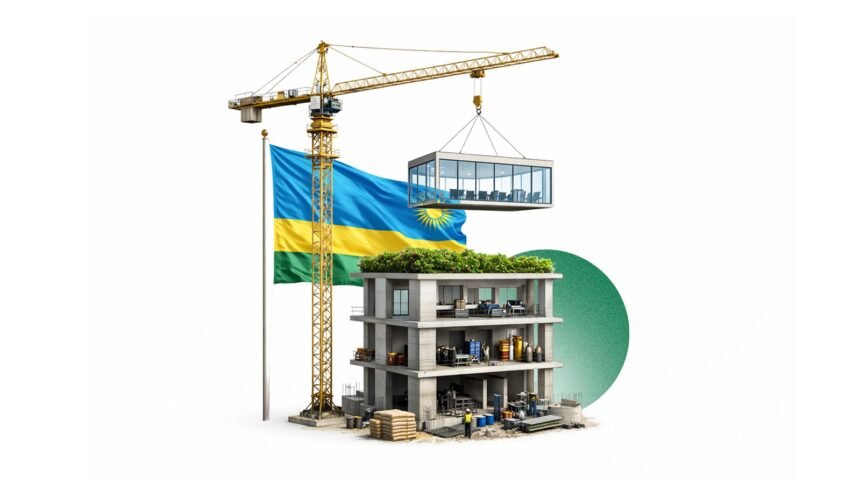
At the core of the expansion is the construction sector, which grew by 20 per cent and continues to drive broader industrial activity. Over the past two years, Rwanda has sustained high levels of public and private investment in infrastructure, including roads, housing developments, industrial parks, and public facilities.
These investments have had spillover effects across manufacturing and mining. Cement production rose sharply, pushing non-metal manufacturing up by 44 per cent, while metal products and chemical inputs such as paints and soaps also recorded substantial gains.
This pattern reflects the deepening of domestic value chains, where construction demand increasingly supports local production rather than imports.
“Infrastructure projects have created consistent demand for locally produced materials such as cement, metal products, and chemicals. This is helping manufacturers expand capacity and reduce reliance on imports,” said Albert Gasana, a manager at a Kigali-based manufacturing firm.
According to the National Institute of Statistics Rwanda (NISR), growth in mining and quarrying is up 14 per cent, mirroring rising demand for construction inputs such as aggregates and raw materials.
The services sector, which accounts for more than half of GDP, remained the economy’s primary stabiliser. Wholesale and retail trade expanded by 20 per cent, underlining strong household consumption and business activity.
“This growth has been supported by population growth, urbanisation, and expanding access to digital payment systems that continue to formalise trade,” said Ivan Murenzi, the General Director of NISR.
Information and communication services grew by 17 per cent, reinforcing Rwanda’s longer-term investment in digital infrastructure and connectivity. The expansion reflects increased data usage, digital financial services, and the growing role of technology in commerce, government services, and education.
Financial services also grew by 10 per cent, indicating rising credit activity and improved confidence among businesses and consumers, even amid tighter global economic conditions.
Agriculture’s 10 per cent growth was driven primarily by export crops, which rose by 35 per cent. Coffee and tea, two of Rwanda’s most important foreign exchange earners, posted powerful performances, with tea harvests doubling and coffee production rising by 32 per cent.
This recovery reflects improved weather conditions compared to the same period last year, ongoing investments in irrigation, fertiliser use, and value addition, and favourable international prices for some export commodities.
Food crop production also rebounded after a sharp contraction in 2024, easing pressure on domestic food supply and inflation, and supporting rural incomes.
Behind the sectoral performance lies continued policy stability and public spending targeted at productive sectors. Government investment in infrastructure has remained a central pillar of economic strategy. At the same time, reforms aimed at improving the business environment have supported private sector participation, particularly in construction, manufacturing, and services.
The steady rise in quarterly growth, from 6.5 per cent in the first quarter to 7.8 per cent in the second, suggests that the third-quarter surge is not an isolated spike but part of a broader upward trend.
Despite the strong overall performance, the data also highlight areas of uneven recovery.
Hotels and restaurants declined by 3 per cent, reflecting lingering pressures in tourism and hospitality, while health services contracted by 16 per cent, partly due to base effects following higher spending in previous periods.
“The third-quarter performance reflects the cumulative impact of sustained public investment and policy consistency. Growth is being driven by productive sectors that generate jobs, strengthen domestic value chains, and improve household incomes,” said Finance Minister Yusuf Murangwa.
“Negative growth rates in hotels and restaurants do not necessarily signal contraction, but rather slower expansion compared to earlier performance,” said Yusuf Murangwa, the Minister of Finance.