





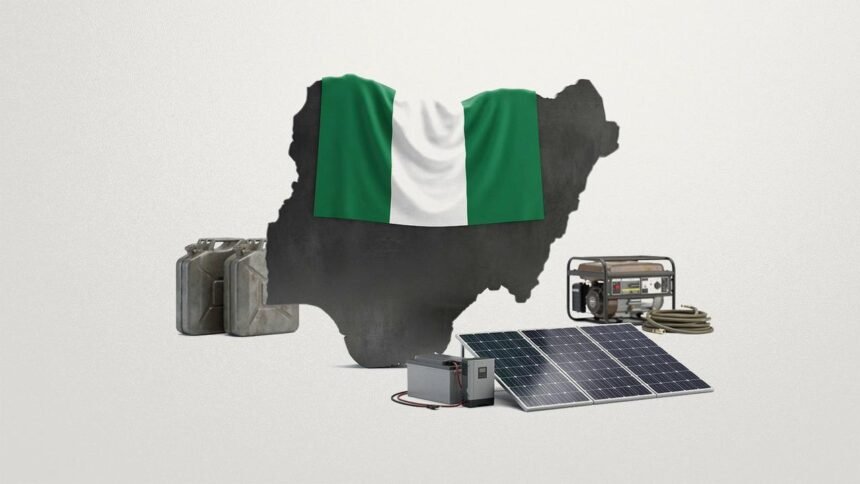
In the corridors of climate diplomacy, Nigeria is often spoken of in the language of targets and plans: net‑zero by 2060, an Energy Transition Plan endorsed at COP, new legislation on climate and carbon markets.
But on the streets of Lagos, Kano, or Onitsha, the real negotiations over energy happen in cash at the fuel pump, in the shadow of small diesel generators that keep the lights on when the grid fails.
This gap between diplomatic narrative and lived reality is no longer just a domestic policy challenge; it is a credibility test for the emerging architecture of “just energy transition” partnerships in Africa.
If Nigeria, Africa’s most populous nation and a key regional power, cannot reconcile its ambitious transition pledges with the everyday dependence of its informal economy on polluting, expensive generators, then the promise of a fair global energy transition risks ringing hollow.
Nigeria has done much of what international partners have asked on paper. It has adopted a Climate Change Act, launched an Energy Transition Plan, and positioned itself as a champion of gas‑to‑power and renewables in multilateral forums.
Reports prepared with international think tanks outline pathways to universal energy access, the creation of hundreds of thousands of green jobs, and a phase‑down of fossil fuels that preserves economic stability.
Yet beneath this architecture, less than half of Nigerians enjoy reliable grid power, and the informal sector, which accounts for the majority of employment and a large share of GDP, relies overwhelmingly on small, off‑grid generators to operate day to day.
This informal “generator grid” is not simply an internal Nigerian issue. It is where international climate and development agendas collide.
Every liter of diesel burned in a market stall adds to global emissions, even as donors and investors channel billions into utility‑scale solar, grid‑scale batteries, and green hydrogen that may never touch the lives of a tailor in Aba or a mechanic in Kaduna.
Every small business priced out of clean energy because its cash‑based fuel payments are invisible to banks undermines the credibility of social justice rhetoric in global climate talks.
Diplomatically, Nigeria sits at a delicate intersection. It is both a fossil fuel exporter and a country with acute energy poverty; both a partner in Western‑backed transition initiatives and a vocal defender of “common but differentiated responsibilities” in UN climate negotiations.
Its Energy Transition Plan explicitly frames natural gas as a bridge fuel while seeking international support for large‑scale solar and decentralized renewables.
European and multilateral partners, in turn, see Nigeria as a test case for a new model of just energy transition partnerships that blend public and private finance, policy reform, and technology transfer.
But most of these diplomatic conversations still look at Nigeria through the lens of formal systems: the national grid, state‑owned enterprises, big IPP contracts, large‑scale renewables.
Far less attention is paid to the 40 million or so enterprises in the informal sector, micro‑shops, street vendors, small workshops, that generate over half of the country’s GDP and employ the majority of its workforce.
For them, the energy transition is not a debate about stranded assets and carbon markets. It is about whether they can afford to keep the lights on tomorrow.
There is growing evidence that power sector reforms, primarily shaped by advice from international financial institutions, have struggled to serve this informal economy. Unbundling, privatization, and cost‑reflective tariffs were promoted as pathways to efficiency and investment.
Yet, they have often led to higher grid tariffs for formal consumers without delivering reliable service, nudging more businesses toward generators.
As one study of Southeast Nigeria argued, reforms heavily influenced by external agendas risk entrenching patterns of dependency, protecting foreign and domestic elites while leaving informal workers to fend for themselves with off‑grid solutions.
A diplomacy that takes justice seriously must start by acknowledging that the generator economy is not an aberration but a rational response to systemic neglect.
Informal entrepreneurs are not choosing diesel because they prefer pollution; they are choosing reliability and control over a system that has historically failed them.
In turn, global partners must ask not only how many megawatts of clean power they can help Nigeria install, but also how many generators they can help Nigeria retire.
That shift requires rethinking what counts as “bankable” information in the eyes of international finance. Current ESG and climate‑finance frameworks demand structured, verifiable data, audited accounts, and standardized emissions reports that informal traders do not produce.
Diesel bought with cash leaves no digital trace; generator expenses are rarely logged in ways that lenders in London or Washington can interpret.
The result is a blind spot: climate funds and impact investors cannot reach the very businesses whose decarbonization would be both socially transformative and emissions‑relevant.
Here lies an opportunity for “generator diplomacy”, a new strand of energy diplomacy focused explicitly on closing this data and finance gap in partnership with Nigeria’s informal sector.
Instead of treating small generators as a residual problem for domestic policy, donors and DFIs could make them an explicit priority in just energy transition negotiations.
Concretely, this could take several forms. First, international partners could support Nigeria in building transaction‑anchored data systems that translate the cash reality of informal energy use into ESG‑grade information.
Pilots could explore simple tools, digitized fuel receipts, QR‑coded jerrycans, USSD‑based energy diaries that feed into secure back‑end systems validated by local banks and regulators.
The goal would not be to surveil traders, but to give them a measurable “energy profile” that can underpin access to credit for solar mini‑grids, efficient appliances, and clean cooking solutions.
Second, just energy transition partnerships involving Nigeria should explicitly earmark concessional finance to de‑risk lending to informal SMEs for clean energy, based on these new data rails.
Rather than focusing solely on large‑scale infrastructure, blended finance vehicles could require a share of funds to flow through microfinance institutions and local banks that serve informal clients, with performance metrics tied to generator retirement rather than just installed capacity.
Third, diplomacy must recognize local intermediaries as essential actors, not afterthoughts. Youth organizations, women’s collectives, market associations, and community-based NGOs can act as “energy and data ambassadors,” supporting traders in understanding their energy options, using digital tools, and navigating new financial products.
Their inclusion in formal JETP‑style platforms and donor coordination groups would help bridge the cultural and political distance between conference halls and markets.
Nigeria’s own climate diplomacy could leverage this reality as a bargaining chip.
By presenting a credible plan to convert its generator economy into a laboratory for inclusive, data‑driven transition, backed by robust national policies and safeguards, the country could argue more persuasively for concessional finance, technology transfer, and flexible conditionality from its partners.
It would move the discussion from abstract fairness to concrete, measurable outcomes: fewer diesel fumes in children’s lungs, more productive hours for small businesses, and a transition that reaches informal workers rather than bypassing them.
The stakes extend beyond Nigeria. Across Africa, from Ghana to Kenya, millions of small generators hum in the background of grand commitments to net‑zero and universal access.
If the international community cannot find ways to make these engines visible, in data, in finance, in diplomacy, then “just transition” will remain a slogan, not a lived reality.
For New York, Brussels, or Beijing, the temptation is to focus on pipelines, LNG terminals, or utility‑scale solar farms, the visible symbols of geopolitical energy strategy.
But in a warming world, the quiet diplomacy that matters may be the kind that helps a market trader in Lagos trade a jerrycan for a solar connection.
How the world engages with Nigeria on that front will say more about the true meaning of climate justice than any communiqué agreed in a conference hall.