






As climate pressures rise and trade routes shift, two Southern African democracies are gambling that deeper cross‑border integration can deliver jobs, resilience, and leverage on the world stage.
On the windswept road that links Botswana’s interior to Namibia’s Atlantic coast, long‑haul trucks kick up sheets of dust as they crawl past thorn trees and empty plains. For drivers hauling copper, coal, or manufactured goods, this corridor is one of the few overland arteries connecting landlocked Botswana to the sea.
Now, their route sits at the center of a diplomatic project with ambitions far beyond the next delivery.
On March 20, Namibian President Netumbo Nandi‑Ndaitwah hosted Botswana’s president, Duma Gideon Boko, in Windhoek for a one‑day working visit that put trade, infrastructure, and natural resources squarely on the table.
“We agreed that we should have regular consultations to assess progress to make sure that what we have agreed is being implemented to serve our people,” Nandi‑Ndaitwah said after their talks.
It was a low‑key statement, but it pointed to a larger bet: that two mid‑sized democracies can turn a long, sparsely populated border into a shared economic corridor resilient to climate shocks and global volatility.
The Bigger Picture
Botswana and Namibia share more than a frontier. Both are members of the Southern African Development Community, a regional bloc that has pledged deeper integration for decades, and both are often cited as relative bright spots for governance and stability in a region marked by coups and contested elections.
Yet they face familiar pressures: stubborn youth unemployment, economies heavily reliant on commodities, and climate change that is already bringing hotter temperatures, more erratic rainfall, and recurring droughts.
In that context, infrastructure has become foreign policy. Botswana has no coastline; to move its minerals, beef, and manufactured goods, it depends on transport corridors through neighboring states and on ports that can be disrupted by congestion or political turmoil.
Namibia, by contrast, has a long Atlantic shoreline and the deep‑water port of Walvis Bay, which its leaders are working to position as a strategic hub for landlocked states across Southern Africa.
The two governments have identified three broad pillars for closer cooperation: expanding trade and easing transit, building and upgrading hard infrastructure, and managing shared natural resources in a region under mounting climate stress.
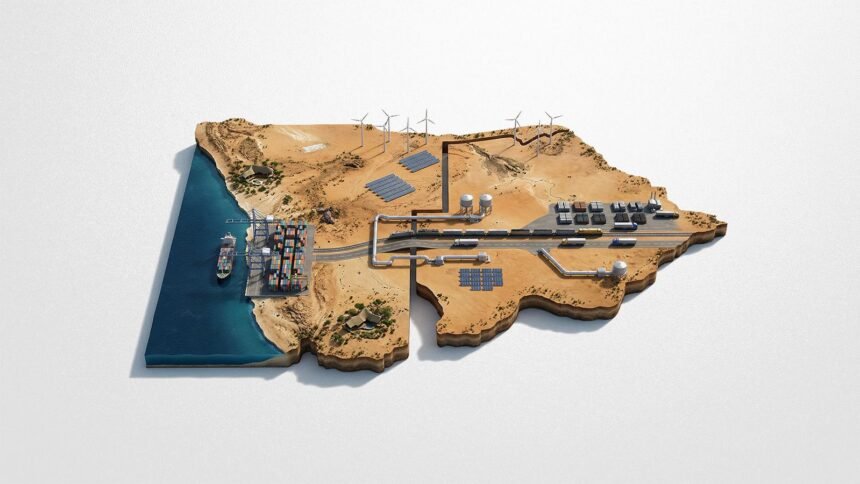
Central to this vision is the proposed Trans‑Kalahari Railway, a roughly 1,500‑kilometer heavy‑haul line designed to connect Botswana’s coal fields and inland economy to Walvis Bay, broadly tracking the existing Trans‑Kalahari Corridor highway.
A new 12‑month feasibility study is underway, and both governments repeatedly cite the project as critical to unlocking regional trade.
Lives Along the Corridor
For truck drivers inching across the semi‑desert, a more efficient corridor would mean fewer days on the road and lower fuel and maintenance costs. For small exporters in Botswana — from beef processors to textile firms, it could mean more predictable access to overseas markets and a stronger case for investing in new capacity.
Border communities are watching for different reasons. In rural districts, farmers already live at the mercy of rainfall that arrives late or not at all; droughts shrink grazing land and leave cattle, a traditional store of wealth, dangerously thin.
Regional water strategies under SADC and basin initiatives stress that coordinated planning of dams, aquifers, and river systems across borders is becoming essential to keep agriculture viable and reduce the risk of conflict over scarce supplies.
Energy links these local concerns to the national agenda. Power shortages and grid instability remain a feature of life in parts of Southern Africa, limiting industrial growth and frustrating households.
Strengthening cross‑border connections and jointly investing in solar and wind, abundant in the Kalahari and Namib regions, could help both countries reduce their reliance on imported fossil fuels while expanding access to electricity.
Tourism provides another layer of potential. Namibia and Botswana are partners in the Kavango–Zambezi Transfrontier Conservation Area, one of the world’s largest cross‑border protected regions, spanning Angola, Botswana, Namibia, Zambia, and Zimbabwe.
Easier movement across their frontier, better roads, and coordinated marketing could turn what is now a patchwork of destinations into a more seamless circuit for visitors, with benefits cascading to guides, lodge owners, and small businesses on both sides.
Politics, policy, and the long game
Officials in Windhoek and Gaborone portray the March visit as part of a longer arc. It builds on the outcomes of a recent Bi‑National Commission, where the two governments signed agreements across sectors ranging from energy and science to labor and policing, and pledged to implement them within agreed time frames fully.
For advocates of regional integration, that continuity, backed by explicit commitments to regular, leader‑level consultations, is as important as any single project.
Supporters argue that the Botswana–Namibia agenda reflects a broader shift in African diplomacy: instead of waiting for China, Europe, or Gulf states to define the terms of engagement, neighboring countries are first aligning their own priorities and then seeking partners to help finance and deliver them.
The Trans‑Kalahari Railway, in this view, is not just a coal line but a test of whether cross‑border infrastructure can be planned and governed on African terms.
Skeptics are quick to point out the risks. Large rail schemes worldwide have a history of cost overruns, delays, and political controversy, and the Trans‑Kalahari route is no exception; it has lingered on drawing boards in various forms for more than a decade and has already missed earlier construction targets.
Securing financing on sustainable terms is likely to prove challenging, especially as global lenders grow warier of long‑lived fossil‑fuel assets linked to coal.
There are tensions on the climate front as well. While both governments highlight renewable energy and more efficient resource use, the current business case for the railway still leans heavily on coal exports from Botswana’s Mmamabula coal fields to markets in Asia, including India and China.
Environmental groups and some analysts warn that locking in such capacity could clash with global efforts to phase down coal, even as the region itself confronts the realities of warming temperatures and water scarcity.
Beyond these debates, regional observers will be watching whether the political will on display in Windhoek can survive the grind of implementation: feasibility studies, procurement, community consultations, and the inevitable bureaucratic friction.
If Botswana and Namibia manage to turn communiqués into smoother border crossings, steel on the ground and shared management of fragile water and energy systems, they could offer a template for other Southern African neighbors.
If they fall short, the trucks will keep inching along the old roads, and a rare opportunity for two quiet neighbors to reshape their corner of the continent, and their leverage in a changing world, may slip back into the dust.





