




In a village in northern Ghana, the workday still ends with the sun. When darkness falls, shopkeepers roll down their metal shutters, not because customers have gone home, but because the car batteries and small solar panels that power a few weak bulbs have run out for the night. Inside one house, a mother lights a kerosene lamp so her children can finish their homework, coughing as the fumes collect under the tin roof.
Scenes like this are still common across sub-Saharan Africa, where nearly 600 million people live without electricity. The absence of power does more than dim the evening; it shapes whether vaccines stay cold, whether machines in clinics run, whether food can be safely stored, and whether young people can study or run a business.
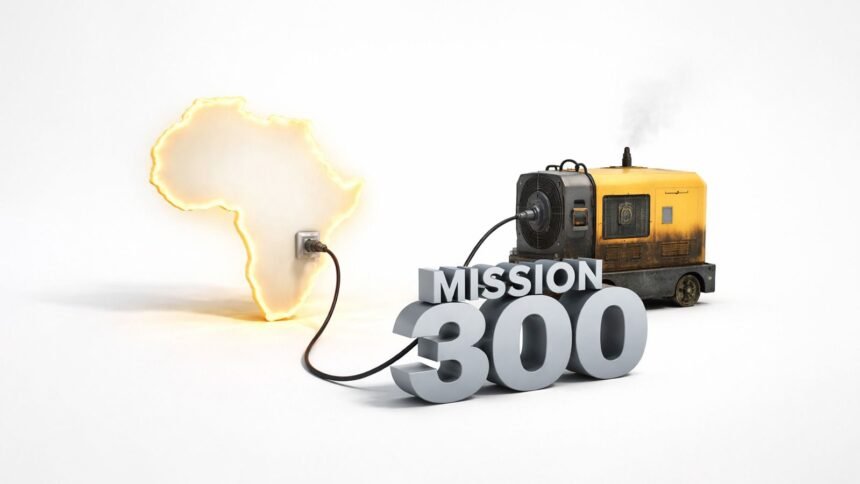
Now, an ambitious initiative backed by the World Bank is promising to change that. In March, the Bank said that more than 50 billion dollars had already been committed to “Mission 300,” a program that aims to halve the number of Africans without electricity by bringing power to 300 million people by 2030.
The plan, developed with African governments and the African Development Bank, could be a turning point, or another missed opportunity dressed up as progress.
Background and Stakes
Energy poverty is not just a symptom of underdevelopment in Africa; it is one of its main engines. Almost half of sub-Saharan Africa’s population — about 570 million people- have no access to electricity, and roughly four in five of those without power live in rural areas. The continent accounts for more than 80 percent of the global population without electricity.
Mission 300 is designed to tackle this problem at scale. Led by the World Bank Group and the African Development Bank, the initiative aims to connect 300 million people to electricity by 2030, combining grid expansion with decentralized solutions such as solar mini-grids and stand-alone systems.
The World Bank says it will connect 250 million people, while the African Development Bank will connect another 50 million. According to Bank statements reported by Bloomberg, more than $ 50 billion has already been pledged, with a “pipeline of tens of billions more” expected by the end of 2026.
The stakes are enormous. Reliable energy underpins nearly every development goal: health, education, jobs, food security, and climate resilience. In a region where about 70 percent of the population is under 30, keeping nearly 600 million people in the dark is not just a technical problem; it is a political and moral failure.
Human Stories on the Ground
The cost of delay is first seen in hospitals and clinics. In rural Malawi and Liberia, health centers still depend on unreliable grids or diesel generators that may sit idle when fuel runs out, forcing staff to time surgeries or deliveries around power availability.
Without steady electricity, vaccines can spoil, oxygen concentrators can stop, and nighttime emergencies can become far more dangerous.
The World Bank and the Rockefeller Foundation have begun supporting “Compact Delivery and Monitoring Units” to help governments plan and track electrification programs, including those that prioritize critical facilities like clinics.
For small businesses, power is the difference between survival and growth. In Nigeria, which has the largest electricity access gap in the world, millions of entrepreneurs depend on petrol and diesel generators to keep lights on and equipment running, paying some of the highest effective electricity costs anywhere.
Each outage means lost income and spoiled stock. Connecting these businesses to reliable, affordable power, whether through a more stable grid or well‑designed mini‑grids, would cut costs, reduce pollution, and free up capital for investment.
There are also examples of what can work. In parts of Kenya, Rwanda, and Zambia, solar‑powered mini‑grids and stand‑alone systems are now powering shops, schools, and irrigation pumps in communities far from national networks.
When tariffs are fair, and service is reliable, residents report longer business hours, more time for study, and new types of income, from phone‑charging kiosks to cold‑storage for fish and vegetables.
These projects remain small compared with the continent’s needs, but they show that reaching the “last mile” is technically possible when financing and regulation align.
Policy Debate and What’s Next
How Mission 300 money is spent will determine whether it genuinely halves energy poverty or mostly boosts statistics. For years, large‑scale projects, big dams, gas plants, and long transmission lines have attracted the bulk of development finance in African power systems.
Those projects are often necessary for industry and cities, but they can leave rural communities waiting decades for a connection that may never come.
Experts and advocates are divided on the right balance between centralized and decentralized solutions. Some government officials and utilities argue that expanding national grids is the only way to support manufacturing and large‑scale economic growth.
Others, including many energy‑access researchers and local companies, warn that if mini‑grids and off‑grid systems are treated as peripheral “projects” instead of core infrastructure, the poorest households will be last in line again.
There is also a justice question. African countries contributed little to historic greenhouse gas emissions but are being asked to expand energy access while staying on a low‑carbon path. Mission 300 emphasizes clean technologies and regional integration.
Still, in practice, countries face hard trade-offs: how much gas to build, how quickly to phase out diesel, and whether to subsidize connections and tariffs for poor households when budgets are already tight.
The World Bank says 30 African countries have now prepared national “energy compacts” that outline how they plan to expand access and what support they need. That is an important step, but it will not be enough if decisions are made mainly in capitals and donor boardrooms.
Communities that have waited longest for electricity should have a say in how it arrives, whether through a grid line, a mini‑grid, or a stand‑alone system, and on what terms.
For this wave of financing to live up to its promise, three things are essential. First, a clear, public focus on universal access, not just on megawatts generated. Second, regulatory reforms that make it easier for private and community actors to invest in off‑grid solutions without facing prohibitive risks or red tape.
Third, concessional finance and guarantees must be steered toward the countries and regions that commercial investors currently avoid, including fragile states and sparsely populated rural areas.
Billions of dollars have been promised before. This time, the alignment of scale, political attention, and climate urgency is unusual and may not come again soon.
If Mission 300 and its backers use this moment to light up homes, clinics, and businesses that have been overlooked for generations, they will reshape Africa’s future in ways that cannot be captured in a balance sheet. If they do not, the world will have to explain to nearly 600 million people why the lights stayed off even when the money was finally on the table.