





The Pan-African Paradigm of Resource Sovereignty and Industrial Self-Determination
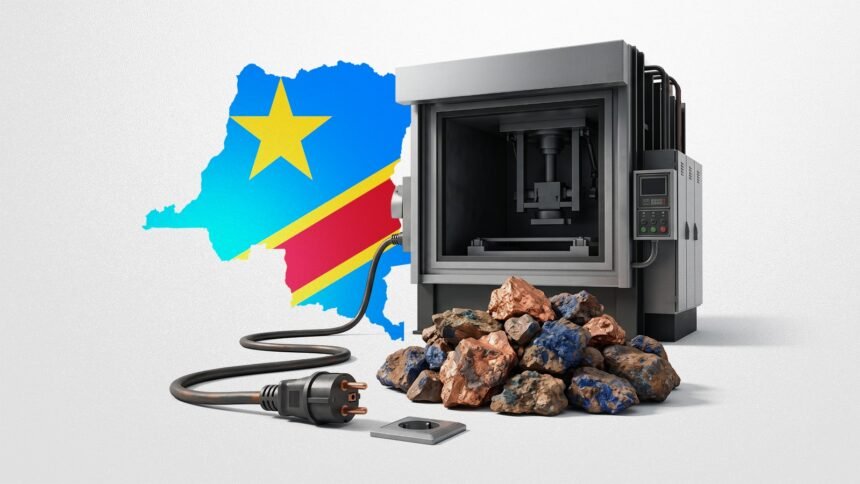
Across the African landscape, the ambition to convert mineral wealth into durable national prosperity has become a defining paradigm of the continent’s economic self-determination, and the Democratic Republic of Congo’s move to restrict raw ore exports sits squarely within that structural project. For decades, the extraction of Congolese copper and cobalt has followed a familiar colonial-era logic: raw material leaves the ground and the country largely unprocessed, with the value-added stages of smelting, refining, and manufacturing captured elsewhere. Kinshasa’s new export restrictions represent an attempt to reverse that asymmetric arrangement, retaining more of the billions of dollars generated annually by these critical minerals within the domestic economy rather than exporting both the ore and the opportunity. Yet the policy’s ambition immediately collides with a systemic constraint that has long undermined the DRC’s industrial trajectory: an electricity architecture too thin to support the smelting and refining capacity the policy presumes. Zambia’s parallel experience with its own copper boom offers a cautionary echo. As the region recalibrates its relationship to the minerals underpinning the global energy transition, the imperative is clear: reclaiming mineral sovereignty requires more than export policy; it requires the industrial infrastructure to make that sovereignty real.
A Ban Without a Grid: The Infrastructure Deficit at the Heart of the Policy
The mechanics of the DRC’s new approach are straightforward in design and formidable in execution. By restricting the export of raw copper and cobalt ore while incentivizing local processing and refining, the government aims to capture a larger share of the value chain currently dominated by foreign smelters, principally in China. The ambition extends beyond fiscal capture: officials frame the policy as a catalyst for job creation, foreign investment in processing capacity, and broader industrial development within the mining sector. But as Landry Djimpe, Managing Partner at Innogence Consulting in the DRC, told Africanews’ Business Africa program, the country confronts a substantial power shortfall that raises fundamental questions about whether existing infrastructure can support expanded mining, smelting, and refining activity simultaneously. This is the structural paradox at the center of the policy: an export ban designed to force value addition onshore is only as effective as the electricity grid available to power that value addition, and the DRC’s generation capacity remains a persistent bottleneck against the scale of its mineral ambitions.
Zambia’s Parallel Reckoning With the Copper Boom
The DRC’s dilemma is not occurring in isolation. Neighboring Zambia, now emerging as a central player in Africa’s critical-minerals economy, faces its own version of the same structural question, not whether copper investment is arriving, but whether it is arriving on terms that benefit the communities living alongside the mines. Global demand for copper, driven substantially by the worldwide transition to green energy technologies, has channeled billions of dollars into Zambian mining operations. International lenders have welcomed the country’s progress on fiscal reforms and debt restructuring, treating these as evidence of a stabilizing macroeconomic trajectory. Yet for many Zambian citizens, the more pressing question concerns distribution rather than volume: whether mineral wealth extracted from their soil is translating into improved livelihoods, employment, and broader economic opportunity, or whether it continues to flow disproportionately toward foreign investors and a narrow domestic elite. The gap between national investment figures and lived community experience remains one of the region’s most persistent structural fault lines in its mineral economy.
The Institutional Stakes of Getting Value Addition Right
What makes the DRC’s export restriction consequential beyond its immediate fiscal impact is its function as a test case for a broader continental question: can African states successfully compel value addition to occur within their own borders, rather than merely regulating the terms on which raw materials leave them? The global copper and cobalt supply chains that power electric vehicle batteries, renewable energy storage, and consumer electronics have historically been structured around extraction in Africa and processing elsewhere, an arrangement critics describe as a modern iteration of colonial-era resource dependency. A successful Congolese pivot toward domestic smelting and refining, if the energy constraints can be resolved, would meaningfully recalibrate that global matrix, showing that mineral-rich African states can capture industrial value rather than export raw commodity volume. But the DRC’s power shortfall illustrates why such recalibrations are rarely achieved through trade policy alone; they require coordinated investment in energy generation, transmission infrastructure, and industrial capacity that typically spans years, not a single policy announcement.
Culture and Commerce Across the Region’s Value Chains
The broader push toward capturing more value from African production is not confined to minerals. In Mali, the traditional bogolan textile craft, a technique passed down through generations of women artisans, is finding renewed commercial relevance both domestically and internationally, offering a parallel illustration of how heritage-rooted production can be converted into sustainable livelihoods without requiring foreign intermediaries to capture the resulting value. For the women producing bogolan, the craft functions simultaneously as cultural preservation and economic independence, a dual mandate that mirrors, at a smaller scale, the DRC’s ambitions for its mineral sector. Whether in copper, cobalt, or textiles, the throughline across the region’s economic recalibration is the same: African producers increasingly seeking to retain the downstream value historically captured elsewhere, even as the institutional and infrastructural prerequisites for doing so successfully remain uneven and, in the DRC’s case, acutely constrained by an energy deficit that no export ban alone can resolve.
Reclaiming the Value Chain, Not Just the Ore
The Democratic Republic of Congo’s export restrictions represent an ambitious assertion of mineral sovereignty, but ambition alone cannot substitute for the industrial architecture required to realize it. Whether this policy delivers lasting economic transformation or becomes another cautionary tale of resource nationalism outpacing infrastructure will depend substantially on whether Kinshasa, alongside its regional partners and international investors, can close the energy gap that currently constrains its refining capacity. Zambia’s experience suggests that even substantial investment inflows do not automatically translate into broadly shared prosperity absent deliberate institutional design. As Africa’s critical-minerals economy continues to expand under the pressure of global demand for the green energy transition, the continent’s task is not simply to negotiate better export terms, but to build the generation capacity, industrial policy, and community-level accountability mechanisms that convert mineral wealth into durable development. Reclaiming sovereignty over the value chain, not merely the ore beneath the ground, remains the unfinished work ahead.