




The Pan-African Paradigm of Education and Environmental Disruption
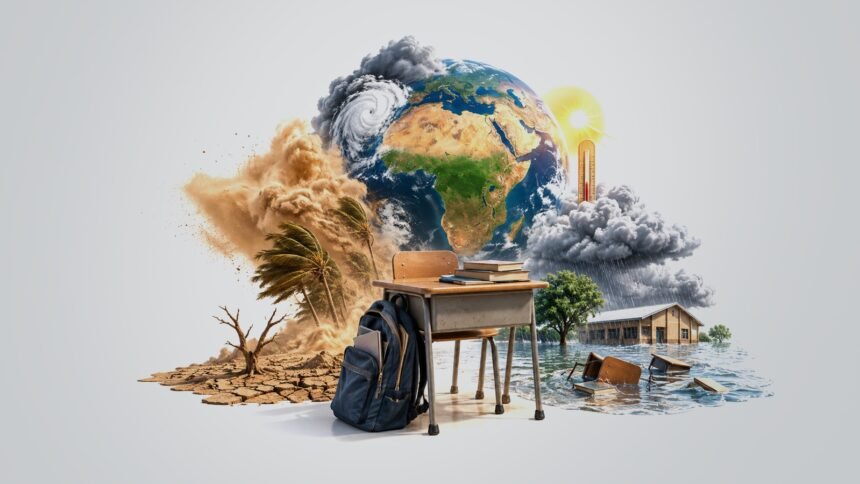
More than 171 million students worldwide, one in every ten enrolled from pre-primary through upper secondary school, had their education disrupted by climate hazards in 2025, according to a new UNICEF analysis released this week. Storms accounted for the largest share, affecting 109 million students globally, followed by floods at 70 million and heatwaves at roughly 50 million, based on data from 106 countries and territories. Within that global total sit African data points that illustrate the continent’s particular exposure: a powerful Khamsin wind and dust storm forced a nationwide, one-day suspension of classes across Egypt in April, affecting more than 28 million students in a single disruption, while Madagascar endured repeated rounds of drought, tropical cyclones and flooding across the year that together affected 280,000 students. UNICEF Executive Director Catherine Russell framed the findings starkly: for millions of children, climate hazards ‘do more than disrupt lessons; they destroy schools, uproot families, and push the most vulnerable children, especially girls, out of the classroom for good.’ For a continent where school attendance already correlates closely with household economic resilience, the report frames climate disruption not as an isolated environmental concern but as a direct threat to the educational foundations of African self-determination. Reclaiming educational continuity amid accelerating climate volatility is fast becoming as urgent a sovereignty question as any diplomatic or economic contest facing the continent’s governments.
Egypt’s Single Day, Twenty-Eight Million Students
The scale of Egypt’s April disruption, a single day’s nationwide class suspension affecting more than 28 million students, illustrates how quickly climate-driven school closures can achieve continental scale even from a short-duration event. Unlike prolonged drought or repeated flooding, a Khamsin storm’s disruption is measured in hours or days, not months. Yet, the sheer size of Egypt’s school-age population meant that even this brief interruption registered among the largest single climate-education disruptions recorded globally in UNICEF’s 2025 analysis, on par with Pakistan’s 28-million-student disruption from weeks of monsoon flooding. This asymmetry, a one-day storm in Egypt matching a month-long flood crisis in Pakistan in raw student impact, underscores how population density and school-system scale can amplify even short climate events into major disruptions, a dynamic African governments with large, young populations will need to account for in designing resilient school calendars and infrastructure standards.
Madagascar’s Compounding Cycle
Where Egypt’s disruption came as a single sharp event, Madagascar’s 280,000 affected students experienced something more corrosive: repeated rounds of drought, tropical cyclones and floods across the same year, part of a pattern UNICEF identified in 40 countries that experienced multiple distinct climate-related school disruptions during 2025. For students in these repeatedly affected regions, the cumulative effect compounds beyond any single event’s direct impact; repeated interruptions erode instructional continuity, increase dropout risk, and strain already resource-limited education systems attempting to rebuild after each successive shock before the next one arrives. Madagascar’s position among low- and lower-middle-income countries bearing three-quarters of the global disruption total reflects a broader pattern UNICEF’s analysis makes explicit: education systems in wealthier nations generally possess the infrastructure, funding, and institutional redundancy to absorb climate shocks with comparatively limited long-term damage, while systems in poorer countries, including much of the African continent, lack that cushion entirely.
Girls at the Center of the Dropout Risk
Russell’s warning that climate disruption pushes ‘the most vulnerable children, especially girls, out of the classroom for good’ points to a gendered dimension of climate-education disruption that African policymakers have already documented in other contexts, from early marriage risk during humanitarian crises to household labor demands that intensify during agricultural shocks. When schools close due to storms, floods, or extreme heat, the resulting gap in structured learning time does not affect all students equally; girls in many African contexts face heightened risk of permanent withdrawal from school during any prolonged disruption, whether driven by conflict, economic shock, or now, increasingly, climate hazard. This gendered vulnerability means that the raw disruption figures UNICEF has published, while alarming in aggregate, likely understate the long-term educational and developmental cost specifically borne by African girls in the hardest-hit communities. This cost compounds with each successive climate event a fragile education system fails to recover from before the next one strikes fully.
Building Resilience Before the Next Disruption
UNICEF’s 106-country dataset makes clear that climate-related school disruption is no longer an occasional anomaly but an annual, near-universal feature of the global education landscape, one African governments can no longer treat as a temporary emergency requiring only reactive response. The gap between Egypt’s ability to absorb a nationwide one-day suspension without long-term system damage and Madagascar’s exposure to repeated, compounding disruptions throughout the year illustrates the uneven distribution of institutional resilience across the continent- resilience that will need deliberate investment in resilient school infrastructure, flexible remote-learning capacity, and early-warning coordination between meteorological services and education ministries, if African education systems are to keep pace with an accelerating climate trajectory. The alternative, allowing each successive storm, flood, or heatwave to chip away at instructional time and push another cohort of vulnerable children, disproportionately girls, out of school permanently, would represent a slow erosion of the human capital African nations will need most as they pursue economic diversification and structural sovereignty in the decades ahead. Reclaiming the classroom from climate disruption is, in this sense, inseparable from reclaiming the continent’s longer-term developmental trajectory.