





The Pan-African Paradigm of Press Freedom and the Architecture of Impunity
A traditional festival in the northern Togolese town of Guérin-Kouka, a camera operator doing his job, and a man’s hand on his shoulder asking whether he worked for the wrong press outlet; from that small, almost bureaucratic error, an entire architecture of intimidation reveals itself. Roland Yaovi Kodjo was not the journalist his abductors were looking for. Still, the fact that they had a journalist in mind at all, that they arrived armed and in a vehicle with a man in police uniform, tells a story larger than one case of mistaken identity. The Committee to Protect Journalists has now documented at least three such seizures of journalists across sub-Saharan Africa within a single month, a frequency that turns what might look like isolated incidents into a recognizable regional pattern of using extralegal violence to police what gets published about those in power. The Pan-African stakes are structural: a press corps that can be seized, blindfolded and threatened with impunity is a press corps that cannot perform the accountability function democratic governance depends on, and reclaiming that function is inseparable from the continent’s broader project of self-governance built on transparent, contestable public information rather than manufactured silence.
A Case of Mistaken Identity: What Happened in Guérin-Kouka
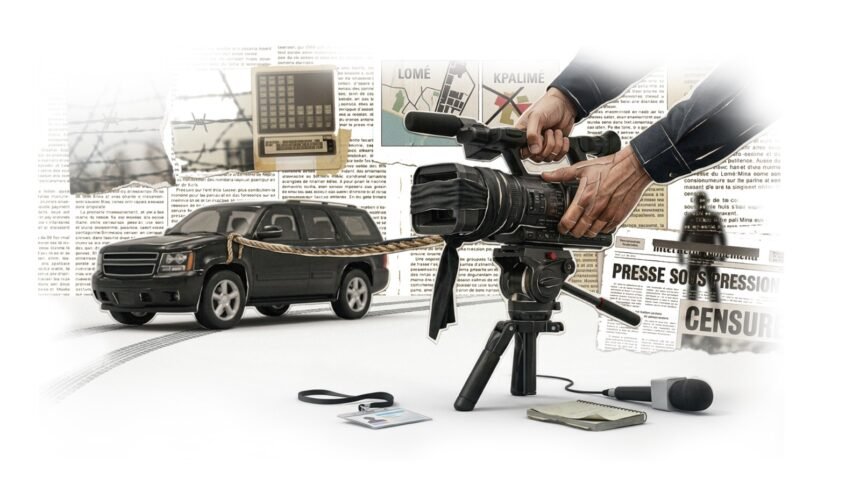
According to Kodjo’s account to CPJ, a man approached him on Saturday, 5 September, while he was covering a traditional festival in Guérin-Kouka as a sports and culture reporter and camera operator for Tampa TV. The man asked whether Kodjo worked for the TAMPA press group, which includes the frequently sued and once-suspended newspaper Tampa Express, before instructing him to follow. Kodjo was pushed into a vehicle occupied by three other men, one of them wearing a police uniform, who handcuffed and blindfolded him. Only when one of his captors asked whether he was the one who “writes about the authorities” and “sullies the image of the authorities” did Kodjo realize the group had confused him with Francisco Napo-Koura, the TAMPA group’s publishing director and a regular commentator on Togolese politics and public affairs.
Slapped, Punched, and Released Fifty-Five Kilometers Away
The men’s response to discovering their mistake was not to release Kodjo immediately but to extract what they could from him regardless. He told CPJ he was slapped and punched in the chest as his captors demanded he reveal Napo-Koura’s whereabouts, a demand he refused. Kodjo was eventually released, still blindfolded, in a village near the Ghanaian border roughly fifty-five kilometers from where he was taken, a distance that speaks to the operation’s planning and resources, whatever its ultimate target. His attackers warned him against telling his employer what had happened, threatening jail or death if he did, a threat that functions as its own form of ongoing intimidation independent of whether it is ever carried out.
A Pattern, Not an Incident: Napo-Koura’s Stolen Computer and TAMPA’s Protest
Kodjo’s abduction did not occur in isolation from the broader pressure campaign the TAMPA group says it has faced. Napo-Koura told CPJ that his car was broken into and his work computer stolen in the capital, Lomé, in late July, a separate incident that, taken alongside the September abduction, suggests a sustained effort to disrupt the outlet’s reporting capacity rather than a single opportunistic crime. Napo-Koura has since written to Togo’s High Authority for the Regulation of Written, Audiovisual, and Digital Communication requesting an official investigation. At the same time, the Togolese Press Employers’ union issued a statement warning against Togo becoming, in its words, a haven for kidnappers of independent journalists where impunity reigns. CPJ said its own calls to Togolese police for comment went unanswered.
Third of the Month: A Regional Wave of Press Intimidation
CPJ’s Francophone Africa representative, Moussa Ngom, called the attack a grave act of intimidation that must not go unpunished, urging Togolese authorities to hold the perpetrators to account and guarantee a safe working environment for the press. Notably, CPJ recorded Kodjo’s case as at least the third seizure of a journalist it has documented across sub-Saharan Africa within the same month, a frequency that, alongside a separate case involving a Lesotho human rights defender and news editor detained the same day, suggests a broader regional deterioration rather than a Togo-specific problem. Togo itself has seen this before: in 2024, at least six Togolese journalists were attacked by unidentified assailants while covering the news, a toll that gives Kodjo’s ordeal a grim continuity rather than the character of an aberration.
Reclaiming the Newsroom as Sovereign Ground
A continent that aspires to genuine self-determination cannot treat its newsrooms as expendable collateral in disputes between the powerful and their critics. The structural fix that CPJ, TAMPA and Togo’s press union are all, in their own ways, calling for- an actual investigation, actual prosecutions, and an actual institutional guarantee of journalist safety- is less about punishing one group of assailants than about establishing that the machinery of intimidation carries a cost. Until Togolese authorities respond to that pressure with something more than silence, the message sent to every reporter covering power in Guérin-Kouka, Lomé, or anywhere else in the country is that the press remains contestable territory rather than sovereign ground protected by the state whose accountability it exists to serve.






