




The Pan-African Paradigm of Federal Cohesion and the Politics of Ceasefire
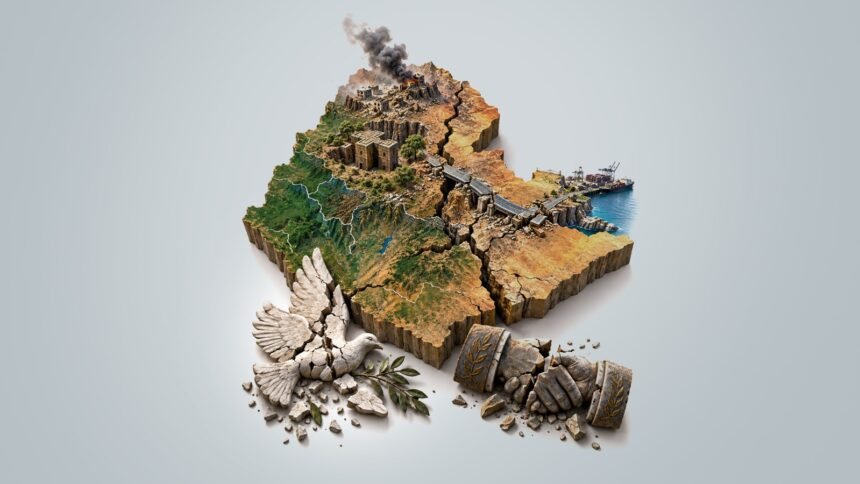
Five years ago, the fall of towns like Alamata marked the advance of Tigrayan forces toward Addis Ababa in a civil war that killed an estimated 600,000 people before a fragile 2022 peace agreement suspended, without resolving, the underlying grievances. This week, pro-government forces reclaimed the same strategic highway town from a renewed Tigrayan offensive, a reversal that conflict monitor ACLED has confirmed and that a splinter faction, the Tigray Peace Force, announced on the government’s behalf. The recurrence is the story: Ethiopia’s federal structure was designed, in theory, to accommodate the country’s ethnic-regional diversity through negotiated autonomy, yet each time that accommodation frays, the mechanism for resolving disputes reverts to the battlefield rather than the negotiating table. The Pan-African stakes extend beyond Ethiopia’s borders; a state of this size and regional weight sliding back into civil war destabilizes an entire security architecture, from Red Sea shipping lanes to Sudanese and Somali conflict dynamics, that neighboring states have spent years trying to insulate from Addis Ababa’s internal politics.
Multiple Fronts, One Collapsing Ceasefire
The Tigray People’s Liberation Front launched coordinated offensives into the neighboring Amhara and Afar regions last Wednesday, opening fronts far beyond Tigray’s own borders and signaling an operation planned well before its public execution. In Afar, TPLF forces took the town of Erebti on Sunday. They continued pushing east, in an apparent bid to sever the supply corridor connecting landlocked Ethiopia to the port of Djibouti, a corridor that carries the overwhelming majority of the country’s trade cargo and whose interruption would inflict economic damage far beyond the conflict zone itself. In Amhara, TPLF fighters have been operating alongside the local Fano militia, with heavy fighting reported near the UNESCO World Heritage site of Lalibela, raising the prospect of damage to one of the continent’s most significant historical and religious landmarks. The recapture of Alamata by government-aligned forces represents the first significant reversal for the rebel offensive, though fighting along the Afar and Amhara fronts continues.
Sudan’s Denial and the Widening Web of External Involvement
Compounding the crisis is a parallel diplomatic dispute: Sudan has publicly rejected Ethiopian government claims that it is backing Tigrayan forces, an accusation that, true or not, illustrates how thoroughly Ethiopia’s internal conflict has become entangled with the wider web of Horn of Africa rivalries. Ethiopia’s relations with Sudan, Egypt, and Eritrea have all been shaped in recent years by disputes over the Grand Ethiopian Renaissance Dam, Red Sea access, and competing claims to regional influence; a renewed Tigray war offers each of these neighbors both risk and, potentially, leverage. Whether or not Khartoum’s denial holds up to scrutiny, the accusation itself signals that Addis Ababa views this conflict as no longer purely domestic, a framing that could justify further militarization of the country’s borders and complicate any future mediation effort that depends on regional neutrality.
The Federalism Question Ethiopia Has Deferred, Not Resolved
Ethiopia’s ethnic-federalist constitution was engineered to manage precisely this kind of centrifugal tension by granting regions substantial autonomy. Yet, the recurring cycle of war suggests the underlying architecture remains unresolved rather than merely mismanaged. Prime Minister Abiy Ahmed’s government has faced repeated warnings, including from Ethiopia’s own president, about “interference” fuelling the renewed fighting, language that implicitly concedes federal authority alone cannot contain the dispute. Each prior ceasefire, including the 2022 Pretoria agreement that formally ended the last civil war, addressed the immediate cessation of hostilities without fully resolving the disputed territorial claims, demobilization terms, and political representation questions that predated the conflict. The result is a peace that has functioned more as an extended pause than a genuine settlement, vulnerable to collapse whenever any faction perceives an opening.
Economic Stakes Beyond the Battlefield
A renewed civil war carries costs measured well beyond casualty counts. Ethiopia’s economy, already strained by years of conflict, drought, and currency pressures, depends heavily on the Djibouti trade corridor the TPLF’s Afar offensive now threatens, and on continued foreign investment that any prolonged instability will chill further. The damage risk to Lalibela, a UNESCO World Heritage site and one of the country’s most significant tourism assets, adds a cultural-heritage dimension to what is already a humanitarian emergency, with aid agencies warning of fresh displacement layered atop populations still recovering from the previous war’s destruction. Ethiopian Airlines, the government’s flagship state enterprise and one of Africa’s most successful carriers, has itself become a barometer of investor confidence in the country’s stability, illustrating how thoroughly a resumed Tigray conflict threatens the broader economic project Abiy Ahmed’s government has staked its legitimacy on.
Reclaiming Peace as Structure, Not Interval
What Alamata’s recapture demonstrates, more than any battlefield calculus, is that Ethiopia’s 2022 peace was never structurally complete, a ceasefire mistaken, by international observers eager to declare the crisis resolved, for a genuine settlement. The path back from renewed war will require the harder work that was deferred the first time: negotiated resolution of Tigray’s disputed western territories, credible demobilization guarantees, and a federal bargain that regional actors trust enough not to test by force. Ethiopia’s sovereignty, and by extension the stability of a Horn of Africa region already strained by conflicts in Sudan and Somalia, depends on whether this recurrence becomes the moment that forces a genuine reckoning, or simply another interval before the next collapse. The towns changing hands this week are not just military positions; they are the visible symptoms of a settlement the continent’s diplomatic architecture has yet to build.