




The Pan-African Paradigm of Debt Recovery and Economic Self-Determination
Six years after defaulting on its external debt during the COVID pandemic, Zambia’s finance ministry has set a target of lifting economic growth to an average of 7% over the next three years, projecting 6.0% in 2027, 7.5% in 2028, and 7.1% in 2029, figures notably more optimistic than the International Monetary Fund’s own forecast of 4.3% growth for this year alone. The ambition reflects a broader continental pattern in which states emerging from debt restructuring attempt to pivot from stabilization to genuine expansion, converting the hard-won breathing room of renegotiated obligations into a platform for investment rather than merely debt-service relief. Zambia’s trajectory carries particular symbolic weight as the first African nation to default under the G20’s Common Framework, a process widely criticized across the continent for its slowness and opacity. Whether Lusaka can translate its post-default recovery into durable growth, rather than a temporary rebound vulnerable to the next commodity cycle, will be read across the region as a test of what debt restructuring can and cannot deliver for structural economic sovereignty.
From Default to Framework: The Arithmetic of Recovery
The government’s medium-term macroeconomic framework, outlined in a finance ministry statement issued Sunday, marks a deliberate escalation from last year’s budget projections, which had forecast growth of only 6.4% for 2026. Finance Minister Situmbeko Musokotwane, recently reappointed following last month’s election, has overseen the protracted debt-restructuring negotiations that followed Zambia’s 2020 default, a process complicated by disputes among bilateral, multilateral, and private creditors over comparable treatment of losses. Zambia’s previous $1.7 billion IMF arrangement expired in January, and Musokotwane said Lusaka hopes to conclude a new program with the Fund before the end of the year. This deal would likely come with conditions on fiscal discipline that could constrain the very spending ambitions underpinning the growth target.
Mining, Energy, and Agriculture: The Sectors Carrying the Growth Bet
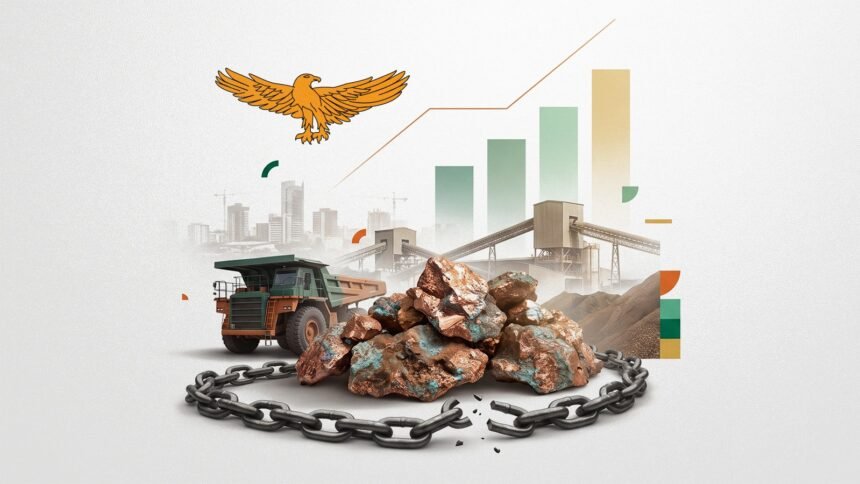
Musokotwane framed the strategy explicitly around moving Zambia “beyond stabilizing the economy to securing more investment, stronger exports and boosting job creation,” identifying mining, energy, and agriculture as the sectors expected to carry that expansion. Copper remains the structural backbone of Zambia’s economy. Any sustained growth acceleration will depend heavily on global copper prices and the country’s ability to attract capital into new and existing mining operations at a moment when demand for the metal, driven by global electrification and battery-supply chains, has made African copper reserves newly strategic to competing international investors. Energy sector investment, meanwhile, must contend with the recurring hydropower shortfalls that have periodically forced load-shedding across the country, underscoring that ambitious growth targets require parallel infrastructure investment the government has not yet fully detailed.
The Gap Between Government Ambition and Fund Caution
The nearly three-percentage-point gap between Lusaka’s growth projections and the IMF’s more conservative 4.3% estimate for this year is itself a structural tension worth examining. Governments emerging from debt crises have institutional incentives to project optimism, both to reassure markets ahead of new borrowing and to demonstrate political dividends from painful restructuring negotiations to domestic constituencies who bore austerity’s costs. The Fund, meanwhile, tends toward conservative baseline forecasts precisely because its own lending conditions depend on realistic fiscal assumptions. This divergence is not unique to Zambia; similar gaps have emerged in Ghana’s and Sri Lanka’s post-default recoveries, but it does mean that Zambia’s stated targets should be read as an aspirational framework rather than a settled consensus forecast, one that will be tested hard against the discipline any new IMF program is likely to impose.
The Common Framework’s Contested Legacy
Zambia’s recovery is inseparable from the broader debate over the G20 Common Framework, the mechanism through which it, Ghana, Ethiopia, and Chad have each sought restructuring since 2020. Critics across the continent have argued that the framework’s slow, creditor-driven process- Zambia’s own restructuring took roughly three years from default to completion- imposed unnecessary economic pain by leaving countries locked out of capital markets far longer than comparable non-African defaults historically required. Proponents counter that the framework at least established a functioning, if imperfect, multilateral mechanism where none previously existed for coordinating between traditional Paris Club creditors and newer bilateral lenders like China. Zambia’s ability to now project above-IMF-baseline growth will be read by other African finance ministries currently negotiating their own restructurings, including Ghana’s ongoing recovery, as evidence for or against the argument that the Framework’s costs were ultimately worth the debt relief it delivered.
Reclaiming Growth as Sovereign Strategy
Zambia’s 7% ambition is, at its core, a bet that a country which spent years subordinating fiscal policy to creditor negotiations can now reassert an agenda of its own, one built around investment and job creation rather than austerity and arrears. That bet carries real stakes for how the rest of the continent interprets the Common Framework’s utility. If Zambia can convert its restructuring into sustained double-digit-adjacent growth, it strengthens the case that African states can use debt relief as a genuine platform for structural transformation rather than a holding pattern before the next crisis. If the targets prove to be political optimism outrunning macroeconomic reality, it will reinforce skepticism, already widespread across the continent, that current international debt architecture is designed to manage African economies rather than to enable their self-directed growth genuinely. Either way, Zambia’s next three budget cycles will be watched closely well beyond Lusaka.