




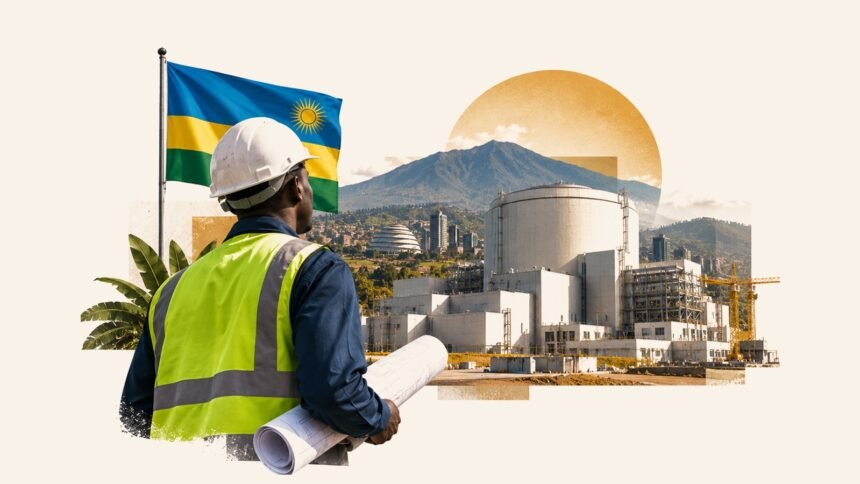
Rwanda is exploring several financing models for its planned nuclear energy program as it seeks to add nuclear power to its electricity mix and meet growing demand for reliable energy.
The country plans to deploy its first small modular reactor (SMR) in the early 2030s, making financing one of the key challenges as it prepares for a technology that requires significant upfront investment, long-term planning, and specialized infrastructure.
SMRs are smaller nuclear reactors designed to generate electricity at a lower capacity than conventional large-scale reactors. Several countries are considering them as they seek to expand low-carbon power generation.
For Rwanda, the nuclear program is also being linked to its broader industrialization plans, with the government seeking to develop local skills, suppliers and manufacturing capacity around the sector.
The financing options are outlined in a new Nuclear Industrial Localization Roadmap published by the Rwanda Atomic Energy Board (RAEB). The roadmap says conventional financing through the government’s balance sheet would not be practical for a developing country pursuing an ambitious nuclear program.
- Build-Own-Operate Model
Under a Build-Own-Operate (BOO) model, a foreign nuclear technology vendor or investor consortium would finance, design, build, and operate the nuclear facility.
Rwanda would not have to provide the upfront capital for construction. Instead, it would provide the site, regulate the facility and guarantee a long-term market for the electricity through a sovereign-backed Power Purchase Agreement (PPA).
The arrangement would also transfer some of the major risks associated with nuclear construction, including delays, cost overruns and early operational challenges, to the private investor.
The roadmap points to Türkiye’s Akkuyu Nuclear Power Plant as an example.
The project uses a BOO structure involving Russia’s Rosatom and has involved Turkish companies in areas including steel, concrete and civil engineering.
For Rwanda, the roadmap says a similar arrangement could attract foreign capital while requiring technology transfer and greater participation by domestic companies.
- Cooperative Ownership
Another option is a cooperative ownership structure based on Finland’s Mankala model. Under this approach, large electricity users jointly finance and own a power plant. Each participant then receives electricity according to its ownership share.
The model has been used in Finland for major nuclear projects, including the Olkiluoto 3 reactor. The roadmap, however, notes that Rwanda does not yet have enough large, well-capitalized energy-intensive companies to support a pure Mankala arrangement.
That could change if the country attracts more large-scale mining operations, smelters, or hyperscale data centers.
Such companies could potentially form a consortium with the state utility to finance an SMR of more than 100 megawatts while securing a long-term supply of electricity for their operations.
The approach would link nuclear financing to industrial demand rather than relying entirely on government funding.
- Government-To-Government Financing
Government-to-government financing has historically played a major role in international nuclear projects, particularly in emerging markets. Under this model, the government of the country supplying the nuclear technology provides financing through state-owned banks or export credit agencies.
The roadmap cites the Barakah Nuclear Power Plant in the United Arab Emirates, which combined UAE government equity with Korean export financing. It also points to Hungary’s Paks II project, where Russia is providing a state loan covering 80 percent of the project’s financing needs.
Such agreements can extend beyond construction financing to include the supply of technology, fuel, training and technical support. However, the roadmap highlights a major concern for countries such as Rwanda: the debt associated with the project can ultimately sit on the government’s balance sheet.
It also warns that relying heavily on one foreign supplier for financing, fuel and technical support could limit a country’s flexibility over the long term.
- Multilateral Development Finance
The fourth option is greater use of financing from multilateral development institutions. The roadmap points to changes in international development-finance policy, noting that the World Bank ended its exclusion of nuclear lending in June 2025, while the Asian Development Bank removed its exclusion of nuclear energy from its lending policy in November 2025.
According to the roadmap, this creates another potential source of capital for countries pursuing nuclear energy, particularly because multilateral financing can offer more concessional terms than some bilateral loans.
The roadmap describes multilateral development bank financing as a potentially politically neutral alternative to bilateral government-to-government debt. It also points to work by the International Atomic Energy Agency (IAEA) to harmonize nuclear regulations and promote greater standardization of SMR components.
Greater standardization could help reduce some of the risks faced by investors and lenders as countries begin developing a new generation of smaller reactors.
Financing The Industry, Not Just The Reactor
The roadmap recommends that financing and procurement agreements require foreign vendors to use local goods and services where they meet the necessary standards. These could include concrete, structural steel and civil engineering services.
It also proposes that government-to-government agreements include technology-transfer commitments, including support for vocational training centers, university partnerships and quality-assurance certification for local manufacturers.
The broader objective is to ensure that money mobilized for the nuclear program does not only finance the reactor itself, but also contributes to the development of skills, businesses and industrial capacity in Rwanda. The roadmap concludes that Rwanda’s financing model should therefore be considered alongside its wider industrial strategy.
“The optimal financing model for Rwanda cannot be selected in a commercial vacuum. It must be inextricably linked to the nation’s overarching sovereign industrial strategy,” it says.
The financing structure will therefore determine not only how Rwanda pays for its first nuclear facility, but also how much financial risk the government assumes and how much of the investment can translate into opportunities for domestic companies and workers.