




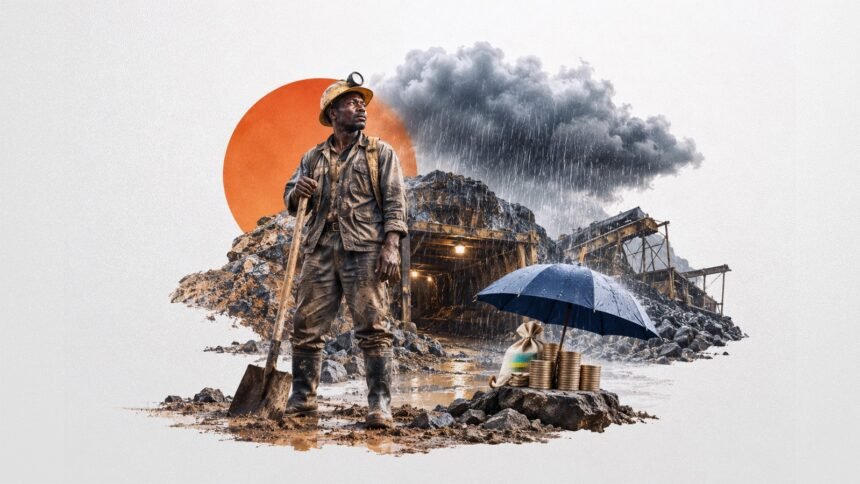
A miners’ union in Rwanda has backed a proposed insurance scheme that would compensate workers for income lost when heavy rains force mining operations to shut down, as extreme weather increasingly adds to the risks facing workers across Africa’s extractive sector.
The Rwanda Extractive Industry Workers Union (REWU) says the proposed climate insurance could provide a financial safety net for workers who depend on daily earnings and can go for days without pay when dangerous weather makes mining unsafe.
Rwanda is exploring a parametric insurance scheme that would automatically pay workers when rainfall reaches an agreed threshold, rather than requiring individual miners to file claims and prove their losses.
The proposal comes at a time when governments and mining stakeholders across Africa are grappling with how to improve social protection and working conditions for workers in artisanal and small-scale mining, much of which remains informal.
The World Bank estimates that about 45 million people work directly in artisanal and small-scale mining globally. In comparison, more than 225 million people are involved directly or indirectly in the sector’s wider labor value chain across Africa, Asia and Latin America. The sector is particularly important in rural areas, where mining can provide one of the few alternatives to agriculture.
In Africa, artisanal and small-scale mining provides livelihoods for millions of people working in gold, cobalt, copper, gemstones and other mineral supply chains. But informality and limited access to social protection can leave workers vulnerable when mines close, or working conditions become unsafe.
Extreme weather adds another layer of risk. Heavy rainfall can cause flooding, landslides, erosion, and unstable ground, forcing mines to suspend operations and leaving workers who depend on daily earnings without income.
The International Labor Organization said in April 2026 that governments, employers and workers need stronger measures to protect people from occupational safety and health risks associated with extreme weather and changing weather patterns.
In Rwanda, the Ministry of Finance and Economic Planning (MINECOFIN) estimates that the mining sector employs about 92,000 people. Many are casual or daily-paid workers who earn only when they work.
André Mutsindashyaka, Secretary General of REWU, said the proposed insurance could help workers cope with income losses while also reducing the pressure to enter dangerous mining sites during heavy rains.
“When there is heavy rain, mine workers do not work. They are paid only when they have worked,” Mutsindashyaka said.
How The Proposed Insurance Would Work
The scheme would use weather data to determine when workers qualify for compensation.
Under the proposed model, a payout would be triggered once rainfall at or near a mining site exceeds a predetermined threshold over a specified period.
Rainfall measurements from Meteo Rwanda would be cross-checked with satellite data before a payout is triggered.
Each enrolled worker at an affected mining site could then receive a fixed payment, tentatively estimated at between Rwf15,000 and Rwf25,000 for each qualifying weather event.
Payments would be made through mobile money, bank or SACCO accounts, to reach workers within about two weeks of the qualifying event.
Unlike conventional insurance, parametric insurance does not require each person to demonstrate their individual financial loss. Instead, the payout is based on an independently measured event, such as rainfall reaching an agreed level.
The proposed scheme is still being developed, with stakeholders yet to agree on premiums, compensation levels, and how the costs would be shared.
Possible contributors include miners, mining companies, cooperatives and the Government.
MINECOFIN would lead policy development, while the Rwanda Mines, Petroleum and Gas Board (RMB) would support implementation and the National Bank of Rwanda (BNR) would provide regulatory guidance.
Initial coverage could focus on Rwanda’s March-to-May rainy season before being expanded to the September-to-December season.
Mutsindashyaka said Government support could help make the scheme affordable for low-income workers.
“The Government can inject subsidies, as it did for crop and livestock insurance schemes,” he said.
He added that mining companies, workers and development partners could also contribute to the fund.
The proposal also fits into a wider push in Africa to expand climate-risk insurance as governments look for ways to protect vulnerable households and workers from weather-related income shocks. The African Development Bank has identified climate-risk insurance as an important part of the continent’s adaptation efforts, although insurance coverage remains limited.
Workers Face Income Losses
For miners who are paid according to their daily output, prolonged rain can quickly affect household finances.
Mutsindashyaka said workers in Rwanda’s mining sector typically earn between Rwf3,000 and Rwf15,000 a day depending on their work and the value of minerals extracted, with average monthly earnings estimated at Rwf60,000.
He said the proposed insurance could also help address worker turnover in the sector, where some workers leave after periods without income.
“Mine workers change every day due to poor wages or not being paid at all,” he said.
Aline Uwimana, a mine worker in Gatsibo District, said heavy rains had previously left her without work for a week.
“In April we spent a whole week without working. I have three children, of whom two are studying. I need to satisfy their basic needs as a family,” she said.
“Such loss of income affects our livelihoods, and some quit their jobs to look for other jobs. Job-loss insurance is needed.”
The problem is not unique to Rwanda. Across Africa, artisanal and small-scale miners often work in informal or precarious conditions and have limited access to social protection. The World Bank has identified better working conditions, social protection and fair labor standards as key challenges for the sector.
The Rwanda Mining Association has also welcomed the proposed scheme, saying it could help protect workers while supporting safety at mining sites during extreme weather.
Deus Kayitakirwa, Chief Executive Officer of the association, said heavy rainfall can increase the risk of flooding and mining accidents, making it necessary for workers to stay away from affected sites.
“Any scheme looking at mine workers’ welfare, development and safety is welcomed,” he said.
Kayitakirwa said a study on the proposed insurance model had been conducted in four mining companies across four districts, which could potentially serve as pilot locations.
He said the association would work with Meteo Rwanda to assess rainfall levels and participate in discussions on premiums and compensation.
However, he said workers’ contributions would have to remain affordable because many miners earn relatively low incomes.
“Miners’ contributions should be affordable because they are small informal workers,” he said.
Insurance Linked to Safety
The proposed scheme is also being considered against the backdrop of safety risks during Rwanda’s rainy seasons.
RMB has instructed mining operators to close and clearly mark dangerous areas, inspect locations where runoff or erosion could enter underground workings and identify cracks, unstable ground and other geological weaknesses that could cause collapses.
REWU says income protection could reinforce these safety measures by reducing the financial pressure on workers to continue mining during dangerous weather.
Mutsindashyaka said the broader issue of miners’ welfare should also include discussions on minimum earnings.
Most miners are paid according to the minerals they extract, meaning they can receive little or no income when production is low.
He suggested that workers could eventually be guaranteed a minimum daily income even when mining activities do not produce enough minerals to generate normal earnings.
The proposed weather insurance remains under discussion. Stakeholders still need to determine who will pay the premiums, how much workers will receive, and how the scheme will be implemented.