




The Pan-African Paradigm of Mobility and Epidemic Preparedness
On 3 October a Kenyan man who had lived in the Democratic Republic of Congo for seven years boarded Jambojet flight JM8523 from Entebbe to Nairobi. He had fallen ill in the DRC about a month earlier, had been treated there, and had travelled overland to Kampala before flying home, according to The Guardian’s account of Kenyan health minister Aden Duale’s briefing. A relative and a friend collected him at the airport and took him to Nairobi Hospital, where he was immediately isolated with fever, chills, intense fatigue, a sore throat and bleeding under the skin at injection sites. He tested positive for Ebola and died late on the night of 5 October. With that death, Kenya recorded its first-ever case of a disease that has stalked its western neighbours for decades.
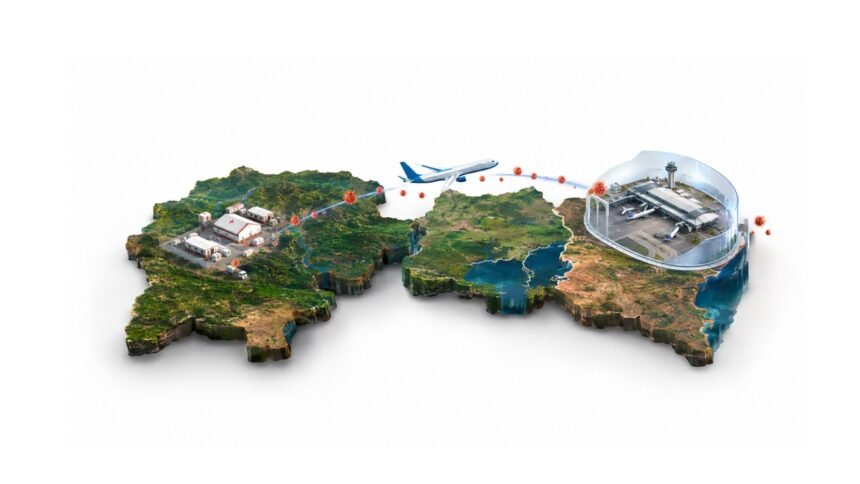
One passenger, one flight and one border crossing now test whether East Africa’s health architecture is built for the mobility that defines the region’s economy.
An Outbreak Without a Vaccine
The virus behind the case is the Bundibugyo strain, for which, The Guardian notes, there is still no vaccine or specific treatment. This is the DRC’s 17th Ebola outbreak, announced in May. As of 2 October, according to the figures The Guardian cites, 4,082 people had died out of 8,463 confirmed cases in the country since the strain emerged. These are the latest published figures and are likely to change as reporting catches up.
The absence of a vaccine changes the logic of response. Control depends almost entirely on surveillance, isolation, contact tracing, supportive care and safe burials, the package of measures WHO describes for outbreak control. Capital FM’s explainer, republished by AllAfrica, makes the same point by citing World Health Organization guidance: early detection and isolation are especially important for Bundibugyo precisely because no approved vaccine or specific treatment exists.
Tracing the Corridor
Kenya’s ministry of health says it has listed 28 contacts of the deceased, including family members and health workers, and is searching for 23 passengers and four crew members who shared the flight. Duale said that so far only one test had come back positive, the man who died, and urged the public not to panic. A safe and dignified burial was planned in line with public health standards.
The tracing task follows a 21-day logic, the maximum incubation period cited by WHO. Capital FM notes that people are not infectious before symptoms appear, so sharing a cabin does not by itself mean exposure, and that the priority is to assess, monitor and rapidly isolate anyone who develops symptoms. The ministry also says it has screened 652,584 travelers since heightening Ebola surveillance in May and tested 267 samples, with only this case positive as of 6 October. That record shows sustained vigilance at the border, and also its limits: a traveler who has already been treated and who crosses through a third country can still pass through.
The Epicentre Expands
Kenya’s case is a symptom of a wider crisis in the DRC. The outbreak began in Ituri province and has spread to seven provinces in the north and east. Médecins Sans Frontières warned of an alarming surge in North Kivu, which borders Uganda, where the province’s share of new cases rose to 40 percent from 24 percent at the end of August. MSF’s coordinator in Butembo compared the response to fighting a megafire, with multiple outbreaks developing at once. The wider Butembo health zone, home to about two million people, has only four Ebola treatment centers, two of them recently opened, and MSF says shortages of beds sometimes force staff to refer confirmed patients elsewhere.
Conflict compounds the epidemiology. North Kivu recorded 134 violent incidents in the past month, more than any other province, according to the Armed Conflict Location and Event Data Project cited by The Guardian. Instability, mistrust of authorities that has spilled into violence against health workers, and deep cuts in international aid have all hindered the response.
Uganda’s Precedent, Kenya’s Politics
Kenya can look across its western border for a model. Uganda recorded 20 cases, almost all among people who had travelled from the DRC, and two deaths, before being declared Ebola-free in August. Containment is possible where surveillance is fast, and communities cooperate. Trust, however, is a political asset as much as a technical one. The Guardian recalls that Kenyans reacted furiously earlier this year to government plans to let the United States set up an Ebola facility at the Laikipia airbase, about 125 miles from Nairobi. A public that suspects outbreak policy is being shaped abroad is harder to mobilize for contact tracing at home.
Health Sovereignty in a Mobile Region
The lesson of flight JM8523 is that no East African state can secure its population alone. People, goods and pathogens move along the same corridors linking Ituri, Kampala, Entebbe and Nairobi. Structural sovereignty in health therefore means shared surveillance data, strong laboratory capacity like that of the National Virology Reference Laboratory and KEMRI, which confirmed this case, linked across borders, and financing that does not collapse when foreign donors cut aid. It also means investing in the treatment capacity of the epicenter itself, because every unfilled bed in Butembo raises the risk in Nairobi. Kenya’s first Ebola death is a test of preparedness; its broader trajectory will depend on whether the region treats the DRC’s crisis as its own.