




The Pan-African Paradigm of Territorial Control and Contested Legitimacy
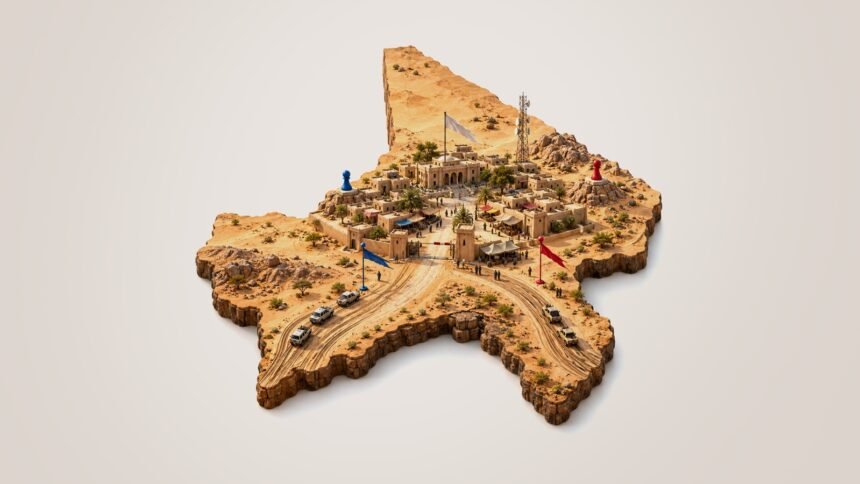
In November 2023, Malian troops and Wagner fighters marched into Kidal, the desert town that had long symbolized the north’s defiance of Bamako. The recapture was the most concrete gain of the partnership between Mali’s military rulers and their Russian backers. Then, in late April 2026, the town was lost again, seized by the Tuareg-led Azawad Liberation Front (FLA) during nationwide attacks, carried out alongside the al Qaeda affiliate Jama’at Nusrat al-Islam wal-Muslimin (JNIM), that also killed Mali’s defense minister. On 6 October the wheel turned once more: the FLA announced what it called a controlled withdrawal from Kidal, and pro-government fighters, including Russians, re-entered the town that afternoon, according to a security source quoted by Reuters.
History in Kidal does not move in straight lines. It cycles, and each turn of the cycle tells us less about who controls territory than about who can claim legitimacy from controlling it.
Withdrawal Without Battle
The FLA framed its departure as tactical, not as defeat. In a statement quoted by Reuters, it called the move a temporary operational measure intended to keep its human and logistical capabilities intact, adding that the withdrawal took place without any direct combat with the enemy. The group said it was responding to airstrikes by Mali’s military backed by Russian fighters. A source close to the FLA leadership told Reuters that the aerial operations had begun three days earlier and played down the withdrawal, saying war is not a race against the clock.
Mali’s general staff told a different story. In a statement reported by AFP via Africanews, it said for the first time that it had engaged in large-scale air-land operations in the Kidal region with its Russian partners to neutralize armed groups and restore security and freedom of movement. A staff officer told AFP that troops had arrived in Kidal ahead of schedule. Both accounts can be true at once: an army can enter a town that its opponent has chosen to leave, and the political meaning of that entry is precisely what is being contested.
The Russian Variable
Kidal is also a referendum on Moscow’s security offer. Mali has relied for years on Russian support, first from the Wagner group and then from Africa Corps, a paramilitary force made up largely of former Wagner fighters. Al Jazeera notes that JNIM gained strength after the junta expelled French forces and some 15,000 United Nations peacekeepers and turned to Russian paramilitaries instead. Beverly Ochieng, associate director at Control Risks, told Reuters that the recapture allows Africa Corps to reprise its role as the government’s security guarantor after appearing to lose significant ground since April.
The dependency runs in both directions. The junta needs Russian air power to project authority across the north, and Russia needs visible victories to sustain its claim to be a more effective partner than the Western forces it displaced. In that asymmetric arrangement, each recapture is as much a marketing event as a military one.
Symbol Versus Strategy
Ochieng’s assessment is careful. A successful recapture, she said, affirms the military government’s authority and lifts the army’s morale after several high-profile setbacks in the north and center in recent weeks. Yet she described the change of control as largely symbolic rather than decisive. AFP recalls that the JNIM and FLA offensive since April also briefly captured the town of Anefis in fierce fighting in early July, and that Mali has been gripped by insecurity since 2012, driven by groups affiliated with al Qaeda and the Islamic State, local criminal gangs and separatists.
The coups of 2020 and 2021 brought soldiers to power on the promise of restoring security, a promise AFP notes has so far not been fulfilled. A town taken without a fight can be lost the same way, and the FLA’s insistence that its withdrawal is temporary is a signal that it intends to test the army’s capacity to hold, not just enter, Kidal.
An Alliance of Convenience
The insurgent side of the ledger is equally fragile. According to Al Jazeera, the FLA, a coalition formed in 2024 that unites Tuareg and other northern separatist factions, presents itself as a secular nationalist movement seeking independence for Azawad, the separatists’ name for northern Mali. JNIM, by contrast, says it is fighting to overthrow the government. The two set ideological differences aside to confront Bamako. Whether that tactical alliance survives the loss of its most symbolic prize will shape the trajectory of the conflict far more than the flag that now flies over Kidal.
Sovereignty Beyond the Flagpole
For Mali’s rulers, Kidal is the emblem of territorial sovereignty, and its recapture will be presented as proof that the turn away from France and the United Nations was justified. But structural sovereignty is measured differently. It depends on whether the state can protect civilians, restore services, and offer northern communities a political settlement that makes armed separatism less attractive than citizenship. A recapture achieved by air power and a foreign paramilitary partner, against an opponent that chose not to fight, is a fragile foundation for that kind of authority. Until Bamako converts a symbolic victory into durable governance, Kidal will remain what it has been for more than a decade: a town that changes hands. At the same time, the architecture of insecurity around it stays in place.