


The Largest Protest Against President Kais Saied in Years, Five Years After He Took Broad Powers, and a Test of Whether a Scattered Opposition Can Stay Together
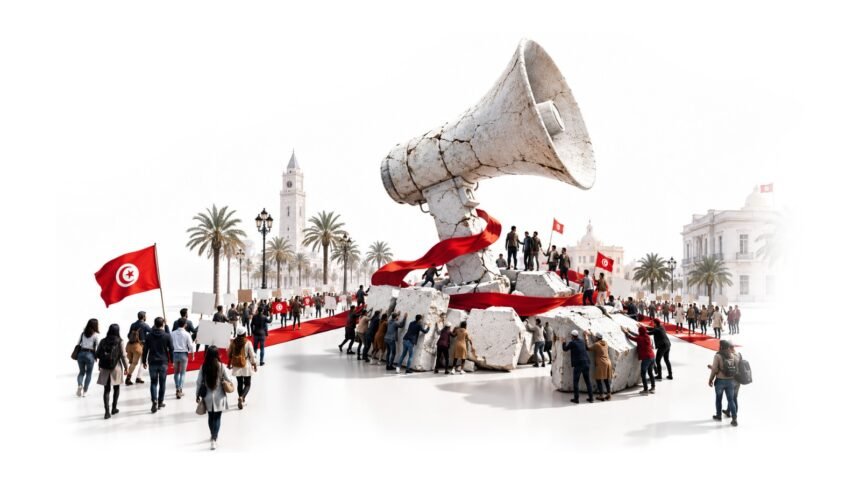
In 2011, Habib Bourguiba Avenue in central Tunis was the place where a dictatorship ran out of road. The crowds that gathered on that boulevard helped force Zine El Abidine Ben Ali from power and set off uprisings across the Arab world. On Saturday, 17 October, the avenue filled again. Thousands of Tunisians marched along it against President Kais Saied, accusing him of undermining democracy and mishandling the economy, in what was widely described as the largest demonstration against his rule in years. One count put the crowd at more than 3,000, a figure that could not be independently confirmed. Hundreds of police officers were deployed across the capital, and several surrounding roads were closed.
The march was led by the Tunisian General Labor Union, the UGTT, the country’s powerful labor federation, together with opposition parties and civil society organizations. What set it apart was who walked side by side. Parties from across the political spectrum, whose long-running quarrels have weakened their ability to challenge the president, marched with lawyers, doctors, journalists, unemployed people and activists. They demanded the release of detained government critics and an end to restrictions on trade union rights. Placards read “No democracy without freedoms” and “No dignity with poverty”, and some marchers revived the slogan demanding the government’s removal that was heard across the country in 2011.
From Rule by Decree to the Street
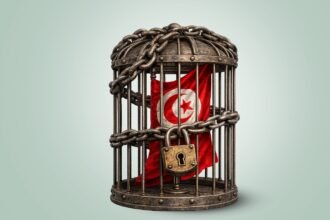
Saied came to power promising an alternative to the political system built after the revolution. In 2021, he suspended parliament and dismissed the government, saying he was confronting corruption and political deadlock. He went on to dissolve parliament, dismiss dozens of judges and rule by decree, steps his opponents called a coup, and a new constitution adopted in 2022 expanded the powers of the presidency. Rights groups say he has since intensified a crackdown on civil society, journalists and opposition figures. Saied rejects those allegations, says he is not a dictator and has accused his opponents of engineering economic crises to fuel social unrest.
Saturday’s march had precedents. On 20 August, protesters in Tunis rallied against rising prices and shortages of basic goods. Last month, fuel transport workers held a two-day strike over wages and working conditions, led by a union federation affiliated with the UGTT. What changed this weekend was breadth. An opposition that for years has struggled to fill a street managed to do it together.
The Union’s Case Against Concentrated Power
Addressing the rally, UGTT secretary-general Salah Eddine Salmi criticized the concentration of political power in the presidency and said: “Silence will no longer be acceptable.” He told marchers that intimidation could not stand in for a policy of government and that the country could not be governed by exclusion. In his account, experience had shown that concentrating power does not produce effective government, that pushing aside competent people and social and political forces piles problems up rather than solving them, and that the absence of accountability does not eradicate corruption but weakens the means of exposing it.
His sharpest criticism concerned the courts. He accused the authorities of turning judicial procedure into a tool for removing opponents, and described pre-trial detention as one of the main forms of abuse of the law. He placed this against institutional gaps that remain unfilled: a Supreme Judicial Council left vacant, its powers absorbed by the Ministry of Justice, and a Constitutional Court that has never been set up. Salmi also said the coordination framework behind the march, which brings together national, civic, professional and human rights organizations, would not end with Saturday’s event and would be opened to other forces.
Shortages Behind the Slogans
The political demands traveled with economic ones. Tunisia has endured prolonged economic difficulty, deteriorating public services, recurring water and electricity cuts, and shortages of medicines and other essentials. Salmi listed the erosion of purchasing power, rising unemployment, shortages of medicines, mounting hospital debts and the insolvency of social security funds. He warned of risks facing public schools and universities, of drug use spreading among pupils, and of decline in public bodies running transport, electricity, water, energy and mining. Other marchers carried banners about unemployment and pollution.
Yassine Gharseli traveled about 250 kilometers from Sfax to take part. He spoke of power and water cuts and of one crisis following another. “I came from Sfax to stand up for my freedom, and I’m not ready to give up, even if I become the last voice in the country,” he said. His journey is a reminder that the grievances on display were not only those of the capital’s political class.
Why Tunis Still Matters to the Continent
Tunisia’s revolution was, for a time, the clearest African case of citizens removing an entrenched ruler and replacing him through competitive elections. Its later course, in which an elected president used that mandate to dismantle the checks around him, raises a question that many African societies now face: what citizens can do when power is concentrated by a leader who first won it at the ballot box. The answer being tested in Tunis is organized, broad and peaceful pressure led by a social movement rather than by any single party. Salmi was explicit that the aim was not a return to the past, not to absolve anyone of responsibility and not to repeat old mistakes, and that Tunisians should not be asked to choose between an old system of government and a new one. The coordination also called for transparency in agreements touching the country’s strategic interests, particularly on migration, and rejected the idea of Tunisia becoming a border guard for others.
Self-Rule Is Not a Blank Cheque
Salmi framed the march in terms of national self-determination. Tunisia’s problems, he said, must be solved by Tunisians, through their own will, dialogue, and skills, within the framework of national sovereignty; sovereignty is neither a slogan for speeches nor a blank cheque handed to those in power to act in the people’s name without oversight. That is the heart of the matter. A country’s right to decide its own course is exercised by its people, through courts that judge independently, unions that can organize and a press that can report. Whether Saturday becomes a turning point will depend on whether the coalition that filled Habib Bourguiba Avenue holds together once the crowd has gone home, and on whether the authorities answer it with dialogue rather than with more arrests.