




Drones Have Become the Deadliest Weapon of Sudan’s War, and People Waiting for a Ride Home After Market Day Are Now as Exposed as Any Front Line
Ahmed Abakar Wadi spent the hours after Sunday evening’s attack on al-Dibab doing what no one should have to do. “50 bodies I helped bury, one of them my own brother Mohamed,” he said of the drone strike that hit the town in Sudan’s West Kordofan state. He gave his account over a satellite internet connection, the only way to reach the outside world through a communications blackout. Most of the dead, he said, were commuters waiting for trucks to carry them back to their villages once the market had closed.
The toll did not end at the graveside. Wadi said 47 wounded people were taken to al-Mujlad, the nearest town. A medical source there, who asked not to be named for his own safety, said 30 of them died of their injuries. “A total of 80 people were killed in the drone strike on al-Dibab, and another drone strike on al-Mujlad injured four who are currently being treated,” the medic said. If that count holds, the strike is one of the deadliest single attacks since Sudan’s war broke out in April 2023.
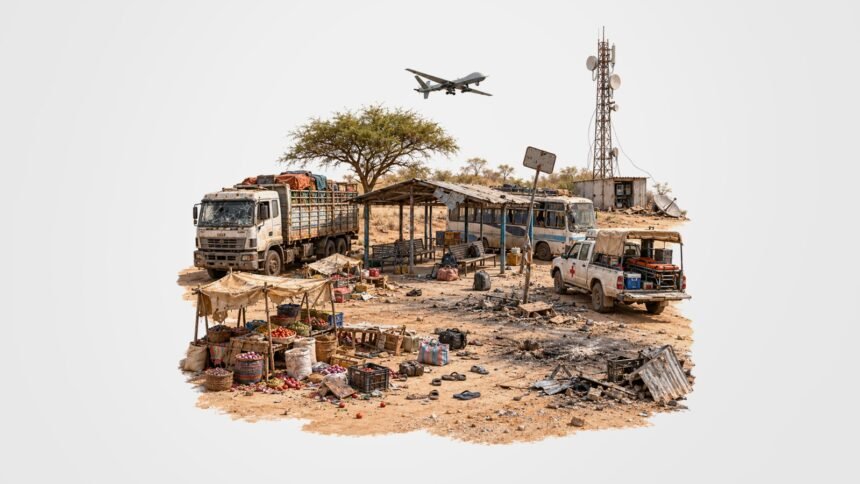
The place that was hit matters as much as the number: not a barracks but a transport hub, the kind of roadside gathering point on which rural economies from the Sahel to the Horn depend: the spot where farmers, traders and day laborers wait after market day for a lift home. The same pattern is being recorded elsewhere on the continent; a new rights report on Mali, covered elsewhere in this brief, describes a drone strike on a village cattle market. When markets and the roads out of them become targets, war reaches people who have no part in the fighting and few ways to avoid it.
Two Strikes and Two Versions of the Day
Wadi said the drone struck twice, ten minutes apart, “on a transport hub where people gather to travel back to their villages after the market day ends.” A second strike minutes after the first tends to fall on those who rush in to help the wounded. The RSF-declared administration that runs the area, known as Tasis, made the same charge in a statement, accusing the army of using Turkish-made drones against unarmed civilians and saying the drone waited for people to gather around the injured before firing again.
The accounts do not match in every detail. The witness described commuters heading home from the market; the Tasis statement said the victims were preparing to travel by truck after attending a funeral, and that the same drone also struck near a girls’ school in al-Mujlad, wounding at least two people, where the medic counted four injured. The toll of 80 rests on the witness and a single medical source; the accusation against the army comes from the army’s enemy, and the claim about where the drones were made has not been independently verified. The army had not publicly responded when the casualty figures emerged. All of West Kordofan is under the control of the Rapid Support Forces, which makes independent access difficult and the blackout harder to pierce.
The War’s Deadliest Weapon
Drones have changed the shape of the conflict. Between January and April this year, drone strikes accounted for at least 880 civilian deaths, more than 80 percent of all conflict-related civilian deaths in Sudan. The strikes run in both directions. On Friday, drones hit a busy livestock market in Nyala, the capital of South Darfur; the army said it had killed RSF fighters, while the RSF said 30 civilians died. On Monday morning, a drone strike on a house in the Nasser Extension neighborhood, just east of Khartoum’s airport, killed four people, three of them children aged between two and six, according to a medical source at the city morgue.
For civilians, this means a war without a safe rear. Each side can now reach deep into territory held by the other, so a bus stop in Kordofan, a livestock market in Darfur and a family home in the capital can all be hit on the same weekend, far from any front.
Foreign Backers and No Talks
The war pits the Sudanese Armed Forces, headed by Gen Abdel Fattah al-Burhan, against the Rapid Support Forces led by Mohamed Hamdan Dagalo. It began as a power struggle that erupted into violence in Khartoum and has been fuelled since by foreign powers with interests in the outcome, which have supported both sides. There is no definitive death toll, but aid workers estimate that more than 200,000 people have been killed, and the conflict has produced the world’s largest hunger and displacement crisis.
Last week Rosemary DiCarlo, the UN under-secretary-general for political and peacebuilding affairs, told the Security Council that the conflict and humanitarian crisis were deteriorating “with no breakthrough on the horizon.” The warring parties, she said, “are not moving closer to dialogue. On the contrary, they seem to believe that they can make greater gains on the battlefield and that continued external support will allow them to pursue their objectives by force.”
What a Truck Stop Means in Kordofan
In a region where, the UN warned earlier this month, drought and war are pushing communities towards famine, the weekly market and the trucks that serve it are a lifeline: the way grain, livestock and cash move between villages and towns. A strike on a market-day transport hub therefore does damage beyond the dead and wounded. It teaches traders and buyers that gathering is dangerous, and every market day that people stay away makes food harder to find and more expensive for those who remain.
The communications blackout compounds the harm. Families cannot quickly learn who is alive, local medics cannot easily call for supplies, and the outside world learns of mass-casualty attacks only when a witness finds a satellite connection. Counts that do emerge are often partial, disputed, or late.
Protecting the People Who Keep Sudan Moving
Sudan’s sovereignty is being hollowed out from both ends: by two armed forces that treat civilian spaces as fair game, and by foreign backing that, in the UN’s own description, lets both sides believe they can still win by force. Restoring it will take more than a ceasefire between generals. It will require African institutions and Sudan’s neighbors to insist on independent investigations of strikes such as al-Dibab, whoever carried them out, on restored communications so that civilians can report what happens to them, and on an end to the arms supply that keeps the drones flying. Until then, the people who keep Sudan’s markets and roads alive will remain the war’s easiest targets.