


Overfishing And Pollution Are Pushing a Staple Protein Out of Reach for Low-Income Households in Congo-Brazzaville, and Land-Based Aquaculture Is Being Tested as a Homegrown Answer
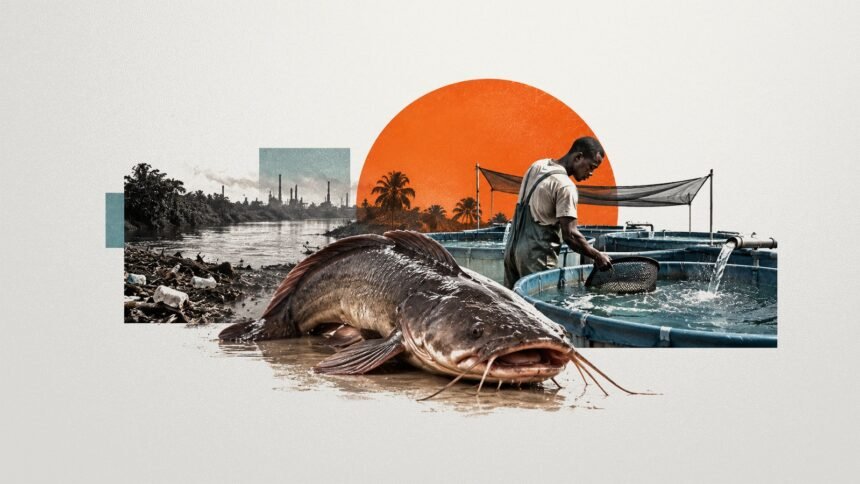
Pointe-Noire has more rivers than most cities could wish for and still struggles to put freshwater fish on its tables. The economic capital of the Republic of Congo is crossed by more than a dozen waterways, among them the Tchinouka. Many of them are unusable as sources of fish because of pollution and other problems, and the result is a paradox that residents feel at the market: a city of rivers where a river fish has become a luxury.
The numbers explain why. Congo already faces shortages of both marine and freshwater fish, partly because of overfishing, and freshwater fish is increasingly absent from people’s plates. In a country where the minimum wage is 50,000 CFA francs, a single giant catfish can cost more than 7,000 CFA francs, about a seventh of that wage. Fish is turning into a luxury, while meat products are increasingly treated as everyday necessities.
Pointe-Noire’s problem is a local version of a continental one. Along Africa’s rivers, lakes and coasts, fish is a vital source of animal protein for many low-income households, and pressure on wild stocks, from overfishing to contaminated water, is forcing cities and governments to ask where that protein will come from next. The answer being tried in Pointe-Noire is to stop relying on the rivers and to farm fish on land.
Tanks and Ponds Inside the City
As the UN Food and Agriculture Organization (FAO) calls for innovation to feed future generations, land-based fish farming is emerging as one possible solution. Fish farmer Wilde Bahamboula explains the logic of keeping production inside the city. “We are operating right in the city, using tanks and ponds. This makes it easier to harvest the fish and monitor them,” he said. “Under the traditional system, you might put 1,000 fingerlings in a natural pond. Six months later, when you return to harvest them, you may find that only 100 or 200 fish remain.”
That comparison is the core of the business case. Losing 80 to 90 percent of a stock in an open pond makes fish farming a gamble; controlled tanks and ponds, close to buyers and easy to watch, turn it into something closer to a planned harvest. Being in the city also cuts the distance between farm and market, which matters when fish is perishable and transport is expensive.
The Feed Bill
The main obstacle is feed, which accounts for around 75 percent of production costs. That single figure shapes everything else: as long as feed is expensive, farmed fish cannot be cheap, and the catfish that costs a seventh of a minimum wage will stay out of reach for the households that most need it. Producers are therefore calling for closer links with the agricultural sector and for more fish feed to be made locally.
Other African producers are working on the same problem. In Uganda, refugee farmers have been raising insects such as black soldier flies to make feed, food and fertilizer, an example of how cheaper local inputs can be built from waste rather than imported. For Congo’s fish farmers, the lesson is that aquaculture is not only a fisheries question but an agricultural one, tied to what local farms can grow and process.
Small Output, Large Appetite
The scale of the gap is striking. FAO estimates that Congo-Brazzaville produces nearly 1,500 tonnes of farmed fish a year, while people in Congo eat an average of 25 kilograms of fish each per year. At that rate of consumption, the country’s entire farmed output would cover the yearly fish needs of about 60,000 people. Aquaculture is being presented as a way to make fish more accessible as prices rise and supplies stay limited, but on current figures it is a start rather than a solution.
What the Rivers Are Telling Us
Moving fish into tanks does not answer the question of why the rivers failed. The pollution that makes many of Pointe-Noire’s waterways unusable is a warning about the wider environment of the coast. In September, a report by the Catholic diocese of Pointe-Noire and Caritas said farmers in the neighboring Kouilou department had seen sharp drops in cassava harvests, blamed by residents on gas flaring by oil companies, and said soil, water and air in the region were contaminated beyond limits set by the World Health Organization. Gas flaring was banned in Congo in 2007, but the authorities granted exceptions in 2022. That report did not examine Pointe-Noire’s fish rivers, and the causes of their pollution have not been set out in detail, but the two stories point in the same direction.
Feeding a City from Its Own Ground
Food sovereignty, the ability of a country to feed its people from its own land and water on terms it controls, is often discussed in terms of grain and fertilizer. Pointe-Noire shows it is also about fish. Tank farming can make the city less dependent on exhausted rivers and expensive imports, but only if feed is produced locally and affordably, and only if the rivers themselves are not written off. Cleaning up the waterways and holding polluters to account would protect a free source of food that no fish farm can fully replace.