



The Pan-African Paradigm of Food Sovereignty and Climate Exposure
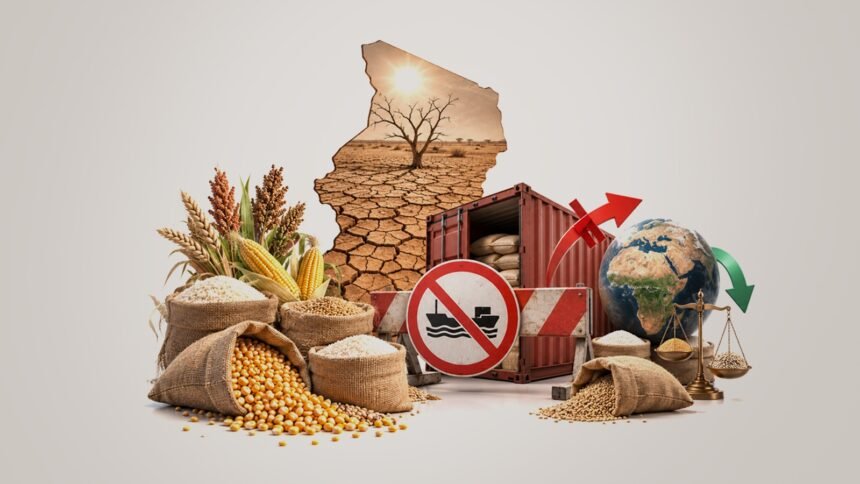
Mahamat Moussa Ali watched drought wipe out twelve hectares of his corn crop this year in Chad’s west-central Chari-Baguirmi province, and he says no one warned him it was coming. ‘We’re definitely going to starve because, in our community, no farmer has been spared,’ he told Reuters. This sentence captures more precisely than any government decree the human stakes behind N’Djamena’s decision this week to ban exports of millet, corn, rice, sorghum, wheat and cotton seed while simultaneously lifting import duties on staple grains. The dual measures, announced in decrees signed by Chad’s finance and commerce ministers, respond to a UN Food and Agriculture Organization finding that repeated dry spells between July and mid-August damaged cereal crops across the country, compounding a lean season during which the World Food Program estimated more than 3 million Chadians faced acute food insecurity. For a Central African nation with limited fiscal capacity to cushion agricultural shocks, the export ban represents a blunt but immediate tool: retaining domestic food supply by force of law rather than through market incentives that drought-stricken farmers can no longer reliably answer. Reclaiming food sovereignty under climate pressure, before scarcity hardens into famine, is the urgent calculation now driving Chad’s economic policy.
A Decree Built on Dual Levers
Chad’s response combines two distinct policy instruments deployed simultaneously: Finance Minister Tahir Hamid Nguilin’s decree exempting wheat, corn, millet, rice, livestock feed, and agricultural equipment from import duties and taxes, intended to make external food supplies cheaper and more accessible, paired with Commerce Minister Mathieu Guibolo Fanga’s separate decree banning exports of the same staple crops plus cotton seed, intended to prevent domestic production from leaving the country during a period of acute shortage. This is a coordinated attempt to widen the funnel of food entering Chad while narrowing the funnel of food leaving it, a strategy that acknowledges domestic production alone cannot meet current demand while also recognizing that unrestricted exports would accelerate scarcity for Chadians competing with regional and international buyers for the same diminished harvest. Agricultural production minister Keda Ballah identified the central, eastern and northern regions as hardest hit, and described government efforts to support off-season, irrigated cultivation as ‘the only way to prevent famine in certain regions,’ a stark acknowledgment from a senior official of how narrow the margin between current policy and famine conditions has become.
A Crisis Compounding a Crisis
Chad’s drought arrives atop a food security situation already strained before this year’s poor rains. The World Food Program’s estimate that more than 3 million people faced acute food insecurity during the June-to-August lean season predates the crop damage now prompting these emergency decrees, meaning the current harvest shortfall compounds rather than initiates the country’s food crisis. Djibrilla Abba Bello, a nomadic herder in the Mayo-Kebbi Ouest region, described streams and ponds that normally sustain livestock at this time of year running dry, forcing weakened animals into declining milk production and mobility. Bello said some herders in his community had already sought refuge in the Central African Republic, despite ongoing insecurity there, calculating that the risk of instability across the border was preferable to certain loss of livestock at home, a grim illustration of how climate-driven scarcity is now reshaping population movement even into countries themselves experiencing active conflict.
The Warning That Never Came
Farmer Mahamat Moussa Ali’s central grievance, that authorities failed to warn communities about the approaching heatwave in time for them to adapt planting or irrigation strategies, points to a structural gap that export bans and duty exemptions alone cannot address: early warning and agricultural extension systems capable of reaching subsistence farmers before, not after, crop failure occurs. Chad’s government has moved decisively on trade policy in the crisis’s aftermath. Still, the lack of effective forecasting and farmer communication before the dry spells struck suggests institutional capacity to prevent future shocks remains underdeveloped relative to the capacity to respond once shocks have materialized. This distinction, between reactive trade policy and proactive climate adaptation infrastructure, will likely determine whether this year’s measures represent a one-time emergency response or the first instance of a recurring cycle, particularly as forecasters warn of elevated El Niño risk in the coming season.
Sovereignty Measured in Granaries
Chad’s export ban and duty exemptions are, at their core, an assertion that a state’s most basic sovereign obligation, ensuring its population does not starve, takes precedence over the market logic that might otherwise send scarce grain to the highest regional bidder. That assertion carries real costs: farmers who might have profited from higher regional prices during a shortage are instead barred from exporting, and the policy’s success depends entirely on whether domestic distribution systems can move retained supplies to the hardest-hit central, eastern, and northern regions before the lean season resumes. For a country with chronically limited state capacity, translating a trade decree into food actually reaching Mahamat Moussa Ali’s community and others like it will be the real test of whether this week’s measures amount to genuine food sovereignty or merely a paper declaration of intent. As climate volatility continues to erode the predictability subsistence agriculture has traditionally relied upon, Chad’s experience offers a preview of the policy dilemmas an increasing number of African governments will face: how to protect vulnerable populations from scarcity using the blunt instruments of trade policy when the underlying climate systems that once made harvests predictable can no longer be relied upon at all.