



Ten Mayors in a Decade
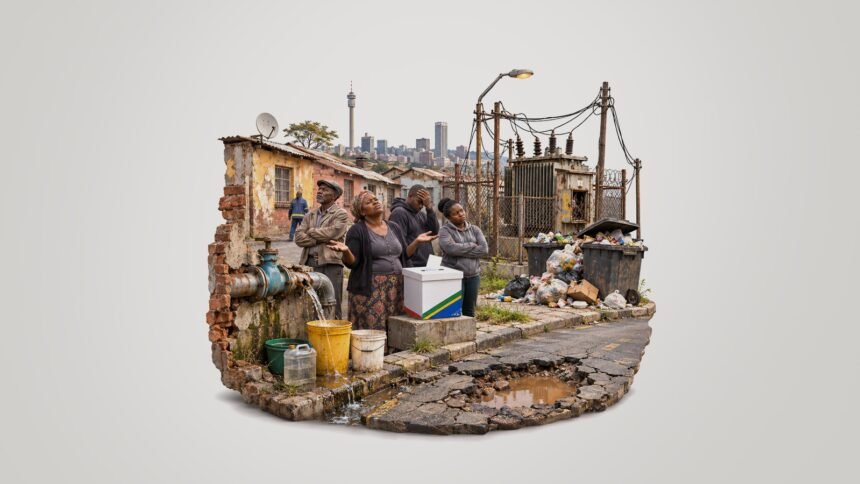
Between the census of 2011 and the census of 2022, Johannesburg grew by 10 percent, to 4.8 million people. The pipes, substations and roads that serve them did not keep pace. A week before South Africa’s local elections, the result was visible in the township of Alexandra: pavements and roads lined with piles of rubbish rotting in the heat, and, at the Jukskei River, banks choked with rubble and litter as foul-smelling brown water flowed out of a culvert.
“We’ve got way too many challenges,” said Semadi Manganye, chief executive of Alexandra Water Warriors, an environmental NGO that organizes river clean-ups and plants trees on the banks. “If it’s not electricity, it’s water. If it’s not water, it’s waste.” He said he understood why the city was failing to cope with its growth. “But we’ve got to mitigate against this – we knew that it was going to happen.”
On 4 November, up to 29 million South African voters will go to the polls amid deep discontent with the water cuts, power outages and potholes that afflict the country’s 257 municipalities. President Cyril Ramaphosa has himself admitted: “Too many of our municipalities are failing to meet the needs and expectations of the people they are meant to serve.”
A National Problem With a Johannesburg Address
The figures behind that admission are stark. In the 2024-25 financial year, only 39 local governments, 15 percent of the total, received a clean audit from the Auditor-General. Two-thirds of municipalities are financially distressed, according to a parliamentary budget office report.
Nowhere are the problems more pressing than in Johannesburg, the country’s largest city and commercial capital. It has been run by a series of unstable coalitions, with 10 changes of mayor in the past decade. City authorities have admitted to an infrastructure spending backlog of 220 billion rand, about 9.9 billion pounds. An estimated quarter of the water bought by the municipal utility, Johannesburg Water, is lost to leaks.
Anger in Rabie Ridge, Thirst in the Suburbs
At a public meeting in Rabie Ridge, a township in the city’s north-east, about 400 people berated the incumbent mayor, Dada Morero, and executives from the electricity utility City Power. One woman said she had been without power for six months. Another said her mother had turned to loan sharks after receiving energy bills as high as 6,000 rand a month, against a monthly pension of 2,000 rand. “If there is any organization that is dysfunctional, it is this organization… it is failing,” one man said, to loud cheers.
The crisis is not confined to poorer areas. Even some affluent northern suburbs go without piped water for weeks. After a month-long outage about six months ago, residents of parts of Melville and Westdene have been unable to predict when water will come since September. “The word I’d use is desperate, because literally there’s been almost no water at all,” said Kate Spiller, a semi-retired management consultant. She and her husband drive almost daily to a mosque with a borehole to fill about a dozen five-liter bottles for bucket showers. “It’s incapacitating … you’re always planning,” she said.
The Mayor Blames Vandals, Researchers Point Inward
Morero defended the city’s record. “Overall, Johannesburg is providing the necessary services to our communities,” he said after the Rabie Ridge meeting. “Isolated areas where they don’t have [services], we are focusing on right now.” He acknowledged that parts of the inner city were without power because of a “collapsed” substation, but blamed vandalism and organized criminal syndicates targeting infrastructure.
Others see the problem as starting inside city government. An October report by the Global Initiative Against Transnational Organized Crime concluded: “Governance failure in the CoJ [City of Johannesburg] has given birth to a criminal ecosystem.” Rashid Seedat, a former city official and executive director of the Gauteng City-Region Observatory, said people running the supply chain system “can easily get backhanders”. “Of course, corruption is the metro police officer taking a bribe of 200 rand [and] a 200m rand tender. It’s across the board and endemic in the entire system and acceptable,” he said. These are the assessments of the report’s authors and of Seedat, not findings of a court.
A Snorkel in a Pothole and an Uncertain Count
The Democratic Alliance, the country’s second-largest party, has run an energetic campaign in Johannesburg under Helen Zille, the 75-year-old former Cape Town mayor, to unseat the African National Congress and its partners, the Economic Freedom Fighters and the Patriotic Alliance. Zille has caused controversy before, particularly among black voters, including over tweets in 2017 saying colonialism was not completely negative. But viral stunts such as snorkeling in an enormous flooded pothole have helped put her party ahead in the polls.
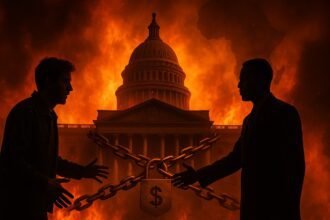
October polls put the DA at between 29 and 36 percent, against 22 to 27 percent for the ANC, which is fielding three possible mayoral candidates amid factional infighting. Voters choose parties and councilors, who then elect the mayor, and analysts say a polling lead may not be enough for Zille to form a coalition. Ziyanda Stuurman of the consultancy Africa Practice noted that across Johannesburg, Tshwane and Ekurhuleni, the ANC, the EFF and ActionSA have repeatedly backed one another’s mayors once in-principle coalition deals are reached. A similar arrangement, she warned, could mean five more years of decline. “It’s been much more horse-trading than it actually has been about the city’s best interests.”
Whose City Is It?
Johannesburg’s election is, at bottom, a test of whether residents can hold anyone responsible for services they pay for. Coalition politics has spread accountability so thinly that a woman paying three times her pension for electricity, or a couple carrying water bottles from a mosque, cannot easily say whom to blame. Ten mayors in ten years have each inherited the same backlog and left it larger.
For a city that is Africa’s most important commercial hub, the stakes extend beyond its own boundaries. Investors, migrants and neighboring economies all depend on Johannesburg working. Control over its own future means being able to keep water in the pipes and power in the lines, and that depends less on which party wins on 4 November than on whether the next council governs for residents rather than for the next coalition bargain.