





The Pan-African Paradigm of Migration Justice and Sovereign Complicity
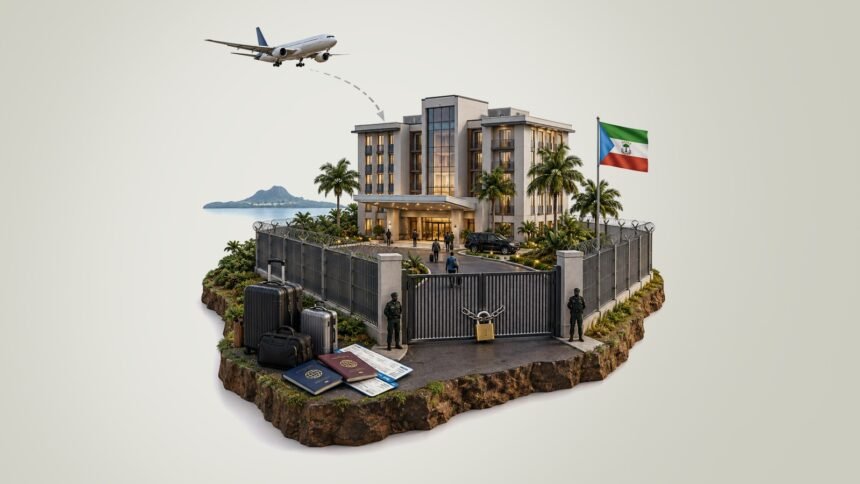
Six people stood on an airport tarmac in Monrovia in late August. They refused to disembark, an act of resistance that instead delivered them into a converted luxury hotel in Malabo, Equatorial Guinea, where they remain confined under armed guard with no legal pathway forward. Their case, believed to be the first instance of a fourth-country deportation under the Trump administration’s expanding third-country removal architecture, exposes a disturbing new frontier in migration governance: African states functioning not as destinations of choice but as contracted holding grounds for people the United States has determined it cannot, or will not, return home. More than 23,000 people have already been redirected to 26 countries other than their own under similar arrangements, and Equatorial Guinea, one of the most repressive and long-governed states on the continent, has now received more deportees than any other African nation. The arrangement implicates questions of sovereignty far beyond migration policy; it asks what African governments owe to people delivered to their soil not through asylum or economic opportunity, but through geopolitical transaction. Reclaiming migration governance as a matter of continental dignity, rather than a revenue line for individual regimes, is the unavoidable next chapter of this story.
A Deal Brokered by the Vice-President
The arrangement funneling deportees to Equatorial Guinea was secured personally by Vice-President Teodoro Nguema Obiang Mangue, widely known as Teodorín, son of Teodoro Obiang Nguema Mbasogo, the world’s longest-serving head of state, with nearly five decades in power. Teodorín’s own legal history complicates the arrangement considerably: he was convicted in absentia by a French court in 2017 of money laundering, embezzlement of public funds, and corruption, a verdict upheld on appeal in 2020, and separate US Senate and Department of Justice investigations concluded he used bribery and extortion to finance lavish personal spending. Despite having previously been barred from entering the United States, Teodorín received a one-month waiver to attend last year’s UN General Assembly, traveled to Washington, and returned with a deportation agreement under which the US government would pay his administration $7.5 million. Tutu Alicante, founder of the Washington-based NGO EG Justice, characterized the political calculus starkly. As Teodorín prepares to succeed his father as president, alignment with Washington matters to him more than the payment itself.
Conditions of Confinement Inside the Bamy Hotel
The six deportees, four Cubans, one Brazilian, and one Cameroonian, are held inside the Bamy Hotel, a property owned by the Obiang family situated within a heavily guarded compound. Meredyth Yoon, litigation director at Asian Americans Advancing Justice-Atlanta, who remains in contact with the group, described conditions of confinement she called horrific: guards have confiscated phones, restricted food and water access for extended periods, and denied basic hygiene and medical care. One detainee, suffering from a large ventral hernia after allegedly being thrown down the aircraft steps while resisting the Liberia landing, was reportedly denied hospital treatment in Malabo for lack of documentation. Nearly 60 other deportees, mostly non-Equatoguinean Africans, have arrived in the country since November as part of a related pipeline, with almost half eventually returned to their countries of origin, including at least four Ethiopians sent back the week of this reporting.
Legal Limbo Without an Asylum Framework
Equatorial Guinea possesses no domestic legal framework for asylum, leaving deportees suspended between indefinite hotel confinement and forced return to countries from which US immigration judges had previously found they faced genuine risk of persecution, torture, or death. Immigration lawyers characterize the fourth-country mechanism as a deliberate legal loophole, one that circumvents prior judicial protections by routing vulnerable individuals through jurisdictions with no capacity or willingness to adjudicate their claims. A US Department of Homeland Security spokesperson defended the practice as lawful removal to a “safe third country,” insisting the administration was “applying the law as written.” That characterization sits uneasily against UN human rights experts’ May warning to Equatorial Guinea to halt onward removals of US deportees, a directive Alicante confirms has gone unheeded.
A Widening Geography of Contracted Detention
Equatorial Guinea is not alone in this expanding architecture; Alicante notes similar arrangements now operating in Eswatini, Sudan, Ghana, and Liberia, transforming a patchwork of African states into an informal detention network serving US immigration enforcement priorities. The structural asymmetry is stark: wealthy states outsource the political and humanitarian cost of mass deportation to governments with far weaker institutional capacity, and in Equatorial Guinea’s case, a leadership whose own human rights record and legal entanglements make it an especially fraught partner for such a bargain.
Toward Institutional Accountability for Contracted Removal
The six people held in Malabo did not choose Equatorial Guinea, did not consent to their transfer, and possess no legal mechanism to contest their confinement. Their case demands continental attention not merely as a humanitarian emergency but as a governance failure: African states accepting payment to warehouse foreign nationals outside any recognized legal process. As the practice spreads to additional countries, the African Union and regional human rights bodies face a pointed test of whether sovereignty rhetoric extends to protecting the dignity of people delivered, unwilling, onto African soil by foreign transactional design.