



From a UN Vote to a Bargaining Table
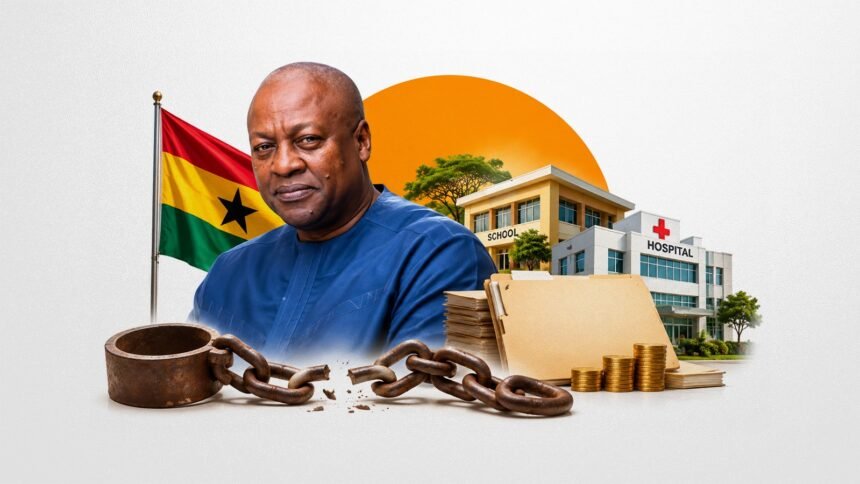
What does it mean to repair a crime that spanned four centuries and moved somewhere between 10 and 15 million enslaved Africans to the Americas? Ghana’s President John Dramani Mahama has offered an answer that is both broader and more practical than the one usually heard in the reparations debate. Speaking to the presidential press corps after returning from a series of foreign trips, he said reparations do not necessarily mean direct cash payments.
There are many other areas, he said, in which countries can cooperate to ease the harm done by the transatlantic slave trade and by colonialism. He named investment in education, health, economic growth and the treatment of debt as forms that repair could take. Slavery, he noted, rested on unpaid labor. At the same time, colonialism extracted Africa’s natural resources for the benefit of colonial powers, and both left consequences that still weigh on the countries that suffered them.
His remarks place Ghana at the center of a question that runs from Accra to the Caribbean: how a moral claim recognized in principle becomes something concrete in budgets, classrooms and debt schedules.
The Resolution Ghana Pushed
In March, the United Nations adopted a resolution, promoted by Mahama, declaring the transatlantic slave trade “the gravest crime against humanity”. The text is not binding, but it goes beyond acknowledgment and asks nations involved in the slave trade to engage in “restitution” and “compensation”. It gained the support of 123 member states, the strongest international endorsement of the case for reparations so far.
Mahama has since set up three working panels to explore practical routes to reparatory justice. On 1 November, he set out five areas he wants covered in proposed talks with the United Kingdom, the African Union, CARICOM and the African diaspora: a formal apology; a coordinated international commitment against systemic racism and Afrophobia; targeted investment in education, science, youth, climate resilience and healthcare; the return of stolen cultural heritage; and development partnerships to tackle structural poverty and unfair global economic and debt arrangements.
London Moves, but Not on Money
The timing reflects a shift in Britain. Prime Minister Andy Burnham has said he is open to a formal apology for Britain’s role in slavery and has held discussions on the subject at the Commonwealth Heads of Government Meeting in Antigua and Barbuda. He has, however, ruled out the financial reparations demanded by some Caribbean countries. Foreign Secretary Ed Miliband has called paying reparations “not feasible”, while saying “there are things we can work on co-operatively”.
Mahama welcomed Burnham’s acknowledgment of the human rights violations of the slave trade and the willingness to consider an apology. But he has been clear that an apology alone would not reverse the injustices suffered by millions of Africans. His emphasis on non-cash forms of repair can be read in two ways: as a concession to London’s red line, or as a deliberate attempt to steer the conversation toward the instruments that matter most to African economies today.
Debt as the Real Agenda
Mahama’s own words point to the second reading. He said he had discussed developing-country debt, access to credit and reform of the international financial system with Burnham, ahead of Ghana’s chairmanship of the African Union and Britain’s presidency of the G20, both in 2027. About 54 countries, he said, now spend more on debt service and interest than on health.
The figures closer to home are stark. Mahama said Ghana will need to find about 50 billion cedis, roughly $5 billion, to meet its debt repayments next year. He also criticized the risk premiums charged to African borrowers, which he said push the cost of financing to around 11 percent. Seen in that light, reparations framed as debt treatment and affordable credit are not a dilution of the claim. They are a way of tying a historical wrong to a present-day constraint that limits what African governments can spend on their own people.
The Risk of a Softer Settlement
The approach carries risks. Investment in schools and clinics is easy to promise and hard to verify, and development partnerships can be relabelled aid that donors were already providing. Apologies plus programs could also become a cheaper substitute for accountability. The return of cultural heritage and action against racism, two of Mahama’s five demands, depend on political will in European capitals that has been uneven.
There is also the question of who speaks for whom. Ghana’s proposals are framed as an agenda for the AU, CARICOM and the diaspora together. Holding that coalition together, while each member faces different creditors and different former colonial powers, will test whether the 123-vote majority in New York can become a shared negotiating position.
Repair on African Terms
At its heart, Mahama’s argument is about who sets the terms of repair. A settlement written in London would likely begin and end with an apology. One written in Accra, Addis Ababa and Kingston would connect that apology to debt, credit and investment, the levers that decide whether African states can fund their own development without asking permission. That is where the sovereignty question in the reparations debate really lies: not in the size of a cheque, but in whether former colonies gain lasting room to shape their own economies. If the 2027 AU and G20 calendars align as Mahama hopes, Ghana will have a rare chance to test whether that idea can move from a UN resolution into the rules of global finance.