



East Africa’s Coast as a Market, Not Just a Corridor
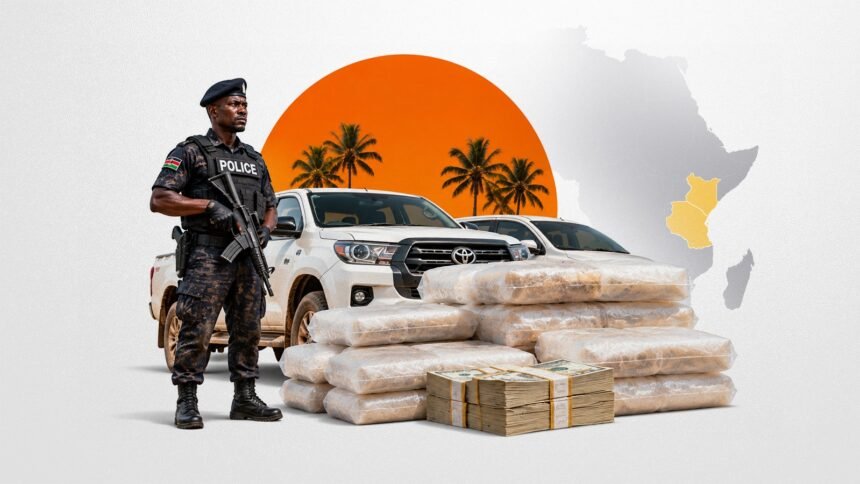
The trail began with one arrest in Tanzania last week. The suspect was handed over to Kenyan authorities at the border and, according to the police, led officers to a site in Msambweni on Kenya’s south coast. There, in an intelligence-led operation run with Tanzanian counterparts, detectives found 454 kilograms of suspected methamphetamine, valued at about 3.6 billion Kenyan shillings, or roughly $27 million. It is one of the largest drug seizures in Kenya’s history.
The haul lands at a moment when East African governments are being forced to rethink their place in the global drug trade. For years, the region’s coastline was described mainly as a transit route for narcotics heading elsewhere. The Institute for Security Studies, a think tank, now warns that it is increasingly also an entry point for manufactured drugs meant for local consumption. Methamphetamine is highly addictive and can cause severe psychosis, heart attacks and strokes, so that shift carries a direct public health cost.
What Was Found, and Where
Kenya’s Directorate of Criminal Investigations (DCI) said the operation began on 7 November with the arrest of Basleman Saleh Khamis, whom it described as a Kenyan-Tanzanian fugitive wanted in both countries over suspected narcotics trafficking. A 37-year-old Ugandan woman, Nakabugo Zuraicah, was arrested in Shirazi village. Further inquiries led detectives to Ganja la Simba village in the Kinondo area of Kwale County, where a targeted search uncovered the consignment and a 54-year-old Tanzanian, Hamad Seif Said, was arrested.
Officers also seized two vehicles, a white Ford station wagon and a white Ford pickup, and a red motorcycle believed to be linked to the network. The drugs and seized items are being held as exhibits, and the suspects in Kenya are in custody pending court appearances.
Accounts That Do Not Yet Line Up
Early official and published accounts differ on some details, and they are best read side by side. The DCI’s account names three suspects in Kenya: the fugitive, the Ugandan woman and the Tanzanian man. Another account, based on police statements, describes a key suspect arrested in Tanzania and three more people arrested in Kenya, two Tanzanians and a Ugandan, with four now held in Kenya.
The earlier seizure in Tanzania to which the key suspect is allegedly linked is also described differently: as 299 kilograms of suspected methamphetamine and heroin in one account, and as 250 kilograms of suspected methamphetamine and cocaine in another. These differences may reflect different counting points in a fast-moving cross-border case, and they will likely be settled when charges are read in court.
A Network Spanning Several Countries
The Tanzanian side of the investigation points to something larger than a single shipment. Aretas Lyimo, head of Tanzania’s Drug Control and Enforcement Authority, said initial questioning indicated that the drugs found in Tanzania had come through the Kenyan port of Mombasa. He said investigations suggested that some of those arrested were key figures in an international trafficking network operating across Afghanistan, South Africa, Mozambique, Zambia, Malawi, Uganda, Kenya, Tanzania and the United Arab Emirates. In total, he said, seven suspects had been arrested in the two countries, five Tanzanians and two Ugandans.
The seizure follows a run of large interceptions along Kenya’s coast. Last month, authorities destroyed more than a tonne of methamphetamine from a consignment seized by the Kenyan navy about 630 kilometers off Mombasa last year. Kenya’s Deputy President, Kithure Kindiki, also declared illicit alcohol and drug abuse to be among the country’s top threats last month and promised tougher laws and wider nationwide operations.
Following the Money
The DCI’s director, Mohamed Amin, framed the latest case as part of a change in strategy. “We are not only targeting those transporting drugs but also the financiers and organizers who sustain these criminal enterprises,” he said. The directorate says it is working with Kenya’s Asset Recovery Agency to trace the proceeds of trafficking, including cash, vehicles, houses, land and businesses, and it has pointed to recent convictions and upheld sentences in large cannabis cases as evidence that prosecutions are following arrests.
Shifting the focus from couriers to financiers matters because couriers are easily replaced. Networks that move hundreds of kilograms across borders depend on money, logistics and, often, protection. Seizures alone remove a shipment; seizing assets and convicting organizers can remove the capacity to send the next one.
Regional Answers to a Regional Trade
This case was solved because Kenyan and Tanzanian agencies worked together, from a handover at the border to a joint search on the coast. That cooperation is the real lesson. Trafficking networks already treat East and Southern Africa as a single operating space, routing goods through ports such as Mombasa and moving them across several countries. National police forces working alone cannot match that reach. Security sovereignty for the region means building shared intelligence, joint operations and common rules on seizing criminal assets, so that the coast stops being an easy gateway for the drugs and the money behind them. If the courts in Kenya and Tanzania can now turn these seizures into convictions of organizers as well as carriers, the region will have shown that it can protect its own ports and communities.