



A Familiar Stretch of Track
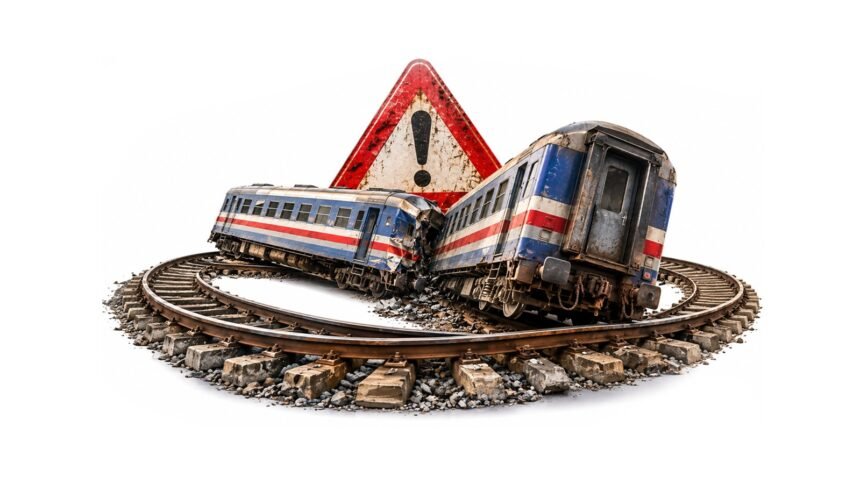
In February 2002, a fire tore through a southbound train on this same stretch of line and killed hundreds of people. Some counts put the dead above 360. On Sunday morning, the place name returned to the news for another reason. In al-Ayyat, a district of Giza province about 30 miles south of Cairo, a passenger train bound for Fayoum ran into the back of a Cairo-to-Aswan service. Carriages left the rails and spilled toward a countryside road. Egypt’s Ministry of Health and Population said at least seven people were killed and 112 were injured.
The health ministry’s first count on Sunday had been lower: four passengers dead and 88 people being treated in hospitals around Giza. State media had spoken of about 120 wounded, without saying how badly. The figures moved upward through the day as rescue teams worked through the wreckage. The cause has not been announced.
Train 134 Into the Back of 2010
Egyptian National Railways identified the trains by number. Train 134, a Tahya Misr service traveling from Giza to Fayoum, struck the rear of train 2010, which was traveling from Cairo to Aswan, between Kafr Ammar and Al-Raqqa stations. Several carriages derailed. An inspection indicated that the Cairo-Aswan train had been stationary on the same track.
Ayman Gamal, a resident of Kafr Girza, the settlement in al-Ayyat where the crash occurred, said people rushed to the scene, pulled out survivors and called for ambulances. He said he saw about 80 of the injured taken to hospital. Some passengers, he said, were trapped inside a carriage of the stationary train and died there.
Seventy-Two Ambulances and a Promise to Investigate
More than 70 ambulances, 72 by one official’s count, took part in the evacuation. The injured were taken to the central hospitals in Al-Wasta, El-Ayyat and Atfih. Health Minister Khaled Abdel-Ghaffar ordered hospitals in Giza and Beni Suef to raise their readiness level. Prime Minister Mostafa Madbouly followed the medical care and other help given to those affected.
President Abdel Fattah el-Sisi said he was following the aftermath closely, offered condolences to the families of the dead and wished the injured a swift recovery. He said the authorities had been directed to provide the necessary medical care and to speed up the investigation, and that anyone found to have been negligent would be held accountable. A team from the Public Prosecution inspected the site and requested a specialized technical committee from the railway authority to examine why the carriages derailed and identify any failings.
Emergency crews and cranes were sent to clear the wreckage and restore traffic on the Cairo-to-Aswan line. Until services resume, the Ministry of Transport is running buses between Al-Wasta and El-Ayyat, and between El-Moneib and El-Ayyat, in both directions.
A Network That Has Not Caught Up With Its Own Ambitions
Egypt’s 110 million people depend heavily on rail. The cross-country network is one of the largest in Africa, and it has a long record of crashes linked to poor maintenance and mismanagement. The government has announced modernization programs in recent years. Over the past decade, it has poured billions of dollars into new highways and high-speed rail lines, but much of the ordinary passenger system remains dated.
Al-Ayyat itself is a marker of that failure. Besides the 2002 fire, multiple train crashes in the area in 2009 killed dozens of people. Last September, a train driver and his assistant were injured after two freight trains collided in the same district. Sunday’s wreck is not an isolated malfunction on an otherwise safe line. It is another collision on a stretch of track that has already written some of the country’s worst transport history.
What an Investigation Will Have to Answer
The known facts already point to a specific kind of failure. One train was moving. The other, on the same track, was not. Why the Fayoum service was not stopped, whether signals failed, whether a driver missed a warning, and whether the stationary train should have been there at all are questions the technical committee now has to answer. Until it does, official talk of negligence remains a promise rather than a finding.
For passengers, the distinction between a high-speed project announced in the capital and a conventional service that actually carries them south is not abstract. The trains that crashed on Sunday were ordinary passenger services, the kind that move students, traders and families between Cairo, Fayoum and Upper Egypt every day. Those are the trains that have not received the same political attention as the new lines.
Who Gets a Safe Ride Home
The structural question is not whether Egypt can build spectacular new railways. It has shown that it can raise the money and pour the concrete. It is whether the state can keep the existing tracks, signals and rolling stock from killing the people who have no other affordable way to travel. Accountability after a crash is part of that test, but only a part. The deeper test is whether the next train through al-Ayyat runs on a line that has actually been repaired, not merely investigated. Until that happens, the country’s oldest passenger routes will keep producing the same kind of Sunday, and the same presidential pledge to find out who was negligent.