




An Outbreak Running Since Late 2022
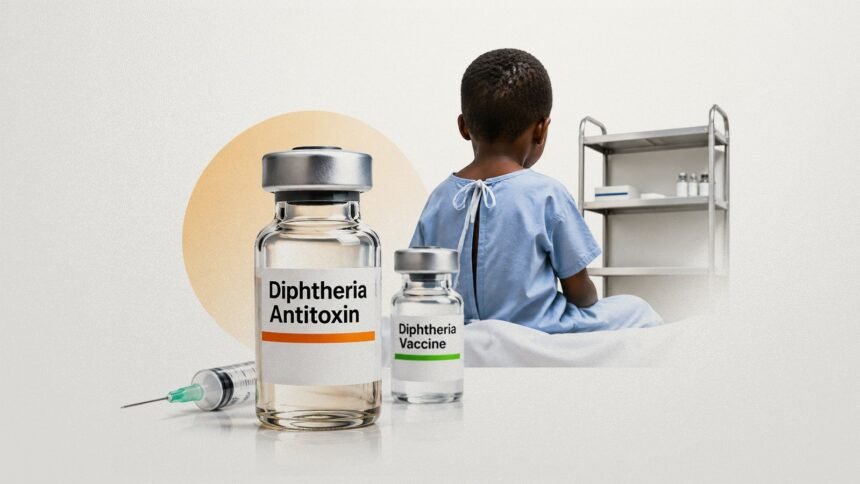
A disease that a vaccine can prevent should not need a scarce antidote. Yet that is the position northern Nigeria finds itself in. Médecins Sans Frontières (MSF) warned on Friday 13 November that shortages of diphtheria antitoxin, the only specific treatment that neutralizes the toxin the disease produces, together with low immunization coverage, are fuelling transmission and undermining efforts to control the outbreak, putting thousands of children at risk of severe illness and death.
“The global shortage of diphtheria antitoxin is becoming a matter of life and death,” said Dr David Kizito, MSF’s medical coordinator in Nigeria. “Our stocks are dangerously low, and we risk being unable to treat children and save lives as the outbreak continues.”
“Diphtheria is a preventable disease, yet children continue to arrive at health facilities with life-threatening complications because they are not fully vaccinated, or cannot access care in time,” he added.
How Big Is the Outbreak? Two Sets of Numbers
Nigeria has faced a major diphtheria outbreak since late 2022, and the figures depend on the date of the count. MSF’s statement, which relies on national data from 9 August, says the cumulative toll since the outbreak began has exceeded 41,000 suspected cases, more than 24,000 confirmed infections and over 1,260 deaths, and that in 2026 alone, up to 9 August, Nigeria recorded 12,977 suspected cases, 10,476 confirmed infections and 406 deaths.
A more recent situation report, issued on 11 November by the International Federation of Red Cross and Red Crescent Societies and the Nigerian Red Cross Society and citing data from the Nigeria Center for Disease Control and Prevention, gives far higher figures for this year: 37,529 suspected cases, 28,151 confirmed infections and 1,126 deaths in 2026 as of 7 November. Kano alone accounted for 12,008 confirmed cases, about 43% of the national total.
The two sets of numbers are not easy to reconcile, partly because they cover different periods. Both point the same way: a large and still-growing outbreak concentrated in the north, in Bauchi, Borno, Kaduna, Katsina, Kano, Plateau, Sokoto and Zamfara, with many areas seeing recent spikes.
Forty-Eight Hours to Act
The antitoxin problem is a matter of timing as well as supply. The medicine is most effective when given within 48 hours of the first symptoms, and it cannot reverse damage once the toxin has entered the body’s cells. It is on the World Health Organization’s Model List of Essential Medicines, yet global availability remains inconsistent. MSF says its teams repeatedly face situations where stocks are insufficient or unavailable, forcing them to ration treatment.
In Katsina State, MSF reported managing 86 diphtheria cases between 26 October and 12 November, 70 of them severe. Its teams reached 1,315 contacts through surveillance and tracing; 1,301 were vaccinated, and 1,311 received preventive antibiotics. MSF did not specify which facilities had run out of antitoxin, how many patients had been unable to get it, or whether the shortage directly caused any deaths.
Where the Vaccines Did Not Reach
The deeper failure is in prevention. Following Zamfara State’s outbreak declaration in September, MSF-supported facilities in Gusau recorded more than 671 admissions in the month from 6 October. Most patients were children, and four in five had not been vaccinated. For a reactive vaccination campaign in Zamfara, only 25,000 of the 90,000 doses needed have been supplied, leaving about three in four targeted children unreached.
In October, Muyi Aina, executive director of the National Primary Health Care Development Agency, said about 93% of children affected by recent outbreaks had not received their full recommended doses. Some had never been vaccinated, and others had received fewer than the three recommended doses. He pointed to misinformation and vaccine hesitancy as obstacles.
There are also signs of what works. MSF says it has treated more than 9,000 diphtheria patients this year. With the Kano State Ministry of Health, it supported two vaccination rounds in April and June that delivered more than 835,000 doses to children. In Sokoto, it supported two rounds between February and April that reached 49,018 children under 15. In Bauchi State, its intervention helped cut the case fatality rate from 8.7% to 1% after treating at least 1,890 suspected patients between August 2025 and May 2026.
Promises Made in August
In August, as the Federal Teaching Hospital in Katsina struggled with an influx of patients, the federal government announced an emergency multi-agency task force to strengthen surveillance, immunization and access to treatment in Katsina and Kano. It promised more antitoxin, antibiotics, staff and protective equipment for the hospital, and treatment annexes across Katsina’s three senatorial districts, Katsina, Daura and Funtua. MSF’s latest statement did not say whether those annexes are operating or how much additional antitoxin has arrived since.
MSF is now asking federal and state authorities, donors and international partners to secure existing supplies of antitoxin, vaccines and other essential medicines, to ensure timely clearance at ports of entry and rapid distribution, and to invest in routine immunization. It also calls on manufacturers and global health partners to expand antitoxin production for Nigeria and other countries facing rising case numbers.
Making the Medicines Africa Needs
Diphtheria exposes a dependence that runs through African health systems. When an essential medicine depends on limited global production and inconsistent supply, a country as large as Nigeria can find itself rationing doses for children. Health self-reliance means routine immunization that reaches every rural district, so that antitoxin becomes a rare last resort, and it means regional manufacturing and pooled procurement of the medicines that global markets neglect.
For the families in Gusau, Katsina and Kano, those debates are distant. What matters is whether a child who develops a sore throat and a thick membrane in the throat reaches a clinic that has both the antitoxin and the staff to give it within two days. Closing that gap is the measure by which the response will be judged.