



A Week That Began at Cantine-Aloya
“Some bodies are already in a state of decomposition. The victims were hacked to death with machetes, while others were shot.” That was how Gabriel Tonge, a local official in Mambasa territory, described what searchers were finding this week in the villages of Ituri province in the north-eastern Democratic Republic of Congo, as the count of the dead kept rising.
Between Monday 9 and Thursday 12 November, fighters of the Allied Democratic Forces (ADF), the armed group of Ugandan origin that pledged allegiance to the Islamic State group in 2019, attacked several villages in Mambasa. Security and humanitarian sources put the number of civilians killed at no fewer than 44. The toll is provisional and has not been confirmed by the army or the government. Several villages remain out of reach because the attackers are still reported in the area.
The raids came only days after the same group killed at least 66 civilians on the night of 5 to 6 November at Cantine-Aloya, in the Beni territory of neighboring North Kivu, about 100 kilometers away as the crow flies. Taken together, civil society counts put the number of people killed by the ADF in the region in a single week at no fewer than 110.
Counting the Dead in Villages Nobody Can Reach
The figures are still moving, and they differ. Civil society sources said that on Thursday alone at least six localities in the Bangole area were raided, leaving 14 dead, and that attacks on other villages in the Babila Babombi chiefdom killed about 30 more. One security source gave a total of at least 44 for the week, while a humanitarian source said 47 bodies had been found, and other local sources mentioned tolls of up to 49. Earlier counts on Friday had spoken of 35 dead and about 15 missing, and a midweek count had put the number at 22.
The spread reflects the conditions on the ground rather than a dispute between rival authorities. Searches for bodies are continuing, and a humanitarian source warned that ADF fighters were still in the bush and had set up ambushes. Until searchers can reach every village, any total is a floor, not a final figure.
Where the Virus Was First Found
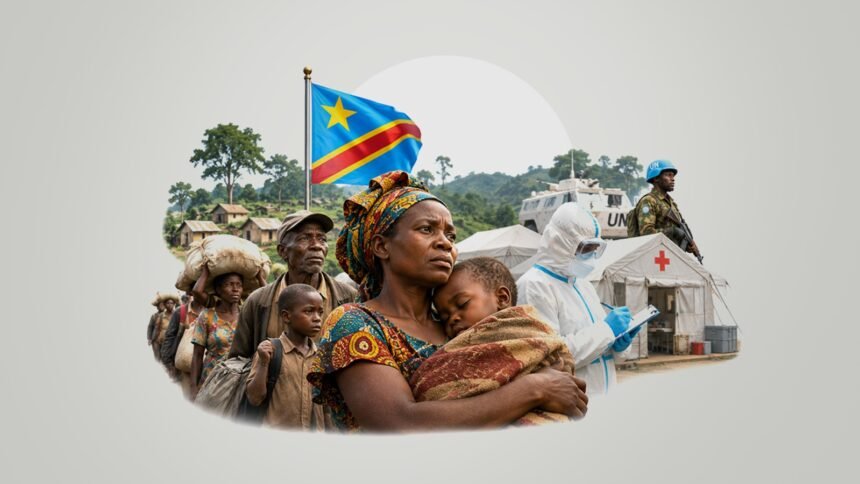
The geography makes the killings doubly dangerous. Mambasa is the territory where Congo’s current Ebola outbreak was first detected about six months ago. Since it was declared in May, the epidemic has become the worst in the country’s history, with more than 5,400 deaths, and it has spread across large parts of the east and north-east.
The Cantine-Aloya attack hit the response directly. Three health workers were among the dead and several medical facilities were burnt. The World Health Organization’s director-general, Tedros Adhanom Ghebreyesus, warned that the region’s chronic instability represented “one of the greatest obstacles to the Ebola response”. Africa CDC, the African Union’s public health agency, also condemned that attack.
Armed groups, including the ADF, have targeted health workers fighting the virus before. Every massacre empties villages, scatters families who may be carrying the infection, and makes contact tracing, vaccination and safe burials harder to organize in exactly the places where they are most needed.
Two Armies and a UN Mission, Still Not Enough
Congo and Uganda have both sent troops to fight the ADF, so far without decisive results. Maxime Tshishimbi, Mambasa’s assistant territorial administrator, said military operations were continuing on Friday in several parts of the territory, with the joint Congolese and Ugandan force keeping up pressure, supported by peacekeepers of the UN mission, MONUSCO, who have been deployed in the area for four months and have stepped up patrols.
He described a war against small, mobile groups, and said the south of the territory, around Biakato, was still seeing incursions. By his account, the ADF has killed hundreds of civilians and displaced thousands in Mambasa since the start of the year. No official toll for this week’s attacks has been published, and no claim of responsibility has been reported; the attribution to the ADF comes from local sources.
Not Only About Cocoa
Mambasa is cocoa country, and human rights defenders had warned on 2 and 5 November that armed men were moving into the territory to terrorize residents. Some observers link the violence to control of the land and its crops. A civil society leader, speaking anonymously, cautioned that this explanation is incomplete, pointing out that there have also been incursions in recent days into neighboring Haut-Uele province, where no cocoa is grown.
That matters for how the violence is answered. If the attacks were simply about a cash crop, security around plantations might blunt them. If they are part of a wider pattern of movement and terror across provincial lines, the response has to be regional and sustained, and it has to protect villages rather than only roads and towns.
Who Answers for Ituri
The deeper question is one of control over territory and over the protection of citizens. For more than 30 years, the east and north-east of Congo have been plagued by a long list of armed groups, and the state’s authority in many rural areas remains thin. When a group born outside Congo’s borders can kill more than 110 people in a week across two provinces, the burden falls not only on Kinshasa but on Kampala, on MONUSCO and on the African Union institutions that have spoken out.
Real self-determination in Ituri would mean villagers able to farm, trade and seek health care without fear, and health workers able to chase an epidemic without being targeted. Until the security response matches the scale of the killing, and until the dead in Bangole and Babila Babombi are counted, named, and their deaths investigated, the Ebola fight, and the fight for civilian safety will remain the same unfinished struggle.