





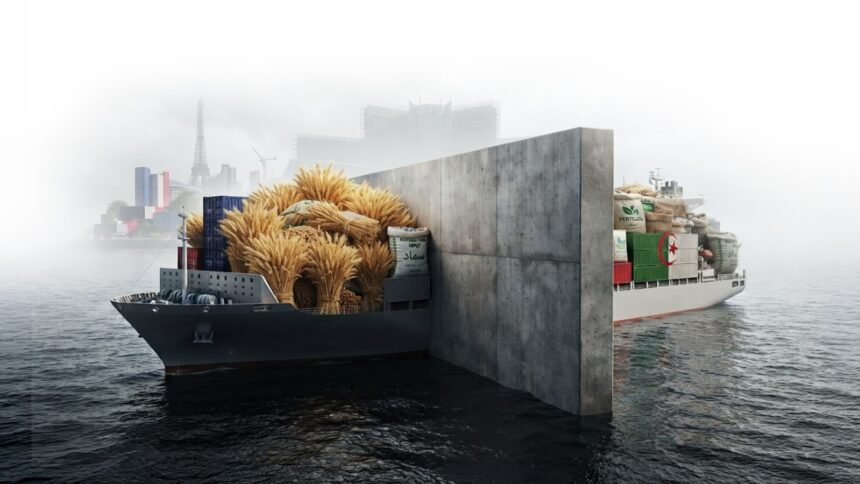
A Trade Fight Without a Single Published Ban
Here is the puzzle at the center of the latest dispute between Paris and Algiers: France says it is facing a near-total blockade of its goods, yet Algeria has never announced a ban on anything. There is no decree to challenge, no tariff schedule to cite, only tenders that French wheat never wins, import permits that do not arrive and fertilizer cargoes that have stopped sailing.
On Friday 13 November, France decided to stop treating this as a bilateral matter. Pascal Confavreux, spokesperson for the French foreign ministry, said Paris would ask the European Commission to examine Algeria’s failure to honor its Association Agreement with the European Union. The agreement “stipulates the possibility to take appropriate measures for the non-respect of commitments,” he told a news conference. “We ask the Commission to examine the conditions for their activation immediately.” He did not specify which commitments Algeria had broken.
The Association Agreement, in force since 2005, liberalized trade and dismantled tariffs between EU member states and Algeria. Because trade policy is an EU competence, France needs Brussels to act if it wants any remedy under it.
What Paris Says Algiers Has Done
The French case rests on curbs that have been described by diplomats and industry officials rather than announced. Diplomats said in October that Algiers had, in late July, imposed a near-blanket ban on French imports, and that officials had been instructed to suspend shipments of urea, the nitrogen fertilizer, to France. French fertilizer and wheat-grower associations warned that the halt could put at risk around 30% of France’s urea imports.
Grain has been affected for longer. Algeria, once the biggest overseas buyer of French wheat, has not imported any since July 2024, with French supplies repeatedly excluded from state tenders without a formal ban. A French diplomatic source said Paris made the formal request because the situation for French firms was worsening, and France’s Treasury held a meeting with several industries on 6 November to discuss the restrictions.
Algeria has not formally announced any of these measures, and several diplomats said Algiers had denied the curbs when French representatives raised them. Its embassy in Paris was not immediately available for comment on Friday. The allegations therefore remain France’s account, supported by diplomats and industry groups, and contested by Algeria’s denials.
Brussels Already Has a File
The Commission is not starting from nothing. In June 2025, it registered a trade barrier complaint alleging that Algeria had been blocking imports of French agricultural and food products since August 2024 by delaying or failing to issue the required import authorizations. The complaint, updated in March 2026, focuses on dairy, where French exporters struggle to obtain the sanitary waivers needed to sell milk and dairy goods, and it describes an approval process without clear deadlines that has been used to restrict trade.
French Foreign Minister Jean-Noël Barrot also raised the broader ban on French goods at a meeting of EU foreign ministers in October. What is new is the request that the Commission consider the agreement’s remedy clauses, a step that would move the dispute from complaint to possible countermeasures.
The Numbers Behind the Quarrel
Customs data show how far trade has already shrunk. French exports to Algeria fell about 12% to 4.2 billion euros in 2025 and were down by roughly the same proportion, year on year, in the first eight months of 2026. France’s imports from Algeria, mostly oil and gas, fell 18% to 5.1 billion euros last year and were down 11% from January to August.
The urea question comes at an awkward moment for French farmers. Nitrogen fertilizers are central to crop yields; costs were already high, and the war involving Iran has disrupted fertilizer supplies from the Gulf. Losing a supplier that provides close to a third of imports would add to that pressure.
Western Sahara, Memory and the Limits of Repair
The trade measures sit on top of a deep political rift. Relations, complicated for decades by the colonial past, deteriorated in 2024 when President Emmanuel Macron backed a plan for autonomy for Western Sahara under Moroccan sovereignty, siding with Morocco in its long dispute with Algeria over the territory. The two governments tried to repair ties last year and at one point declared relations back to normal, but they soured again.
Algeria last year passed a law describing French colonization as a “state crime”, which France called “manifestly hostile”. Several sources see the current curbs as an extension of the bilateral quarrel, noting that they target France rather than the EU as a whole, with which Algeria has its trade agreement.
Leverage and Its Price
For Algiers, informal trade pressure is a way of using economic weight in a political dispute without the legal exposure of a published ban. That is a form of leverage many states use, and it reflects a desire to set the terms of a relationship long shaped by Paris. But it carries costs. Taking the dispute to Brussels turns a bilateral grievance into a question about Algeria’s commitments to the whole European bloc.
For France, the move signals that it would rather share the fight with 26 other members than keep absorbing losses alone. The test for both is whether the Commission becomes a venue for de-escalation or a channel for retaliation. If farmers, dairy exporters and fertilizer users on both sides of the Mediterranean are to be spared, Algeria will need to put its trade policy on paper, and France will need to show that its complaint is about rules, not about history.