




Two Resource Economies Looking for Each Other
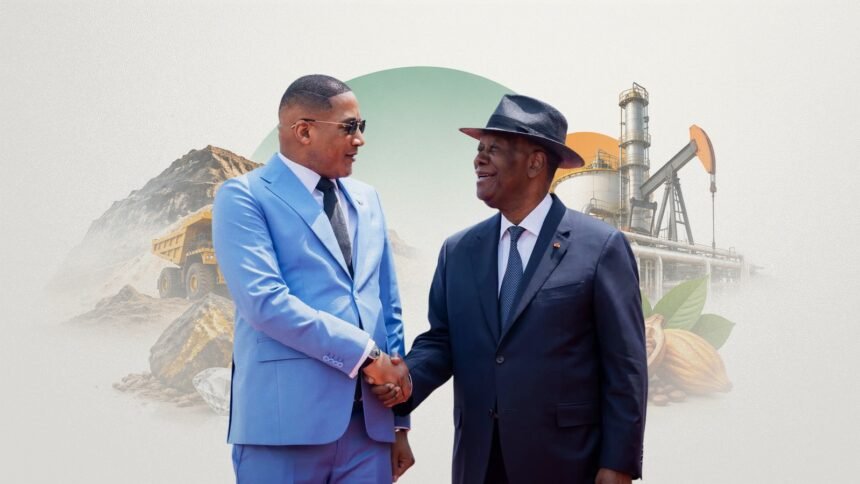
Neighbors trade because they must; distant partners trade only when someone decides they should. Botswana and Côte d’Ivoire sit thousands of kilometers apart, on opposite sides of the continent, and their presidents admit that commerce between them is far below what it could be. On Monday, 16 November, they set out to change that, signing seven cooperation agreements at the presidential palace in Abidjan during a state visit by Botswana’s President Duma Boko.
“This state visit therefore holds particular significance, as it will help to increase overall exchanges, which in no way reflect the potential of our economies,” said Ivorian President Alassane Ouattara, who described the talks as fruitful. Boko, accompanied by a delegation of about 60 business leaders, is in Côte d’Ivoire until 18 November.
What Was Signed
The package contains four intergovernmental agreements and three sectoral deals between state companies. On the government side, the two countries signed a framework cooperation agreement to give their relations a legal basis and institutional mechanisms, a memorandum on regular political consultations on bilateral and multilateral issues, a reciprocal visa exemption for holders of diplomatic and service passports, and a memorandum on technical cooperation in animal and fisheries resources.
The sectoral deals go to the heart of both economies. Côte d’Ivoire’s mining development company, SODEMI, signed a mining cooperation framework with its Botswanan counterpart, covering exchanges of experience and skills on critical and strategic minerals and the transfer of expertise through services. The national oil company PETROCI signed a memorandum with Botswana Oil Limited on exploration and production, strategic energy infrastructure and joint investment. A third agreement links the Ivorian refiner SIR with Botswana Oil Limited on energy development and related infrastructure.
The deals build on a first protocol on mines and energy signed on 30 July, which provided for exchanges on geological research, exploration, diamonds, gold, critical minerals, governance of the sector and training.
Diamonds Meet a New Mining Frontier
The logic of the partnership is a swap of experience. Diamond mining has been central to Botswana’s economy for decades and accounts for some 30 percent of its GDP, and the country also produces copper, gold, coal, nickel and soda ash. “Botswana brings its extractive expertise and its stewardship capabilities over mineral resources,” Boko said.
Côte d’Ivoire, better known for cocoa, is in the middle of an extraction boom, with discoveries of oil and gas as well as coltan, gold and manganese, and it wants mining to play a larger role in its economy. Ouattara invited Botswanan companies to invest in mining, oil, energy and the infrastructure planned under the country’s 2026-2030 National Development Plan. Boko, for his part, pointed to agro-industry linked to Ivorian cocoa and cashew nuts as an area for joint projects. Ivorian authorities are seeking more private capital in priority sectors to process raw materials locally.
The visit continued on Tuesday with a business forum in Abidjan held under the auspices of the General Confederation of Enterprises of Côte d’Ivoire. On Wednesday, Botswana is the guest country at the opening of the second International Extractive and Energy Resources Fair at the Abidjan Exhibition Center.
A Case for Trading With Each Other
Boko used the visit to make a broader argument: that African countries can shield themselves from global shocks by trading more with one another. “We need to harmonize our trade regimes; we need to harmonize our laws and practices so that we don’t impose unnecessary barriers to trade and commerce,” he said. Removing those barriers, he argued, would “immunize us a great deal from the exogenous shocks that we suffer… when there is war between Ukraine, Russia, crisis in Iran and other parts.”
The argument is familiar, and so is the gap between words and practice. The African Continental Free Trade Area officially came into force in 2021, but an Africa where goods and people move freely between countries remains a distant prospect. A visa waiver limited to diplomatic and service passports, for example, will help officials travel but does little for traders.
What Could Go Wrong
Memoranda of understanding are easy to sign and hard to turn into business. Cooperation frameworks between distant partners can easily stay on paper when transport links, financing and rules do not line up. The real test of the Abidjan agreements will be whether SODEMI and PETROCI projects with Botswanan partners appear in the coming years, whether the business forum produces signed contracts, and whether Botswana’s experience in managing its mineral resources actually transfers.
There is also a question of balance. Botswana arrives as a country that relies heavily on a single mineral. Côte d’Ivoire is building a new extractive sector. Both will need to make sure that cooperation means shared skills and local processing, not simply a new channel for exporting raw materials.
Owning the Value of the Ground
The most interesting thing about the visit is who is advising whom. African mineral producers have often learned the business from foreign companies and foreign consultants. Here, an African state that has built its economy on diamonds for decades is offering that experience to another African state at the start of its own mining boom.
If the partnership works, it could become a model of resource cooperation in which African countries share know-how on contracts, governance and local value addition, so that more of the wealth under their soil stays with their citizens. That is the kind of control over natural resources that summit speeches often promise. Boko and Ouattara have signed the papers; the measure of success will be trade figures that finally begin to reflect the potential both leaders say they see.