





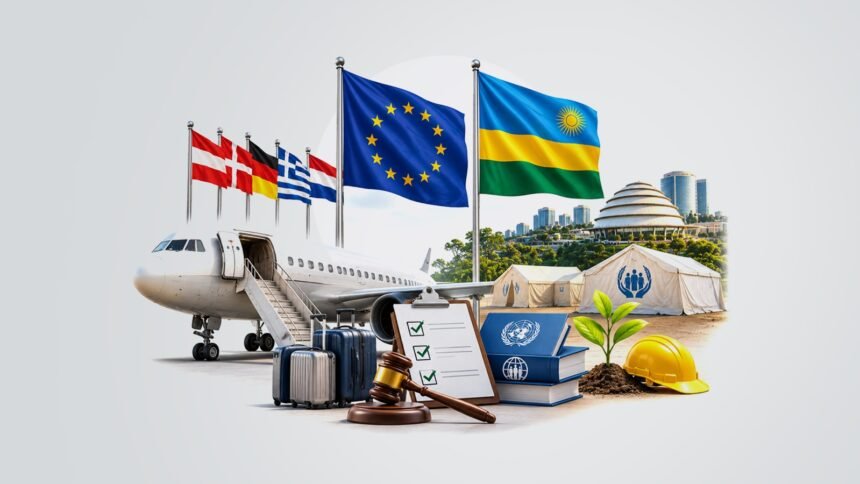
Five European governments seek new ways to return migrants who have no legal right to remain in their territories, and Rwanda has agreed to explore a partnership that could see it receive people transferred from European Union member states from 2027.
The proposed arrangement, involving Austria, Denmark, Germany, Greece and the Netherlands, reflects a broader shift in European migration policy towards cooperation with countries outside the continent to manage migration and enforce return decisions.
Announced in Vienna, Austria, on November 16, the partnership would establish a migrant return hub in Rwanda. However, the operational details are still under negotiation, meaning the announcement does not amount to a fully operational agreement.
For Africa, the development raises wider questions about the role of African countries in international migration management, the sharing of responsibility between wealthier and developing nations, and the protection of migrants transferred across borders.
Who Would be Transferred to Rwanda?
The proposed arrangement is not intended to cover every migrant, refugee or asylum seeker living in Europe.
It would apply to people in the five participating EU countries who have no legal right to remain and are subject to enforceable return or removal decisions. Under the terms outlined by the governments, those transferred must not need international protection or have another legal basis to stay in the participating countries.
In practical terms, the arrangement is intended for people who have gone through the relevant legal procedures and are no longer entitled to remain in those European countries, but whose return to their countries of origin has not been completed.
This distinction is important because refugees and people who qualify for international protection are not meant to be transferred under the proposed model.
What Happens to People Transferred to Rwanda?
Those received in Rwanda would have three possible options: integrate into Rwandan society, return voluntarily to their countries of origin, or move to another country where they have the legal right to reside.
Rwanda’s Minister of Interior, Vincent Biruta, said those who choose to remain would be supported through skills development and employment programs to help them become part of local communities.
“These people who choose to stay in our country, to live in our country, will be integrated into our communities. And of course we work on a development program to give them skills. They will need to be able to work,” he said.
The government has also indicated that the programs could benefit Rwandan communities through broader development initiatives.
The five European countries are expected to meet the costs associated with receiving and supporting the migrants. However, the detailed financing arrangements and the full operational framework are yet to be made public.
Why is Rwanda Involved?
Rwanda has presented its experience in receiving displaced people as part of the basis for the partnership.
One example is the Emergency Transit Mechanism (ETM), established in September 2019 through cooperation between Rwanda, the African Union and the United Nations refugee agency, UNHCR.
The mechanism was created to evacuate vulnerable refugees and asylum seekers stranded in Libya and provide them with temporary protection while longer-term solutions, including resettlement, are pursued.
According to Biruta, Rwanda has received more than 3,000 people through the mechanism, many of whom have subsequently been resettled in countries including Canada, the United States, Germany and Finland.
However, the ETM and the proposed return hub serve different purposes. The former protects vulnerable people evacuated from Libya. At the same time, the new arrangement would receive people who no longer have a legal right to remain in the participating European countries.
Rwanda’s participation also forms part of what the governments describe as a broader partnership covering migration and other areas of common interest, rather than a migration arrangement alone.
What Role will International Organizations Play?
The International Organization for Migration (IOM) and UNHCR are engaging with the countries involved, but their roles should not be confused with responsibility for implementing the arrangement.
IOM has said it can support the proposed process in principle, provided its mandate and international standards can be upheld. Its potential assistance would begin after people arrive in Rwanda and could include healthcare, mental health and psychosocial support, information, counseling and referrals to protection services.
The organization has also made clear that it does not participate in forced removals, detention, law enforcement or security functions.
UNHCR, meanwhile, is providing advice on compliance with international refugee and human rights law, with particular attention to protecting asylum systems and ensuring that people who need international protection are not wrongly transferred.
The UN refugee agency’s involvement does not mean it has agreed to implement the return hub.
The European Commission has also followed the preparatory discussions as an observer, with the countries saying the arrangement must comply with applicable European, Rwandan and international law.
A Wider Debate About Europe’s Migration Policies
The proposed partnership comes amid growing efforts by European governments to increase returns and explore arrangements that would allow people without the right to remain in Europe to be transferred to countries outside the bloc.
If implemented, Rwanda’s proposed hub would mark a significant development in this approach, extending Europe’s migration management arrangements beyond its own borders.
The model also brings renewed attention to questions of responsibility. While European governments argue that such partnerships can make return decisions more effective and discourage irregular migration, critics question whether transferring people to countries with which they may have no personal or family ties offers a lasting solution.
The European Council on Refugees and Exiles (ECRE), a network of organizations working on refugee protection, has criticized the proposal, warning that it could expose migrants to human rights risks and shift responsibility for their treatment beyond Europe’s borders.
The United Nations has also stressed the importance of fair asylum procedures, respect for refugee and human rights law, and continued international responsibility-sharing.
UN High Commissioner for Refugees Barham Salih, who participated in the Vienna discussions, emphasized that people who need international protection must continue to receive it and that any return arrangements must be humane and legally sound.
These concerns are particularly relevant because the people transferred may have no established connections, family networks or support systems in Rwanda. Their legal status, access to services and long-term prospects will therefore be important issues as the countries negotiate the arrangement.
The partnership also differs from the United Kingdom’s earlier plan to send asylum seekers to Rwanda while their claims were processed in the UK. That arrangement was ruled unlawful by the UK Supreme Court in 2023 and was later abandoned. Under the new proposal, asylum claims are not intended to be processed in Rwanda.
What Happens Next?
The six governments intend to move forward through further negotiations to establish how the return hub will operate, including the arrangements for receiving migrants, supporting those who choose to stay and facilitating voluntary returns.
The aim is to reach an arrangement and begin the first transfers in 2027.
Until those details are finalized, important questions remain about the hub’s capacity, accommodation, legal safeguards, oversight and how long people may remain in Rwanda if they cannot return to their countries of origin or secure residence elsewhere.
For Rwanda, the partnership presents an opportunity to deepen cooperation with European countries on migration and other areas of mutual interest. For the wider African continent, it adds to an important debate over how migration responsibilities are shared between countries of origin, transit and destination.
Ultimately, the success of the proposed arrangement will depend not only on whether transfers take place, but also on whether the rights, safety and long-term welfare of the people concerned are protected.