



A Front on the Ethiopian Border Reaches the State Capital
Fifteen, sixteen, seventeen or nineteen: on Wednesday, the number of people killed by drones in Sudan’s Blue Nile state the night before depended on who was counting. Each figure stands for families in Ed Damazin, the state capital, and in El Roseires, the dam town to its south, two places that had taken in people fleeing fighting elsewhere in the state. Within hours, the strikes had also fed into a diplomatic quarrel over who could ever host talks to end Sudan’s war.
Blue Nile sits in Sudan’s south-east, bordering South Sudan and Ethiopia. Since the war between the Sudanese Armed Forces and the paramilitary Rapid Support Forces (RSF) began in April 2023, the state has been a secondary front. It is now moving closer to the center of the conflict, and its geography makes it a test of how a domestic war spills into, and is shaped by, a contested regional border.
What Happened on Tuesday Night
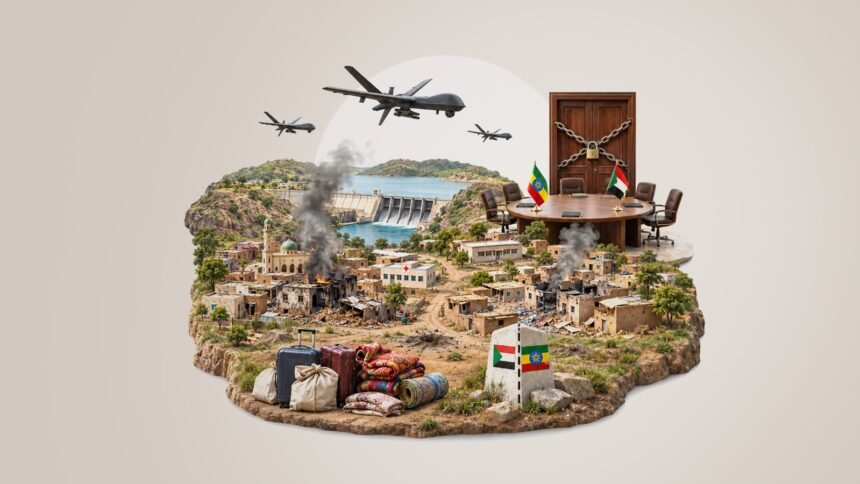
Drones struck Ed Damazin and El Roseires on Tuesday evening. The Blue Nile Civil Society Initiative, a local group, said more than 40 suicide drones were used. In Ed Damazin, strikes hit the El Matar, Rayih Balak and El Saliha neighborhoods, setting homes on fire, and also targeted the headquarters of the army’s 4th Infantry Division. The initiative said 14 members of three families were killed when drones hit a residential area in El Saliha, west of the city. In El Roseires, strikes hit a public viewing hall known as the Okasha Club and nearby homes, and a soldier was also reportedly killed.
The Sudanese rights group Emergency Lawyers said drones had earlier that day targeted the Roseires dam and power facilities, wounding five civilians, and warned that the attacks could disrupt electricity across Blue Nile and damage the national grid. Residents who witnessed the attacks confirmed that drone strikes had taken place.
A Toll That Kept Changing
The casualty figures differ and should be read side by side rather than as one settled number. The Blue Nile Civil Society Initiative first reported 15 dead and 15 injured, then revised its count to 17 dead and 20 injured. The Blue Nile government spokesperson, Saif El Nasr Minallah, put the toll at 16 dead, including seven women and two children, with 22 injured. Emergency Lawyers said 19 civilians, including six women, were killed in Ed Damazin, where drones struck three residential neighborhoods, and that a total of 20 people were wounded across the two cities. The differences may reflect timing, the areas each group covered and whether soldiers were counted; none of the groups has explained the gaps.
Responsibility is also stated by the accusers rather than established. Emergency Lawyers attributed the strikes to the RSF, which did not immediately respond to a request for comment. The civil society initiative blamed both the RSF and its ally, the Sudan People’s Liberation Movement-North (SPLM-N), and called for an investigation and accountability.
Curfew and a Closing Front
The state authorities imposed a curfew from 22:00 to 05:00 and banned motorcycles except those used by authorized security personnel. The measures reflect fear of further attacks. RSF and SPLM-N forces have advanced around Sodari locality, Kurmuk, Geissan locality and Wad El Mahi, raising concern that Ed Damazin itself could be targeted again. The RSF said in August that it had captured Geissan, part of a front that runs along the Ethiopian border. Both Ed Damazin and El Roseires had absorbed people displaced from Bau and Geissan, so the strikes hit communities that had already fled once.
Ethiopia’s Offer and Khartoum’s Answer
The strikes came as Sudan’s government rejected an offer by Ethiopian Prime Minister Abiy Ahmed to host and facilitate an inclusive Sudanese dialogue. Abiy announced on Tuesday that Ethiopia was ready to bring together Sudan’s military, political and civilian forces, said it would keep an equal distance from all parties, and pointed to Ethiopia’s role in bringing Sudanese military and civilian leaders together in 2019.
In a statement, the government said Ethiopia lacked the neutrality to host talks, accusing it of supporting the RSF, particularly on the Blue Nile front, and of allowing drones to be launched from its territory to attack Sudan. Ethiopia denies the allegations. Khartoum called for an independent investigation and urged the African Union and international partners to exclude Ethiopia from any mediation, insisting that Sudanese parties decide the venue, agenda and facilitators by consensus. The RSF-aligned Sudan Founding Alliance (TASIS) and the civilian coalition Sumoud both welcomed Abiy’s proposal. A TASIS minister, El Basha Tebeig, accused Egypt of influencing the government’s rejection. Sumoud leader Shehab Ibrahim said the rejection was expected, given disagreements over implementation and guarantees and leaders’ fear that multiple negotiating platforms let the other side regroup.
Who Decides Where Sudan Makes Peace
Blue Nile shows how Sudan’s war is being regionalized: a border front, contested accusations about where drones are launched, and a neighbor’s mediation offer rejected on grounds of bias. Sudanese control over their own peace process is the principle every side invokes, yet it now depends on neighbors keeping their territory out of the fight and on mediators all parties can accept. For the families of El Saliha, the more immediate questions are simpler: an independent count of their dead, an inquiry into who sent the drones, and protection for towns that were supposed to be places of refuge.