





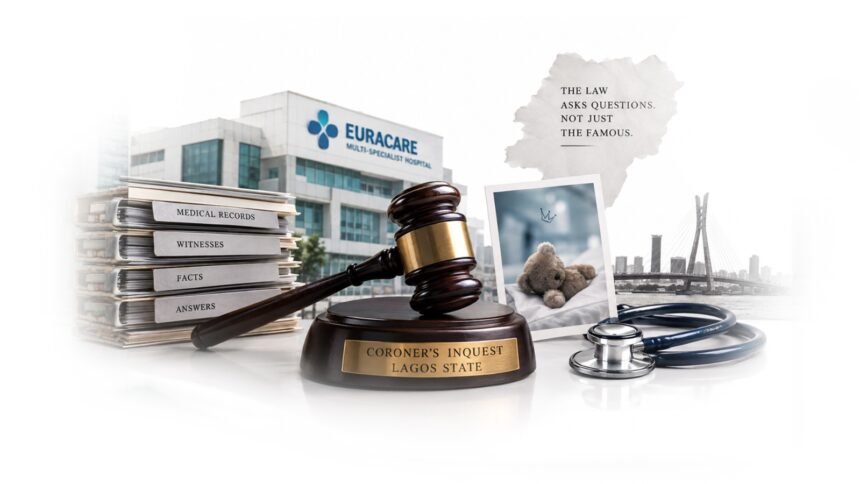
Medical Accountability, Coroners’ Law and the Right to Answers
A coroner’s inquest is not a trial. Justice Aishat Opesanwo said so plainly in Lagos on Monday, then struck out the hospital’s attempt to stop one. Eurapharma Care Services Nigeria Limited, which operates Euracare Multi-Specialist Hospital, had asked the High Court to halt the coroner’s inquiry into the death of Nkanu Esege, the young son of author Chimamanda Ngozi Adichie and Dr Ivara Esege. The judge dismissed the application, upheld preliminary objections by the respondents, and cleared the inquest to proceed.
Nkanu, aged 21 months, died on 7 January 2026 after medical procedures at Euracare in Lagos. The Lagos State Government opened a coroner’s process. The hospital then sought judicial review, arguing among other things that cremation of the body deprived the coroner of jurisdiction and that the planned order of evidence violated fair hearing. Adichie and Esege had asked the court to dismiss that suit.
What the Law Compels
Justice Opesanwo relied on Section 15 of the Coroners System Law of Lagos State, 2007, which requires an inquest when a death within the coroner’s district results from specified circumstances, including deaths linked to medical facilities under the statute’s terms. “The provision gives no room for exercise of discretion in the decision to conduct an inquest once a death results from any one of the nine situations specified,” she held. She also distinguished Section 20, which concerns bodies found in a district, from Section 15, which concerns deaths occurring there. Neither section, she said, requires the body to remain in the district on the day of the inquest.
Cremation Does Not End Jurisdiction
Counsel for the hospital argued that without the corpse a post-mortem was impossible and the inquiry would rest on speculation. The judge was unpersuaded. Jurisdiction arose from the statutory conditions of the reported death, she held, and was not extinguished by later cremation. Concerns about the eventual findings were, in her words, about “future occurrences” rather than a completed decision ready for quashing. “It is not a trial; no one is on trial in a coroner’s court,” she said, describing the process as inquisitorial fact-finding meant to establish who died and how, when and where.
Fair Hearing Inside an Inquiry
The hospital also objected to receiving evidence from its medical personnel before hearing what other parties would say, calling that a breach of Section 36 of the 1999 Constitution. The court held that a coroner has discretion over the sequence of statements and evidence, guided by principle but not identical to the adversarial order of a criminal trial. Disagreement with the chosen sequence did not, by itself, prove a fair-hearing breach. The judge found the application rooted in apprehension and a misunderstanding of how coroners’ courts work.
Why This Matters Beyond One Family
High-profile medical deaths often stall in a fog of procedure. Monday’s ruling says that fog is not a shield. Families seeking answers, and hospitals defending their practice, both remain subject to a statutory inquiry whose job is facts, not verdicts of guilt. That distinction protects due process while refusing to let the absence of a body, or anxiety about publicity, cancel the law’s duty to ask what happened.
Public Trust in Private Hospitals
Lagos is a dense market of private specialty hospitals serving patients who can pay for advanced care. When a child dies after procedures in that system, the demand for a public, statutory account is not celebrity culture; it is the same demand any family should be able to make. By refusing to let cremation or sequencing disputes cancel the inquest, the High Court kept that channel open. Hospitals that fear unfair process still have remedies inside the inquest and on appeal from any ultimate finding; what they cannot do, after Monday, is stop the asking.
Answers Still Ahead
The ruling does not find negligence and does not decide professional responsibility. Those questions, if they arise, belong to the inquest and to any separate legal or regulatory tracks. What it does decide is that the coroner may continue. For Nigerian patients and practitioners alike, that is a signal: medical accountability through the coronial process is not optional theatre. It is a legal obligation once the statutory conditions are met.