




Post-Election Bargaining, A Woman Tasked to Form a Government and a Majority Locked In
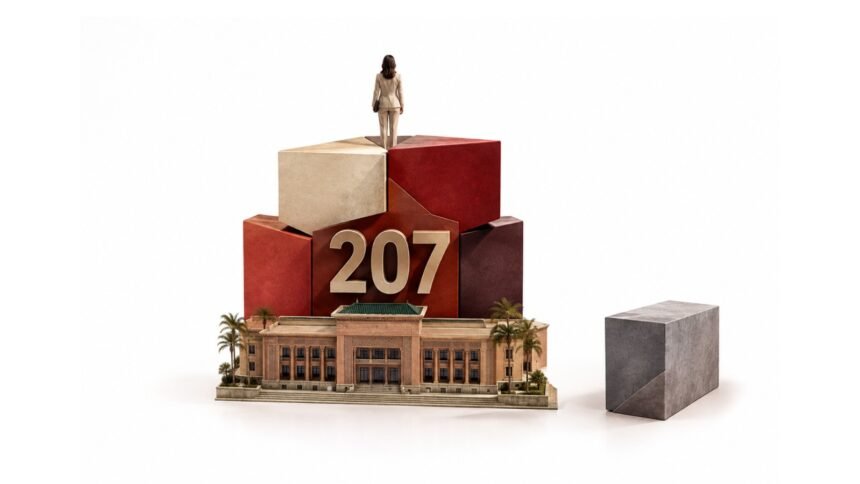
How do you turn an election win into a working majority? In Rabat, the Authenticity and Modernity Party has answered with arithmetic. After a second round of talks, PAM announced on Monday a governing coalition with the Istiqlal Party, the Socialist Union of Popular Forces and the Party of Progress and Socialism. Together, the four parties hold 207 seats in the 395-member House of Representatives, above the 198 needed for a majority. PAM holds 97, Istiqlal 65, USFP 26 and PPS 19.
King Mohammed VI tasked PAM leader Fatima Ezzahra El Mansouri with forming a government on 29 September after her party came first in the 23 September parliamentary elections. The National Rally of Independents, which led the outgoing government and finished second with 66 seats, is not in the new coalition. The partners said they would propose ministerial candidates and draw up a government program as soon as possible.
A Majority Without the Incumbent Bloc
Leaving the RNI outside the deal is the political signal of the week. Election winners often absorb parts of the outgoing majority for continuity. PAM chose a different map: a four-party bloc large enough to govern without the previous lead party. That may simplify messaging for El Mansouri’s mandate; it may also sharpen opposition from experienced ministers now on the outside. The seat count, however, is unambiguous. Two hundred and seven is a working majority if the partners hold.
What Coalition Government Demands
North African politics has long experience with multi-party cabinets that look solid on paper and fray over portfolios, budgets and regional patronage. The joint statement’s promise to name ministers and write a program quickly is the first test. Disputes over who gets finance, interior, foreign affairs and the social portfolios will show whether 207 seats are a coalition or four parallel parties sharing a corridor.
A Continental Lens on Women’s Executive Power
El Mansouri’s designation fits a wider African conversation about women in top executive roles, still rare as heads of government, more common as party leaders or ministers. Her task is not symbolic. It is to assemble a cabinet that can pass laws and survive Morocco’s institutional balance between the palace, parliament and parties. Success will be measured in legislative output and public services, not in the novelty of the appointment alone.
Policy Before Personalities
Voters who backed PAM will look for delivery on the campaign themes that travel across Maghreb politics: jobs, water stress, living costs, education and local administration. A coalition that spends its first months on spoils rather than a program will waste the majority it just built. A coalition that publishes clear priorities and sticks to them will set a higher bar for opposition parties still counting their seats.
North Africa’s Coalition Season
Across the Maghreb, election nights increasingly give way to multi-week coalition seasons in which seat maths matter more than campaign slogans. Morocco’s 207-seat bloc mirrors that trend while carrying a distinctive twist: the previous governing lead party is outside. That can produce clearer lines of accountability if the new cabinet owns its program, or sharper instability if Istiqlal, USFP and PPS each treat PAM’s lead as temporary. El Mansouri’s first cabinet list will reveal which path Rabat has chosen.
Regional neighbors will watch for continuity on trade, energy interconnectors and migration cooperation with Europe. Abrupt policy swings are unlikely overnight; personnel swings are not. For citizens, the measure will be simpler: whether prices, water access and public services move in the direction the campaign promised.
The Work Begins After the Statement
Monday’s announcement ends the suspense over whether PAM could find partners. It begins the harder work of governing. Morocco’s next months will show whether 207 seats produce a stable cabinet under El Mansouri or a bargaining loop that returns the country to caretaker politics. The numbers favor the former. History suggests only discipline will secure it.