





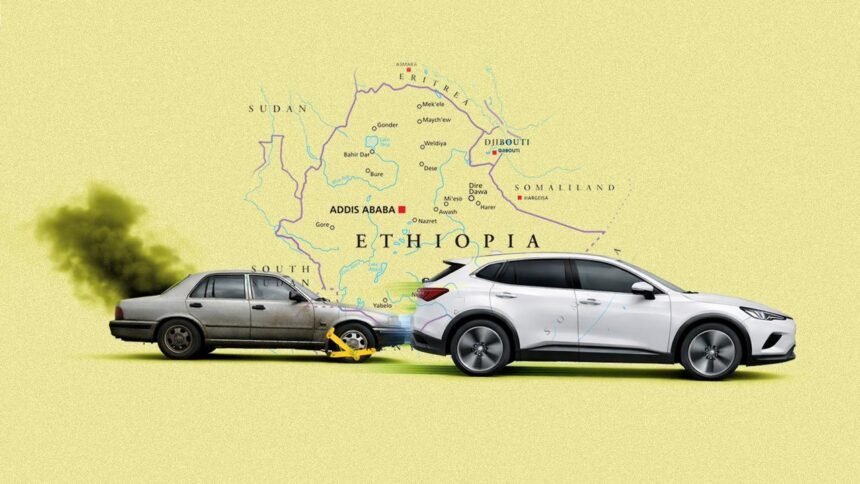
In early 2024, Ethiopia did something governments in far richer countries are still only debating: it stopped allowing new petrol and diesel cars across its borders. The Ministry of Transport and Logistics issued a directive banning the import of combustion‑engine vehicles, pushing the market towards electric alternatives in what experts describe as a world‑first national policy.
Less than two years later, more than 100,000 electric vehicles (EVs) are on Ethiopian roads, and the government has moved to extend the ban to diesel and gasoline trucks as well, signalling that the shift away from fossil‑fuelled transport is meant to be structural, not symbolic.
For a low‑income country grappling with debt, conflict, and inflation, the move is as much about economic survival as it is about climate ambition. Fuel imports have been estimated at between 4.5 and 7 billion dollars a year, a huge burden for an economy struggling with foreign‑exchange shortages.
“The decree is primarily intended to help us rationalize our foreign currency expenditure,” explained Yizengaw Yitayih, a senior climate expert at the ministry, after the ban took effect.
By cutting off new imports of internal combustion engines (ICEs) and steering drivers toward EVs, officials hope to curb fuel demand, ease pressure on the balance of payments, and redirect scarce dollars into power generation and infrastructure rather than petrol. Ethiopia’s energy system makes this gamble unusually plausible. The national grid is dominated by hydropower, with dams providing the bulk of its electricity, and the Grand Ethiopian Renaissance Dam is rapidly boosting capacity.
In climate terms, that means each new electric car or minibus is, in principle, running on renewable energy rather than on coal‑heavy power, as is often the case in Europe or Asia. Transport sits at the heart of the country’s Climate‑Resilient Green Economy strategy and its updated climate pledges under the Paris Agreement, which aim for near‑carbon‑neutral growth around 2030.
The core policy is striking in its simplicity. In January 2024, authorities banned the import of all gasoline and diesel cars, making Ethiopia the first country in the world to impose a blanket prohibition of this kind. In October 2025, they expanded the measure to include gasoline and diesel trucks, further narrowing the space for new ICE vehicles and forcing logistics and freight operators to seek alternatives. To make electric options viable, officials rewrote the tax system to favor vehicles.
Under the 2025 import guidelines, fully assembled EVs face customs duties of about 15%, semi‑knocked‑down units about 5%, and completely knocked‑down kits for local assembly are effectively exempt from customs duty. EV imports also benefit from generous exemptions from value‑added tax, excise tax, and surtax, whereas conventional vehicles remain subject to multiple layers of taxation.
Industry observers say the reforms have cut EV prices by around half compared with the pre‑reform period, transforming them from luxury curiosities into realistic options for fleet operators and wealthier urban households. The electric vehicle import mandate and ICE ban are explicitly linked to Ethiopia’s nationally determined contribution and to its Climate‑Resilient Green Economy plan.
The Ministry of Transport and Logistics has publicly set an ambition to see at least 500,000 EVs on the road within the next decade, alongside a major expansion of electric buses for urban and inter‑city routes.
Behind the sweeping policy lies a basic macroeconomic calculation. Ethiopia imports almost all its refined fuel, leaving it acutely exposed to global price spikes and a stronger dollar. Recent analyses by officials and independent outlets estimate that fuel imports cost around 4–4.5 billion dollars a year, a heavy burden for an economy already struggling with foreign‑exchange shortages.
By halting the inflow of new ICE vehicles now, the government aims to slow the growth of that bill and, as EV uptake rises, eventually secure fuel‑import savings of billions of dollars. At street level, the numbers are equally persuasive: electricity tariffs in Ethiopia remain very low by global standards, at roughly a few US cents per kilowatt‑hour for many users.
Studies and media reports indicate that, once fuel and maintenance are factored in, electric taxis and minibuses in Ethiopia can be roughly 50–70% cheaper to operate than petrol or diesel vehicles, particularly for high‑mileage operators in cities such as Addis Ababa. For drivers and fleet owners, lower running costs and tax breaks at purchase create a strong financial case for switching. Environmental arguments, though, are not an afterthought.
In Addis Ababa and other rapidly growing cities, vehicle emissions are a major contributor to respiratory disease. Shifting to electric mobility offers a path to cleaner air without constraining movement, and the policy also aligns with the African Union’s Agenda 2063, which calls for greener, more sustainable growth and infrastructure.
Because Ethiopia’s grid is already heavily renewable, the emissions reductions per electric vehicle are larger than in many industrialised countries. Few expected the market to adapt as quickly as it has. From fewer than 1,000 EVs in 2023, Ethiopia has surpassed 100,000 EVs on its roads, according to the Ministry of Transport and Logistics, a figure corroborated by industry reports.
That gives EVs an estimated 6–8% share of the national vehicle fleet, already higher than the global average of around 4%. Chinese automakers have moved fastest to fill the vacuum left by petrol and diesel models.
Reporting from Bloomberg and regional outlets highlights the dominance of Chinese brands, including BYD and several others, in showrooms, often at prices significantly below European or Japanese equivalents, mirroring a broader African trend in which Chinese manufacturers view the continent as a key growth market for electric cars and buses.
Local firms are not standing still. Dodai, a mobility start‑up, is assembling electric two‑wheelers and small vehicles in Ethiopia and building charging and service networks tailored to delivery riders and urban commuters. At the same time, BKG Manufacturing and other businesses have reportedly shifted resources away from conventional vehicles and towards EVs, maintaining ICE capacity only in segments where electric options remain limited.
Together, these moves are beginning to create new employment in assembly plants, maintenance workshops, charging infrastructure, and software services. When the ban was first announced, Ethiopia had only one public charging station nationwide, a detail widely cited abroad as a sign of how audacious the policy was. Today, there are just over 100 public charging points, mostly in Addis Ababa and a few larger towns, and the government’s national e‑mobility strategy maps out a network of more than 2,200–2,300 public charging sites across the country, with fast‑charging stations planned every 50 to 120 kilometres along major corridors
across the country, with stations every 50 to 120 kilometres along major corridors. The progress is real, but so are the constraints.
Electricity access and reliability remain serious obstacles: recent assessments suggest that just over half the population has grid access, with rural households especially underserved, and businesses report power cuts several times a month, often lasting hours, which undermines confidence in relying on the grid for something as essential as transport.
A hundred or so charging stations cannot meet the needs of a vast, mostly rural country. Until the planned network materialises, range anxiety will continue to restrain potential buyers outside a few urban centres.
Even with duty cuts and tax exemptions, most imported EVs still sell for tens of thousands of dollars, putting them out of reach for most households and concentrating early adoption among fleet operators and relatively affluent individuals. At the same time, a shortage of trained mechanics and limited spare parts supply adds operational risk.
Commentators have also warned that petrol and diesel vehicles can still slip into the country via porous borders, creating a potential black market that could undermine the policy. Although authorities have tightened customs controls and launched public awareness campaigns, high EV prices and patchy charging infrastructure keep the incentives for smuggling strong.
Officials like Yizengaw Yitayih argue that international finance and technology will be decisive, calling for concessional loans and grants to build out charging infrastructure, strengthen the grid, and train technicians, and presenting Ethiopia’s transition as both a national project and a potential model for other countries, if it can be backed at scale.
Ethiopia’s experiment is already shaping debates across the Global South about how to decarbonise transport under severe fiscal and infrastructural constraints. Analysts note that the country has effectively leapfrogged the intermediate stage of mass ICE motorisation, choosing to lock in a cleaner technology pathway from the outset, and argue that its experience suggests an EV market can be built not only with subsidies and pilots, but through firm regulation, targeted tax policy, and strategic use of domestic renewable energy.
Whether that message endures will depend on what happens next: Ethiopia must stabilise its power system, reduce EV purchase costs, contain smuggling, and ensure that cleaner, cheaper mobility does not remain an urban privilege.
Yet early evidence, in booming sales, emerging local industry, and tangible fuel‑cost savings for high‑mileage drivers, suggests the policy is more than a headline‑grabbing gesture.
As governments in Europe, North America, and Asia continue to argue over 2030 and 2035 phase‑out dates for combustion engines, Ethiopia has already crossed that line in practice. Its streets, increasingly filled with quiet electric taxis, buses, and delivery vehicles, hint at a future in which leadership on clean transport does not automatically belong to the world’s richest countries, but to those prepared to move first.


