





The Pan-African Paradigm of Judicial Sovereignty and Public Order
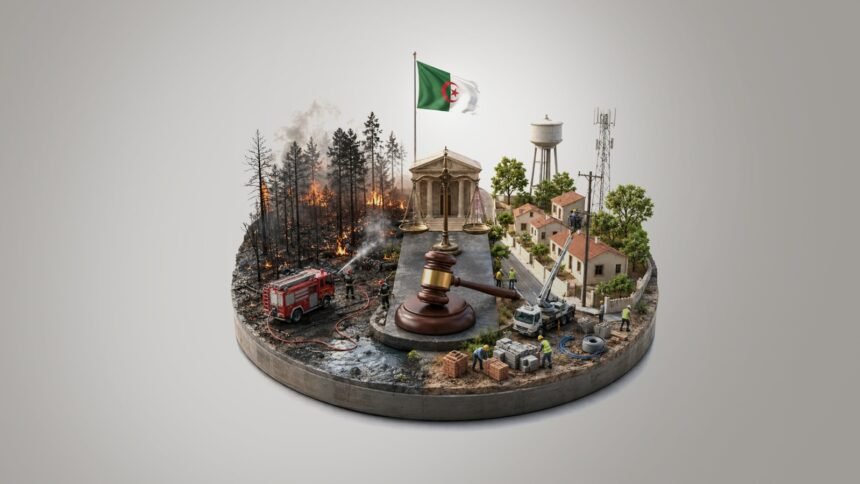
Twelve coffins and a penal-code amendment drafted within the same week: that is the arithmetic behind Algeria’s latest confrontation with the politics of punishment. Moments of visible catastrophe frequently become the occasion for governments to redefine the boundaries of state power, testing how far a population will accept the recalibration of justice systems in the name of order and protection. Algeria’s decision, announced by President Abdelmadjid Tebboune, to fast-track a penal code amendment introducing capital punishment for arson-driven forest fires arrives in exactly this register. Following a wave of blazes that killed twelve people across the country’s eastern provinces in late August, the directive represents more than a punitive reflex; it is a claim about the state’s authority to define existential threats to communal safety and to answer them with its most severe instrument. That Algeria has maintained a de facto moratorium on executions since 1993 makes the symbolism heavier than the likely practice, at least for now. The episode sits within a broader continental pattern in which states under environmental and security strain reach for judicial maximalism as a substitute for, or complement to, slower structural investments in fire prevention, rural infrastructure, and climate adaptation. Whether Algeria’s gambit restores public confidence or performs sovereignty for a frightened electorate will depend on what follows the headline.
A Directive Born of Emergency
The sequence of events is direct. On Sunday, President Abdelmadjid Tebboune convened a high-level meeting with senior civilian and military officials to address the wildfire crisis, and used the occasion to instruct the justice minister to submit a penal code amendment by 15 September introducing capital punishment for anyone convicted of deliberately setting forest fires. State television reported that any resulting death sentence would be carried out only after all avenues of appeal had been exhausted, a procedural safeguard officials appear intent on emphasizing even as the substantive punishment escalates sharply. Under existing law, intentional forest arson already carries penalties of up to thirty years’ imprisonment, or life imprisonment in aggravating circumstances, meaning the proposed amendment does not close a legal gap so much as raise the ceiling of consequence in response to a specific, politically charged emergency.
Investigating the Spark: Arson Suspicions and State Response
The urgency behind the announcement stems from a specific and still-unresolved question: whether some of the fires that swept several eastern provinces in late August were deliberately ignited. Tebboune pointed to video footage showing multiple fires breaking out at roughly one o’clock in the morning as grounds for suspicion, and directed provincial governors to hand over all available intelligence to security services investigating the pattern. Algeria’s interior ministry confirmed that twelve people had died in the latest wave of wildfires across the affected eastern provinces, a toll that, combined with the suspicious timing of ignition points, has hardened the government’s rhetorical posture from environmental disaster response toward a criminal-justice and national-security framing of the crisis.
Reconstruction as Counterpart to Retribution
Alongside the punitive measures, Tebboune ordered a parallel reconstruction effort intended to demonstrate the state’s capacity to restore normal life quickly. Committees have been tasked with assessing property damage and determining compensation for affected families. At the same time, the housing minister has been instructed to coordinate with construction companies to repair damaged homes against fixed deadlines. Electricity, gas, water, and telecommunications services in fire-affected areas were ordered restored by the following Saturday at the latest, and Tebboune stated publicly that normal life in the affected communities should resume within a week. This pairing of severe punitive legislation with rapid, visible reconstruction is itself a governance strategy: it allows the state to project both retributive resolve against suspected arsonists and restorative competence toward victims, addressing two distinct constituencies within the same political moment.
The Weight of a Moratorium and the Limits of Deterrence
The practical significance of introducing capital punishment for arson is complicated by a fact that runs through Algerian criminal justice more broadly: the country has maintained a de facto moratorium on executions since 1993, even though the death penalty already applies to a range of existing offenses. This history raises a pointed question about the amendment’s actual function. If Algeria has been unwilling to carry out executions for three decades despite having ample legal authority to do so, the new arson provision may operate less as a genuine deterrent than as a symbolic assertion of state resolve at a moment of public anger and fear. That symbolism carries its own risks, including the possibility that crisis-driven legislating, however emotionally resonant, expands the state’s most severe punitive tools without a corresponding evidentiary framework robust enough to withstand the pressure of a frightened public demanding someone be held responsible.
Toward a Sovereignty That Prevents Rather Than Only Punishes
Algeria’s wildfire crisis, like similar climate-linked emergencies recurring across the continent, ultimately poses a choice between two models of state authority: one that demonstrates sovereignty chiefly through the severity of its punishments, and one that demonstrates it through the durability of its prevention. Judicial deterrence has its place, but genuine structural sovereignty over environmental risk will depend far more on investment in rural fire-prevention infrastructure, climate adaptation planning, and rapid-response capacity than on a capital statute rarely, if ever, enforced. Whether Tebboune’s government follows this month’s punitive gesture with the slower, less politically visible work of prevention will determine whether Algeria’s response to this crisis marks a genuine turning point or simply another instance of legislating in the heat of the moment, then moving on once the headlines fade.