




The Pan-African Paradigm of Humanitarian Sovereignty and Regional Burden
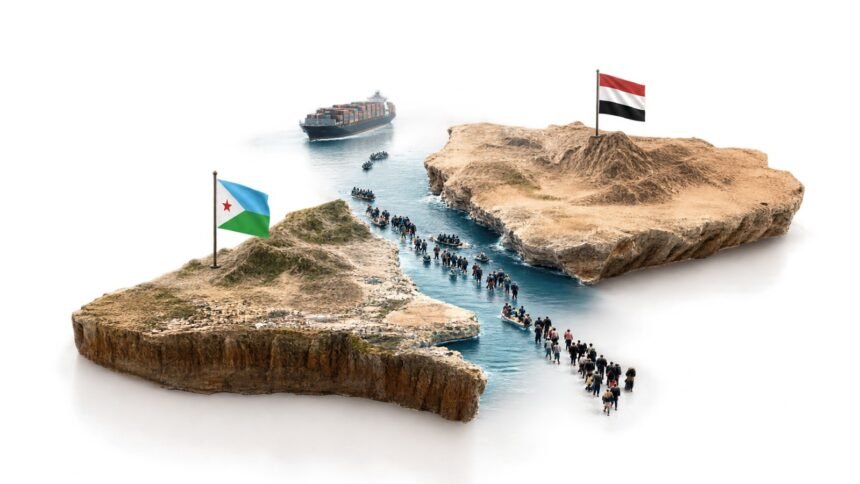
Fourteen hundred people crossed the Bab al-Mandeb strait in a single twenty-four-hour window this week, and Djibouti, a nation of roughly one million people occupying a sliver of the Horn of Africa, absorbed them without the luxury of a phased plan. The scale of that single-day influx crystallizes a burden that recurs across the continent’s frontline states: nations bordering conflict zones inherit humanitarian obligations that far exceed their fiscal or infrastructural capacity, yet receive a fraction of the international attention and financing directed at the conflicts producing the displacement in the first place. Djibouti’s position on the western shore of one of the world’s most strategically sensitive waterways has made it a de facto shelter for a war it did not start and cannot resolve, a role many African states play with little recognition of the structural inequity embedded in it. As Yemen’s conflict grinds on, Djibouti’s capacity to absorb its human cost becomes not merely a domestic policy question but a test of whether the continent’s humanitarian architecture can meet an obligation the international system has largely outsourced to its smallest and least-resourced frontier states.
Crossing a Narrowing Strait
The arrivals crossed the Bab al-Mandeb, the narrow maritime passage linking the Red Sea to the Gulf of Aden, fleeing what officials describe as escalating fighting in Yemen and intensifying Houthi activity around the strategic city of Marib. The coastal town of Obock, on Djibouti’s side of the strait, has become a recurring landing point, having previously received hundreds of Yemenis who made the crossing, including people rescued at sea after their boats ran out of fuel mid-passage. The latest wave arrives as the security situation inside Yemen continues to deteriorate: the International Organization for Migration has reported that nearly 76,000 people have been displaced within Yemen since July alone, a figure that signals the scale of need both inside the country and among the neighboring states absorbing its overflow.
A Nation Already Stretched Thin
Djibouti had already been hosting more than 36,000 refugees and asylum seekers prior to this latest surge, a population drawn from Somalia, Ethiopia, and Yemen that reflects the country’s position at the convergence of several of the region’s most protracted conflicts. The newest arrivals are expected to place additional strain on accommodation, food supplies, healthcare systems, and other basic services already stretched by that existing caseload. Unlike states with deeper fiscal reserves or larger territories to absorb displacement, Djibouti’s capacity constraints are structural and immediate: a small population, limited arable land, and an economy heavily oriented around port and logistics infrastructure rather than the kind of diversified base that could readily absorb sudden humanitarian shocks. Aid agencies operating in the country have repeatedly flagged funding shortfalls even before this latest wave, meaning the arrivals of the past week are landing on a response system already working at the edge of its means.
A Strait That Is Also a Chokepoint
The Bab al-Mandeb’s dual identity, as both a humanitarian crossing point and one of the world’s most consequential shipping chokepoints, means Djibouti’s predicament sits at the intersection of humanitarian and geopolitical concern. Regional military activity around the strait has intensified alongside Yemen’s conflict, complicating both the safety of crossings and the broader security calculus of a waterway through which a substantial share of global maritime trade transits. Djibouti’s hosting of foreign military bases, a long-standing feature of its foreign policy given this strategic position, adds a further layer of complexity: the same geography that has made the country a magnet for international security investment is what now channels a humanitarian crisis directly onto its shores. That paradox is rarely acknowledged in the security partnerships that keep foreign naval and logistics installations anchored along Djibouti’s coastline, arrangements structured overwhelmingly around strategic access rather than the humanitarian obligations those same waters routinely impose on the host nation.
Reclaiming Burden-Sharing as a Continental Principle
Djibouti’s predicament illustrates a structural imbalance that the continent’s humanitarian frameworks have yet to resolve: frontline states absorb the immediate human cost of conflicts largely generated elsewhere, while the international financing architecture built to support displaced populations remains chronically underfunded relative to need. A genuine reckoning with this imbalance would require African and international institutions alike to treat burden-sharing not as charity extended to frontline states but as a structural obligation owed to them. For Djibouti, the choice is not whether to receive those fleeing Yemen’s war, its coastline and its history leave little alternative, but whether the wider continental and international community will finally match that hospitality with resourcing proportionate to the sovereignty it exercises daily simply by keeping its doors open.