


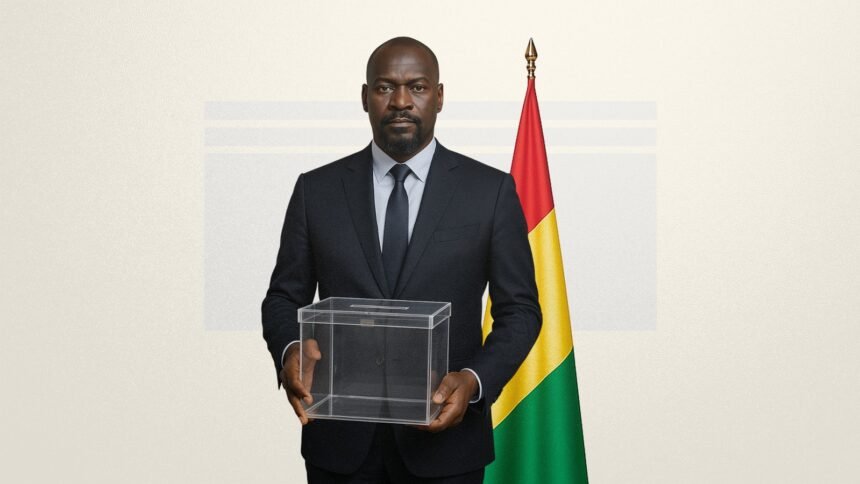
Mamady Doumbouya arrived at Guinea’s Supreme Court on Monday morning in an armoured vehicle, flanked by security forces, to file his presidential candidacy for elections scheduled on December 28. He spoke no words to the assembled media. He did not need to. The thousands of supporters who had travelled to the capital by bus said it for him, chanting slogans outside the courthouse: “Mamady, president! Already elected!” The theatre of it all—the armed escort, the pre-programmed crowds, the predetermined conclusion—captured something essential about Guinea’s peculiar brand of democratic transition: it is a process designed by those with power to preserve their power, dressed in the language of constitutional restoration.
This is not what Doumbouya promised when he seized power in September 2021. In that coup, the military general justified his takeover by pointing to the corruption and mismanagement of Alpha Conde’s civilian administration. At the time, and in the months that followed, Doumbouya insisted he had no intention of remaining in office beyond a brief transition period. The international community, particularly Western nations and West African neighbours, urged Guinea toward democratic elections that would return the country to constitutional governance. Four years later, those elections are finally arriving—but the person who seized power appears determined to win them.
What changed was a constitution. In September 2025, Guineans approved a new constitutional framework championed and promoted by Doumbouya’s military administration. The constitution serves multiple purposes, all of which benefit the current leadership. Most obviously, it replaces the post-coup arrangements that had barred members of the junta from running for office. It also imposes age restrictions (candidates must be between 40 and 80) and residency requirements (they must live in Guinea) that conveniently eliminate two of the most potentially formidable opponents: former president Alpha Conde, now 87 and living abroad, and former prime minister Cellou Dalein Diallo, 73 and in exile owing to corruption allegations he denies.
Other candidates have submitted their applications. Former prime minister Lansana Kouyate and former foreign minister Hadja Makale Camara are among those who cleared the administrative hurdles to stand. But the optics are clear: Doumbouya, at 40, enters the race as the sitting leader with command of state institutions, security forces, and the machinery of government. His challengers are fragments of Guinea’s fractured opposition, divided by personal ambitions and historical grievances.
The arithmetic of Doumbouya’s political calculation is coldly rational. Guinea has experienced multiple coups—the political culture is accustomed to military intervention, even if international law condemns it. The country experienced a brief democratic flourish following Alpha Conde’s 2010 election as the nation’s first democratically chosen leader after decades of authoritarian rule. But Conde’s governance, whilst far from uniformly disastrous, accumulated grievances. He was perceived as favouring his ethnic Malinke group, and he controversially pursued a third presidential term before Doumbouya’s coup removed him from office. Guinea’s 14.5 million people, exhausted by political instability and yearning for progress, might yet reward continuity over the uncertainty of a contested transition.
Yet Doumbouya’s decision to run complicates the international narrative. The military junta that came to power in 2021 had positioned itself as a temporary custodian of governance, a necessary intervention to arrest decay and prepare the nation for elections. That story was always somewhat fragile. Now it has been abandoned entirely. The signal being sent is unambiguous: the military is not a temporary force but a permanent player, and it will use democratic mechanisms when doing so serves its interests.
The West African regional body ECOWAS has suspended Guinea following the 2021 coup, though the junta’s promise of elections may provide a pathway to reintegration. International observers will likely monitor December’s vote, and their presence might impose some procedural fairness. But monitoring cannot manufacture genuine competition when the playing field is tilted so dramatically. The media, security apparatus, and state resources will serve Doumbouya’s candidacy. His challengers will operate from positions of structural disadvantage.
What unfolds in Guinea matters beyond the country’s borders. West Africa has experienced a destabilising wave of military coups in recent years—Mali, Burkina Faso, and Niger have all experienced takeovers. If Doumbouya successfully transitions from coup leader to elected president through elections he has carefully structured, it creates a dangerous precedent: that military rule can be legitimised through constitutional engineering and democratic theatres. Other generals across the region are watching, calculating whether similar pathways might extend their tenure in power.
For Guinea’s citizens, the December vote presents a painful choice: Doumbouya offers continuity, stability, and the resources of state power; his opponents offer hope for genuine democratic renewal but little institutional advantage. The thousands who cheered outside the Supreme Court on Monday may have genuinely supported Doumbouya, or they may have been mobilised because saying no comes with risks. In Guinea’s political culture, enthusiasm for the sitting ruler is sometimes the safest form of self-preservation