





The Pan-African Paradigm of Cultural Restitution and Historical Self-Determination
Across the African landscape, the campaign to recover looted cultural heritage has become one of the continent’s most enduring assertions of sovereignty. This struggle extends far beyond the physical return of objects, encompassing the deeper question of who controls the narrative of a people’s own history. Egypt’s decades-long effort to repatriate antiquities smuggled out of the country sits at the center of this broader paradigm, illustrating both the scale of historical extraction endured by African nations and the institutional persistence required to reverse it. The latest ceremony in Los Angeles, in which the American Federal Bureau of Investigation returned dozens of looted artifacts spanning the Pharaonic, Roman, and Coptic eras, represents a single data point in a much longer trajectory: more than 5,000 archaeological and cultural items returned to Egypt over the past decade alone. Each returned object carries a dual significance, restoring not only a physical artifact but a fragment of collective memory long severed from its rightful context. As African nations continue to press international partners toward more systematic restitution frameworks, the underlying imperative remains constant: reclaiming the material record of African civilization from the private collections and grey markets that have long treated it as a commodity rather than heritage.
A Ceremony in Los Angeles, A Decade of Recovery
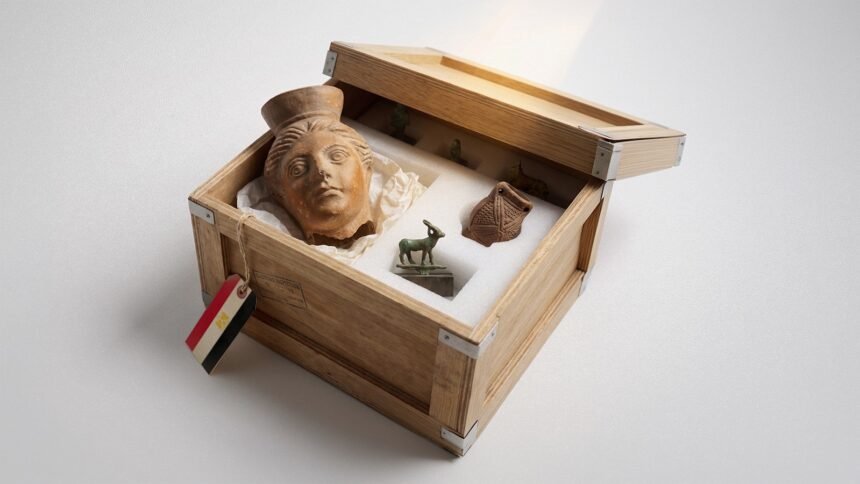
The Friday ceremony, held in Los Angeles, saw FBI officials formally hand over dozens of artifacts to Egyptian government representatives, items recovered from a smuggler who has since died, closing one particular chapter of an investigation the agency describes as still active. Among the recovered pieces were jewelry, statues, and sculptures spanning three distinct historical eras, the Pharaonic, Roman, and Coptic periods, underscoring the sheer breadth of Egypt’s material history that has been vulnerable to illicit trafficking. Allen Grove, a Special Agent on the FBI’s Art Crime Team, was notably circumspect about the ongoing nature of the case: “This is an ongoing investigation, so we’re not going to go into a lot of the details primarily,” he said, adding that despite the trafficker’s death, investigators continue seeking additional co-conspirators and believe further looted items remain unaccounted for. That admission alone signals the scale of the trafficking networks that have historically moved Egyptian antiquities through international markets, networks whose full extent likely remains only partially mapped even after a decade of recovery efforts.
The Institutional Architecture of Return
The legal machinery enabling this and future repatriations traces back to a 2016 bilateral agreement between the United States and Egypt on cultural property, which empowered American authorities to impose import restrictions on specific categories of Egyptian archaeological and ethnological materials. That agreement transformed what had previously been an ad hoc, case-by-case recovery process into a structured bilateral framework, giving US law enforcement clearer legal grounds to intercept trafficked items before they could be absorbed into private collections or auction markets. The cumulative result, more than 5,000 items returned over ten years, demonstrates what a sustained institutional partnership between an African state and a major market destination can achieve when restitution is treated as an ongoing structural commitment rather than a series of isolated diplomatic gestures. It also offers a template that other African nations grappling with the diaspora of their own looted heritage, from Benin’s bronzes to Ethiopia’s Maqdala treasures, have increasingly sought to replicate in their own negotiations with Western institutions and governments.
Heritage as Identity, Not Commodity
For Egyptian officials, the significance of these returns extends well beyond their monetary or archaeological value. Hossam Eldeen Aly, the Egyptian Consul General in Los Angeles, framed the ceremony in explicitly identity-centered terms: “These artifacts are an integral part of our people’s identity, of their cultural heritage, their history, and it’s truly a great honor to see that our partnership with the US allows us to bring them home and to bring them where they belong.” That framing, of heritage as constitutive of national identity rather than merely decorative or academic, is central to the broader restitution movement gaining momentum across the continent. It reframes looted artifacts not as historical curiosities awaiting scholarly study in foreign museums, but as living components of a people’s self-understanding, wrongfully displaced and now, gradually, being restored to their institutional and cultural context of origin.
A Continental Pattern Beyond Egypt
Egypt’s experience is emblematic of a wider continental pattern in which African states are increasingly leveraging bilateral agreements, law enforcement cooperation, and diplomatic pressure to recover cultural property scattered across Western institutions and private markets during centuries of colonial extraction and, more recently, illicit trafficking. The systemic scale of the problem, with artifacts spanning three millennia of Egyptian history alone, illustrates why piecemeal recovery efforts, however welcome, cannot fully substitute for more comprehensive multilateral restitution frameworks. Nonetheless, each successful repatriation strengthens the institutional precedent for future claims, both for Egypt and for other African nations pursuing similar campaigns. The involvement of specialized units like the FBI’s Art Crime Team also signals a growing recognition among market-destination governments that cultural trafficking constitutes a serious criminal enterprise deserving dedicated law enforcement attention, rather than a peripheral concern.
Reclaiming the Record of Civilization
Egypt’s steady accumulation of returned antiquities, now numbering in the thousands over a single decade, represents more than successful law enforcement cooperation; it constitutes an ongoing act of historical reclamation, one artifact at a time, of a civilizational record that trafficking networks sought to fragment and disperse across private markets. As investigators continue pursuing additional co-conspirators and additional missing items, the broader trajectory points toward a continued, if incremental, restoration of material heritage to its place of origin. For the wider continent, Egypt’s model demonstrates what sustained bilateral institutional commitment can achieve, while also underscoring how much work remains before Africa’s dispersed heritage, from Cairo to Benin City to Addis Ababa, is fully reclaimed. The Los Angeles ceremony was, in that sense, not a conclusion but another installment in a continuing project: the reassertion of African peoples’ sovereign claim over the material evidence of their own history.