


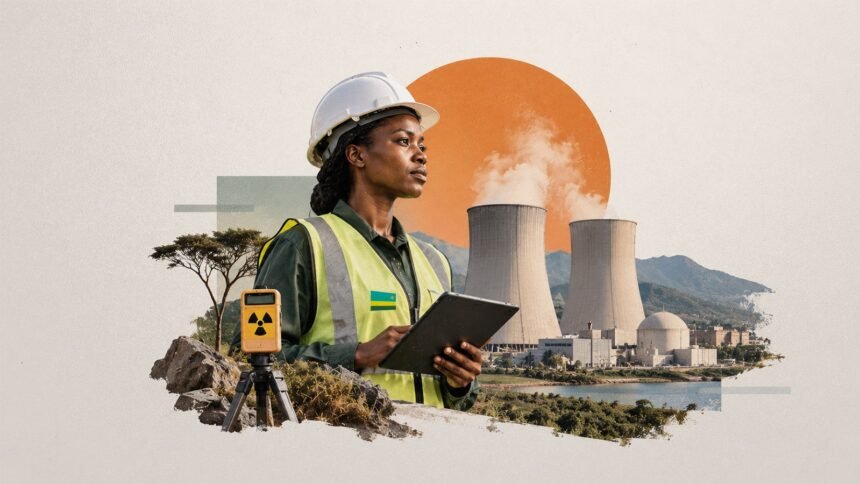
Rwanda is putting in place regulatory, monitoring, and emergency-response systems to ensure safety is built into its planned nuclear energy program before construction begins and throughout the operation and eventual decommissioning of nuclear facilities.
The measures include strengthening the country’s nuclear regulatory capacity, applying International Atomic Energy Agency (IAEA) safety standards, developing radiation monitoring systems, preparing for possible nuclear and radiological emergencies and establishing arrangements for radioactive waste and spent fuel management.
The Rwanda Atomic Energy Board (RAEB) said the approach will cover the entire lifecycle of nuclear facilities, from planning and site selection to construction, commissioning, operation and decommissioning.
The development comes as Rwanda works towards its first nuclear power plant, with the government targeting 110 megawatts of nuclear-generated electricity between 2030 and 2033, with two potential sites currently undergoing approval processes.
According to RAEB, nuclear power projects will have to comply with Rwanda’s nuclear and radiation safety regulations, IAEA safety standards and internationally recognized practices.
The requirements will cover site selection, reactor design, construction, commissioning and operation, as well as emergency preparedness, nuclear security and radioactive waste management.
RAEB said that the Rwanda Utilities Regulatory Authority (RURA) is the independent regulatory authority responsible for nuclear and radiation safety oversight, including licensing, inspection and enforcement. At the same time, RAEB is responsible for supporting implementation of the nuclear program and ensuring safety requirements are incorporated throughout its development.
The IAEA’s Integrated Nuclear Infrastructure Review (INIR) mission conducted in March assessed the country’s preparedness across 19 areas, including the legal and regulatory framework, safety and security, human resources, radioactive waste management and stakeholder engagement.
The IAEA said such reviews are designed to identify gaps and provide technical recommendations rather than certify a country as ready for nuclear power.
According to RAEB, Rwanda has also established a National Nuclear and Radiological Emergency Preparedness and Response Plan through the Ministry in charge of emergency management.
The plan provides a framework for coordinating government institutions and protecting workers, the public and the environment in the event of a nuclear or radiological emergency.
RAEB said a national emergency exercise is planned for early next year to test the arrangements, identify gaps and improve Rwanda’s response capacity.
The exercise will be used to assess how effectively institutions can coordinate during an emergency before the plan is submitted for approval by the Minister.
Monitoring radiation
Radiation monitoring is another part of the safety framework being developed. According to RAEB, the regulatory authority is strengthening national radiation monitoring infrastructure and establishing systems for continuous monitoring and early detection of abnormal radiation levels.
The program will include radiation monitoring probes deployed in phases across the country.
The monitoring systems will complement inspections, regulatory controls and emergency preparedness measures aimed at identifying and controlling radiation risks to workers, nearby communities and the environment.
Rwanda is also developing arrangements for managing radioactive waste and spent nuclear fuel, covering their handling, treatment, storage, transportation and eventual disposal or decommissioning.
RAEB said the country will determine the appropriate long-term arrangements as the nuclear program develops, guided by national regulations and international safety standards.
The approach is intended to cover waste generated during the operation of nuclear facilities as well as materials that remain after a facility reaches the end of its operating life.
The safety framework is being developed alongside efforts to build a specialized workforce, according to RAEB.
The country is also building the human resources needed to regulate and operate nuclear facilities, with a target of more than 230 nuclear professionals by 2028, covering areas including nuclear regulation and licensing, nuclear safety and security, reactor operations, engineering and radiological protection, with current expertise estimated at between 30 and 50 professionals across relevant institutions.
The government has also been working with the IAEA and other international partners on training, technical assistance and peer reviews.
In March, the IAEA conducted the first phase of its INIR mission to assess Rwanda’s readiness for a nuclear power program. The review was intended to identify areas requiring further development and provide recommendations for the next stages of preparation.
In July, a separate IAEA review assessed Rwanda’s preparedness for a research reactor under the planned Center for Nuclear Science and Technology. The mission also provided recommendations on safety and security as Rwanda develops its nuclear science infrastructure.
The IAEA’s March assessment noted that developing a nuclear power program is a long-term process and that countries typically take 10 to 15 years from entering the IAEA’s Milestones Approach to operating a nuclear power plant.