





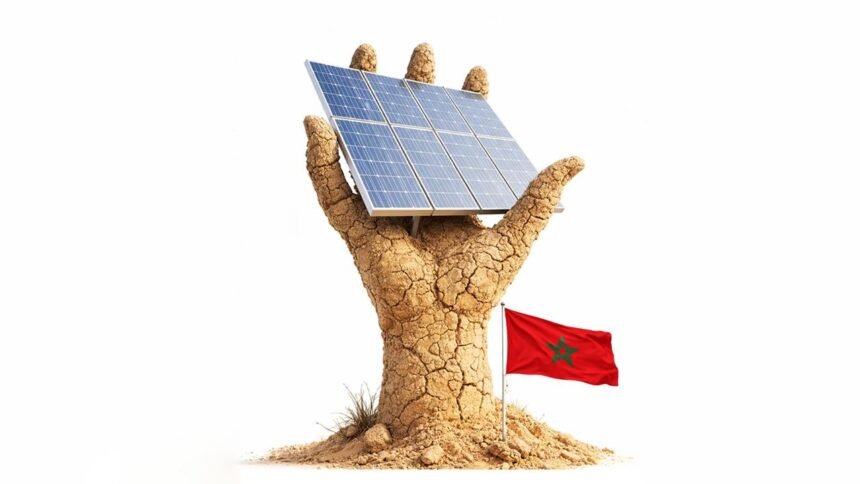
Morocco is turning its desert sun and Atlantic winds into a new model of green industrialization, linking renewable energy with green hydrogen, fertilizers, and electric mobility, thereby reshaping regional and global climate strategies.
By the end of 2024, it is expected to account for more than capacity, and the country is reinforcing its goal of exceeding 52% renewable capacity before 2030 through large‑scale investments in solar, wind, storage, and grid upgrades.
From Desert Sun to Industrial Power
Morocco’s core strategy rests on exploiting its vast solar and wind potential, especially in the southern regions and along the Atlantic coast. Using the latest available data from the end of 2024, renewables made up more than 45% of Morocco’s total installed power capacity; within that installed renewable mix, wind accounts for about 44%, hydropower 24%, photovoltaic solar power (PV) and concentrated solar power (CSP) around 17%, and pumped storage roughly 15%.
Projects such as Noor Ouarzazate and newer schemes like Noor Midelt I and Noor Midelt II have helped drive down generation costs and anchor renewable power as a competitive base for industrial growth.
This 52% target is now seen as a minimum, with Morocco aiming to exceed it by the late 2020s as part of a broader strategy to triple renewable capacity by 2030, supported by the 2026 finance bill and long‑term plans to reduce coal’s dominance in the generation mix.
Policymakers are also confronting rising electricity demand and water stress by pairing renewables with grid reinforcement and large desalination projects, which in turn require robust system planning and storage solutions.
Green Hydrogen and Renewable Ammonia
Morocco is positioning itself as a green molecules hub, using low‑cost solar and wind to produce green hydrogen and ammonia for fertilizers, industry, and export.
In recent years, the government has approved multi‑billion‑dollar investment pipelines for green hydrogen and renewable ammonia, focusing on industrial clusters that can serve both domestic demand and European markets.
OCP Group is developing a major renewable ammonia complex in southern Morocco, often linked to the Tarfaya region, with a total planned investment of about USD 7 billion and around 3.8 GW of dedicated wind and solar capacity. Initial output is expected to reach about 3 million tons of renewable ammonia annually by 2032, following an initial phase of 200,000 tons from 2026 and 1 million tons by 2027.
These developments support Morocco’s ambition to decarbonize fertilizer production, reduce ammonia imports, and secure a premium position in low‑carbon agricultural inputs.
They also underpin the country’s emerging role as a future exporter of green hydrogen derivatives to the European Union, which is tightening carbon constraints on industrial imports through mechanisms such as the Carbon Border Adjustment Mechanism (CBAM), making low‑carbon production a competitive advantage.
Electric Vehicles (EVs) and Battery Manufacturing
Electric vehicle and battery manufacturing are rapidly advancing across the automotive and battery value chains, with Morocco emerging as a continental leader. The country has established itself as both a major automotive supplier to the European Union and a top automotive hub in Africa.
Building on this momentum, a new battery gigafactory near Kenitra, developed by Chinese company Gotion High‑Tech, is expected to start production around 2026 with an initial capacity of 20 GWh per year. Over time, the facility is expected to scale up to 100 GWh annually, producing complete battery cells, including cathodes and anodes, to serve both local EV production and export markets.
This development will further strengthen Morocco’s position in global electric vehicle (EV) and energy storage supply chains.
This battery push complements Morocco’s existing vehicle manufacturing base and strengthens efforts to attract end‑to‑end electric mobility investments, from assembly to components.
Because much of the auto and battery output is destined for Europe, where regulations are phasing out new internal combustion engine car sales, Morocco’s renewable energy and decarbonization policies directly affect its industrial competitiveness and export resilience.
Socioeconomic Outcomes and Policy Signals
Morocco’s renewable‑driven industrial strategy is tightly linked to development outcomes, including export growth, job creation, and regional value‑chain integration. Automotive exports reached about 157 billion Moroccan dirhams (roughly USD 15.5–15.8 billion) in 2024, reflecting the sector’s robustness and its centrality to industrial policy.
The government’s 2026 finance bill further strengthens incentives for renewable energy, green hydrogen, and industrial decarbonization, embedding climate goals into fiscal and investment planning.
At the same time, the country faces structural challenges related to grid capacity, coal’s continuing role in electricity generation, and the integration of variable renewables alongside energy‑intensive desalination and industry.
International assessments note that Morocco’s policies remain broadly aligned with a Paris‑compatible trajectory but will need continued reforms, particularly on coal phase‑down and demand management, to reach long‑term climate neutrality.
A Replicable Model for Emerging Economies
By 2026, Morocco’s desert‑powered industrialization offers a promising blueprint for other resource‑rich developing countries seeking to turn their natural advantages into sustainable, export‑oriented green industries.
If Morocco can successfully phase down coal, modernize its grid, and manage water constraints, it could emerge in the 2030s as a major exporter of green-energy-based industrial products, offering a practical model for other resource‑rich developing countries.


