



The Pan-African Paradigm of Contested Territory and Institutional Fragility
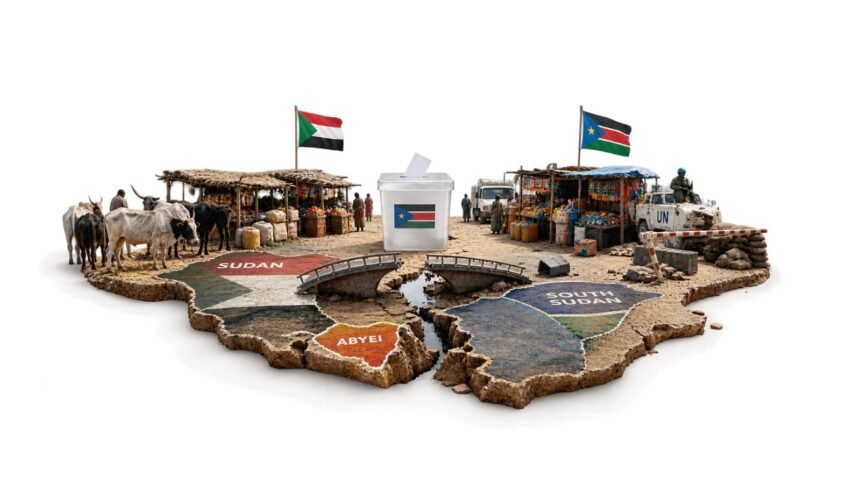
What is a market worth to two peoples who have shared and split it for a hundred years? In Abyei town, on the disputed border between South Sudan and Sudan, the answer this week was at least 26 lives and 82 injuries, after clashes between the Ngok Dinka and Misseriya communities erupted around the Amiet Common Market following the killing of two men from each side earlier in the week. Abyei’s unresolved status, jointly administered by Khartoum and Juba since South Sudan’s 2011 independence and never settled by the referendum both sides once promised, is a microcosm of a continental pattern: borderlands whose sovereignty remains legally suspended become the sites where the deepest structural fractures of statehood surface first and most violently. The clash arrives as South Sudan, largely at peace since a 2018 agreement ended five years of civil war, approaches its first elections since independence, scheduled for December. The paradigm at stake is whether institutions built to manage contested sovereignty, from peacekeeping mandates to power-sharing frameworks, can hold through an election season that will test them as never before, or whether unresolved territorial ambiguity will keep generating exactly this kind of deadly, cyclical violence.
A Market, Two Tribes, and a Long Memory
The Amiet Common Market has functioned for years as a rare point of economic contact between the Ngok Dinka, who form the majority sedentary population of Abyei, and the Misseriya. This pastoralist Arab group migrates seasonally through the area with cattle herds. That proximity, meant to foster commerce, has repeatedly curdled into violence over grazing lands and watering points. These disputes recur with almost ritual regularity as climate pressure and population growth intensify competition over increasingly scarce resources. This week’s escalation began with the killing of two men from each community on Monday and Tuesday, tensions that spiraled by Thursday into open clashes at the market itself. The United Nations Interim Security Force for Abyei, UNISFA, said it had reinforced its security presence and deployed additional forces to de-escalate the situation, a rapid-response posture that reflects years of institutional experience managing this specific flashpoint, even as it underscores how little structural progress has been made toward resolving the underlying land-use disputes that keep reigniting it.
A Territory Neither State Will Release
Abyei’s oil-rich status is central to why neither Khartoum nor Juba has been willing to cede full administrative control since South Sudan’s independence split the two countries in 2011. The region was meant to hold its own referendum on whether to join North or South, a vote promised in the original Comprehensive Peace Agreement but never held, leaving Abyei in an institutional limbo that both governments have found more useful to maintain than resolve. That ambiguity concentrates every subsequent dispute, however local, with a geopolitical charge that ordinary land conflicts elsewhere do not carry: a fight between Ngok Dinka and Misseriya herders becomes, by extension, a proxy indicator of the fragility of Sudan-South Sudan relations more broadly, at a moment when Sudan’s own civil war continues to destabilize the wider region. UNISFA’s peacekeeping mandate, renewed repeatedly by the UN Security Council, has become a permanent institutional fixture precisely because the political settlement it was meant to bridge toward has never materialized.
Elections on the Horizon, Fragility Underfoot
South Sudan’s approach to December’s elections, its first since independence, adds national stakes to what might otherwise read as a localized tribal clash. The country has been mostly at peace since the 2018 agreement that ended a civil war in which tens of thousands died. Still, that peace has always rested on a fragile power-sharing architecture among rival political and ethnic constituencies. Violence in Abyei, even when rooted in longstanding grazing disputes rather than national politics, tests the credibility of the institutions meant to prevent broader relapse into conflict as the country heads toward its most consequential democratic exercise since independence. Whether the government in Juba treats this week’s deaths as a contained, local matter or as a warning sign requiring deeper institutional investment in the borderlands will shape how resilient the country’s peace proves to be under the strain of an actual electoral contest, the first genuine test of the 2018 settlement’s durability.
Reclaiming Abyei’s Unfinished Sovereignty
Nearly fifteen years after independence was meant to resolve the question of who governs Abyei, the territory remains suspended between two states, protected by an international peacekeeping force but never granted the self-determination its people were promised. The structural fix, a long-delayed referendum or a negotiated permanent-status agreement, remains politically inconvenient for both Khartoum and Juba, each content to let UNISFA absorb the recurring violence rather than resolve the underlying dispute. Until that changes, markets like Amiet will keep serving as flashpoints where old grazing rivalries collide with unresolved national sovereignty, and communities that have coexisted, however uneasily, for generations will keep paying the price of a settlement their governments have never delivered. As South Sudan heads toward the ballot box, Abyei’s unfinished business is a reminder that self-determination deferred does not disappear; it simply relocates to the next market, the next grazing season, the next disputed well.