




The Pan-African Paradigm of Migration and Continental Solidarity
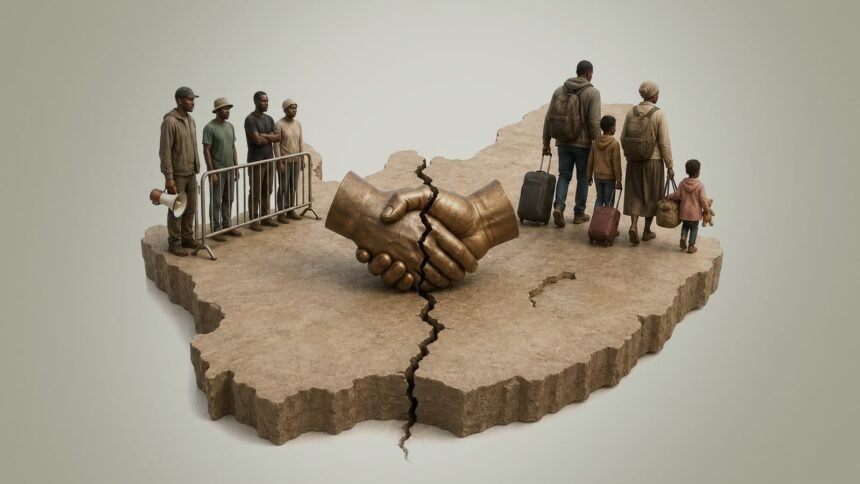
Across the African landscape, no promise has been tested as severely as the one Nelson Mandela extended in 1994, when a newly democratic South Africa opened itself to migrants fleeing poverty and repression elsewhere on the continent. Three decades later, that founding gesture of Pan-African solidarity is being unwound in the streets of Johannesburg, where months of anti-immigration marches have displaced more than 160,000 people, at least 54,000 of them formally deported, and left at least four dead. The movement, led by groups such as March and March, frames its campaign as a demand that the government address unemployment and inequality only after undocumented migrants leave. This framing displaces structural economic failures onto foreign nationals rather than the institutions meant to address them. What is unfolding in Thembelihle, Alexandra, and outside the Malawian consulate is not simply a law-enforcement crisis but a test of whether the continent’s most industrialized economy can reconcile its own citizens’ economic grievances with the sovereignty and dignity of migrants whose presence has, for three decades, been part of the post-apartheid settlement. The answer will shape migration politics across the region ahead of November’s contested local elections.
A Community Unravels in Thembelihle
In Thembelihle, an informal settlement south of Johannesburg, Malawians and South Africans had coexisted for years until a wave of armed robberies broke the peace. On June 29, several men broke into the compound of Eibraheem Hussein, a 60-year-old Malawian who has lived in South Africa since 2000, beating him and stealing valuables. On the night of July 16, a gang robbed at least four Malawian households, telling terrified residents to go home in Zulu. Moosa Addi Kunje was beaten with a pistol and robbed of his fridge, television, and phone by five men who kicked down his door; he required stitches after the attack. His neighbor, Aisha Muhammed, said the men took the 4,000 rand, about £180, she had been saving to return to Malawi, telling her: ‘You are foreigners. You want to go, you must go.’
The Scale of Displacement
More than 160,000 people from countries including Mozambique, Nigeria, and Zimbabwe have left South Africa since the protests began in March, according to an AFP tally of official figures, with at least 54,000 formally deported and at least four people killed. The demographic backdrop is significant: South Africa’s foreign-born population nearly tripled to 2.4 million between 1996 and 2022, according to census data that aimed to include undocumented residents, rising from 2% to 3.9% of the country’s 62 million population. That growth, layered atop persistently high unemployment and inequality, has fed a scapegoating dynamic that periodically erupts into fatal violence, of which the current wave is simply the latest and most sustained iteration.
Consulate Sieges and the Healthcare Fallout
Thousands of Malawians slept without shelter outside their consulate in an affluent part of northern Johannesburg last week as temperatures dropped below 10 degrees Celsius, waiting for buses home. Claire Waterhouse, who managed a Médecins Sans Frontières pop-up clinic outside the consulate, documented two cases of drug-resistant tuberculosis at a displacement camp in Musina near the Zimbabwe border, and a woman who suffered severe hallucinations after being blocked from a government clinic that would have provided her psychiatric medication. Justice Minister Mmamoloko Kubayi told a media briefing, ‘there is no humanitarian crisis,’ noting that the government is only obliged to provide emergency care to undocumented migrants, a position rights lawyer Sasha Stevenson of Section27 disputed, noting that South African law guarantees everyone in the country access to primary healthcare regardless of immigration status.
Politics, Policing, and the March and March Movement
March and March leader Jacinta Ngobese-Zuma set June 30 as an unofficial deadline for undocumented migrants to leave, vowing to continue weekly demonstrations for six months until they had. Spokesperson Sandile Dube framed the campaign starkly: ‘We have made a call to say, can we have illegal immigrants vacate the country first, so that we can deal with the problems of the country.’ The opposition uMkhonto we Sizwe party, led by former president Jacob Zuma, along with ActionSA and coalition partner the Inkatha Freedom Party, have all backed the marches, even as some government ministers have questioned the timing given November’s contested local elections. In Alexandra on July 16, a march that began peacefully turned violent by afternoon, with marchers breaking down doors indiscriminately, affecting South Africans Karel Shirilda and Ketibone Lamola as well as migrants, while police looked on. Police spokesperson Brenda Muridili said door-to-door document checks are illegal, calling them ‘tantamount to impersonating a law enforcement officer.’
Reclaiming the Promise of Continental Solidarity
The gap between South Africa’s founding Pan-African ideals and its present street-level politics is now a matter of policy consequence, not just symbolism. A government that has struggled to reduce unemployment and inequality faces a movement that has found a more immediate, if scapegoated, target in migrant communities that have called South Africa home for decades. Rebuilding continental solidarity will require South African institutions to separate legitimate immigration enforcement, conducted through lawful, accountable processes, from vigilante violence currently operating with police standing by. It will also require confronting the economic grievances driving the marches directly, rather than allowing migration to substitute for the harder work of structural economic reform. Whether that recalibration happens before or after November’s elections may determine how many more Malawians, Mozambicans, and Zimbabweans are forced to abandon the lives they built under a promise South Africa itself extended three decades ago.