




Living Mosaic: Africa’s Rangelands in Deep Time and Space
Africa’s rangelands cover 6.8–7.2 million square kilometres—nearly half the continent’s terrestrial surface—and stretch unbroken from the Mauritanian fescue plains across the Sahel, down the rift valleys of East Africa, through the miombo woodlands of the south-central plateau, and into the succulent Karoo. These are not empty spaces but living archives co-authored by fire, mega-herbivores, and human herders for at least 6,000 years. They store 20–30 percent of the continent’s terrestrial carbon, host 40 percent of its remaining large-mammal biomass, and support 320–350 million people, of whom 60–70 million depend directly on mobile livestock keeping. In arid zones receiving less than 600 mm of rain annually, pastoralism remains the only form of food production that consistently outperforms rain-fed cropping in calorie and protein yield per hectare.
Bloodline Economies: The Pastoral Contribution to Continental Plates
Pastoralists deliver 60–80 percent of the beef, 50–70 percent of the sheep and goat meat, and 40–50 percent of the milk consumed in sub-Saharan Africa. In countries such as Somalia, South Sudan, Chad, Mauritania, and Mali, livestock products account for 70–90 percent of agricultural GDP and up to 40 percent of total GDP when informal trade is included. A single litre of camel milk in Garissa or Gao can travel 1,000 kilometres by foot, donkey, truck, and motorcycle to reach urban consumers, sustaining value chains that employ millions of women in processing, transport, and retail. These economies are not relics; they are hyper-adaptive networks that have absorbed colonial land grabs, post-independence ranching experiments, and recurring drought with remarkable tenacity.
Hunger’s Silent Accelerator: How Extreme Heat Dismantles Food Security
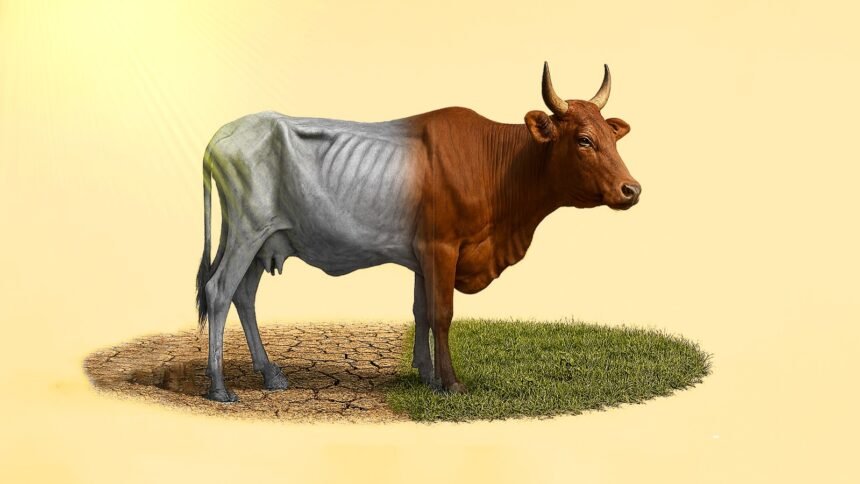
When daytime temperatures remain above 40 °C for more than ten consecutive days, lactating cows and growing animals enter negative energy balance: feed intake drops 15–30 percent, milk yield collapses by 40–60 percent within a week, and weight loss accelerates. Conception rates plummet, abortions rise, and calf mortality can exceed 70 percent in severe events. The 2020–2025 Horn of Africa drought-heat compound event demonstrated the whole cascade: grazing biomass fell 70–90 percent, livestock prices crashed by 60–80 percent, terms of trade for pastoralists (goats-to-cereals) deteriorated fivefold, and 26–29 million people slid into crisis-level food insecurity. Across the Sahel, the same years saw 11–14 million pastoralists and agro-pastoralists requiring emergency food assistance after successive 45 °C+ heatwaves. Because rangelands supply the protein buffer for the entire continent during crop failures, their collapse triggers price spikes felt from Dakar to Durban.
Thermodynamic Betrayal: The Physiology of Collapse in Herd and Herder
Above 35 °C, cattle, sheep, and goats shift from evaporative to open-mouth panting, raising respiration rates from 20–30 to 150–200 breaths per minute and increasing maintenance energy needs by 20–30 percent. Camels, long celebrated as the ship of the desert, begin to suffer irreversible organ damage at sustained temperatures above 42 °C for more than six hours. Humans fare little better: pastoralists walking 20–40 km daily with loads experience core temperatures above 39 °C, cognitive impairment, and heatstroke rates that rise exponentially after the fourth consecutive day above 40 °C. Night-time minima that refuse to fall below 28–30 °C eliminate physiological recovery, turning each new day into compounded debt. The result is a slow-motion biological bankruptcy that no amount of traditional knowledge can fully offset when the physical limits of thermoregulation are breached.
The New Fire Next Time: Climate Models and Pastoral Futures
Under current emissions trajectories, by 2040–2060, large parts of the Sahel, Horn, and Kalahari fringe will experience 60–120 additional days per year above 40 °C. The number of nights above 30 °C—the threshold at which livestock cannot recover overnight—will triple in East Africa and quadruple in the western Sahel. Rainfall variability is projected to increase by 20–40 percent, leading to longer dry spells punctuated by intense deluges over baked, grassless soil. By mid-century, 30–50 percent of current rangeland productivity could be lost unless mobility, water points, and forage systems are radically re-engineered. At 2 °C global warming, the southern Sahel and northern Kenya may cross into permanent hyper-aridity; at 1.5 °C, the same zones retain a fighting chance.
Memory as Method: Indigenous Adaptation Already in Motion
Pastoralists have never been passive. In northern Tanzania, Maasai and Barabaig communities have reopened colonial-era blocked corridors, increasing effective grazing area by 35 percent and reducing livestock mortality during the 2022–2024 heatwaves. In Niger, Fulani herders have partnered with regreening projects to plant 200 million trees since 2005, creating thermal refugia that lower midday temperatures by 3–5 °C. In Somalia, camel herders have shifted entirely to browsing species (Acacia, Salvadora) that remain green at 48 °C air temperature. Mobile abattoirs, solar boreholes, index-based livestock insurance, and community-based rangeland observatories are spreading from pilot to landscape scale. Yet these efforts remain chronically underfunded: less than 2 percent of global climate finance reaches mobile pastoralists despite their stewardship of 35 percent of the planet’s remaining grazing lands.
Tomorrow’s Commons: A Pan-African Pathways Out of the Furnace
The International Year of Rangelands and Pastoralists 2026 offers a continental hinge moment. Combined with the African Union’s 2024–2034 Policy Framework for Pastoralism and the Great Green Wall’s accelerated phase, there exists a narrow window to secure tenure over 1.5 billion hectares, restore 350 million hectares through managed grazing, and establish 100,000 new or rehabilitated water points designed for 50 °C heat. Carbon and biodiversity markets—if redesigned to reward mobility rather than tree planting alone—could generate $6–12 billion annually for pastoral communities. The choice is binary: recognise rangelands and their keepers as the continent’s largest remaining food-security asset and invest accordingly, or watch the inferno consume the last great nomadic food system on Earth. The herds are still walking. The question is whether the world will walk with them before the grass burns away forever.