





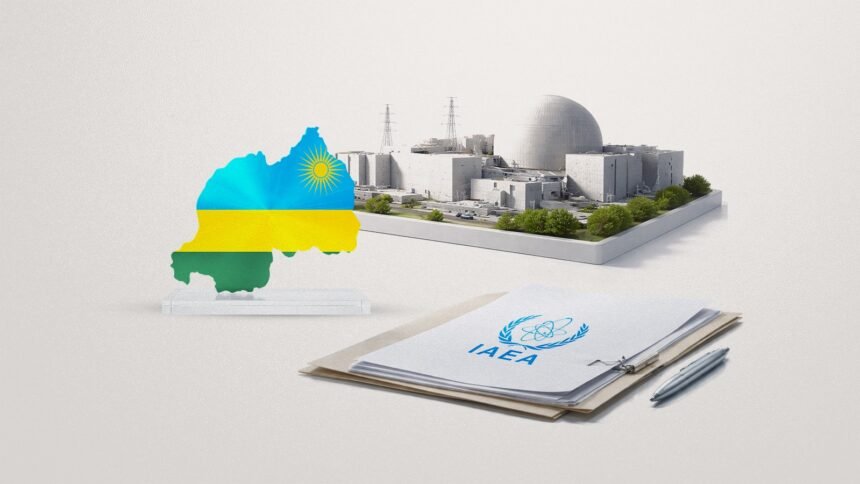
Experts from the International Atomic Energy Agency (IAEA) begin the first phase of an Integrated Nuclear Infrastructure Review (INIR) mission to assess Rwanda’s preparedness for safe, secure, and sustainable nuclear power.
The mission, running from March 2–9, marks a milestone not only for Rwanda but also for a continent increasingly exploring nuclear energy as part of long-term development strategies.
The INIR mission evaluates progress across 19 infrastructure areas, including policy and strategy, legal and regulatory frameworks, safety, security, human resource development, radioactive waste management, and stakeholder engagement.
Phase One of the review typically occurs before a country decides to introduce nuclear power. It focuses on laying the groundwork for an informed national decision.
Aline des Cloizeaux, Director of the IAEA’s Division of Nuclear Power, clarified that the review is not an approval process.
“We provide advice and identify gaps. The country can then develop an action plan to address those gaps, and the decision to pursue nuclear energy remains entirely sovereign,” she said during a press conference at the opening of the mission.
Globally, 31 countries operate 413 nuclear reactors, generating about 10 percent of the world’s electricity, according to the IAEA. Interest among newcomer countries is growing, with around 40 nations currently engaged in the agency’s nuclear power programme.
Across Africa, countries are grappling with rising electricity demand driven by population growth, industrialisation, and urbanisation. Many face supply deficits, a heavy reliance on hydropower that is vulnerable to climate change, and dependence on imported fossil fuels.
For Rwanda, electricity access has reached 84.6 percent, but per capita consumption remains low at approximately 77 kWh. Officials project national demand could rise to between 2.5 and 4.5 gigawatts by mid-century.
Domestic sources alone are unlikely to meet that demand, officials said.
Why is Rwanda Considering Nuclear?
To close the anticipated energy gap, the government is developing a nuclear energy programme designed to complement its existing energy mix. The plan prioritises Small Modular Reactor (SMR) technology, which is expected to contribute at least 110 megawatts in the early 2030s.
One megawatt of SMR capacity can supply electricity to roughly 3,000 homes, with estimated costs ranging between $2 million and $3 million per megawatt. According to national policy projections, nuclear power development could cost up to Rwf 1 trillion ($714.3 million) by 2034/35.
Des Cloizeaux noted that nuclear development is inherently long-term.
“The process from entering the Milestones Approach to the operation of a plant typically takes 10 to 15 years. Rwanda’s ambition to have a plant operational in the 2030s is considered feasible within global benchmarks.”
Fidele Ndahayo, Chief Executive Officer of the Rwanda Atomic Energy Board (RAEB), stressed that nuclear infrastructure extends far beyond physical construction.
“When people hear the word ‘infrastructure,’ they often think about roads or buildings. But in nuclear energy, infrastructure starts with policy, legal and regulatory frameworks, as well as competent institutions,” he said.
These so-called “soft infrastructure” elements must be firmly established before any construction begins.
On the technical side, Rwanda has assessed grid stability and potential sites for future installations. Nuclear power requires a stable and reliable grid to distribute electricity effectively.
“Nuclear power is stable and constant, and it requires a stable grid,” Ndahayo explained.
Rwanda’s move reflects a broader African conversation about energy sovereignty.
While only a few African countries currently operate nuclear power plants, interest in diversifying energy sources is rising as governments seek cleaner, more reliable, and large-scale baseload power.
The IAEA mission in Kigali does not authorise plant construction. Instead, it provides an independent assessment and structured guidance to help Rwanda determine whether and how to proceed.
For Rwanda, the review represents an early but critical step in a long-term strategy to secure sustainable energy, not just for today’s population, but for future generations in a rapidly transforming Africa.