



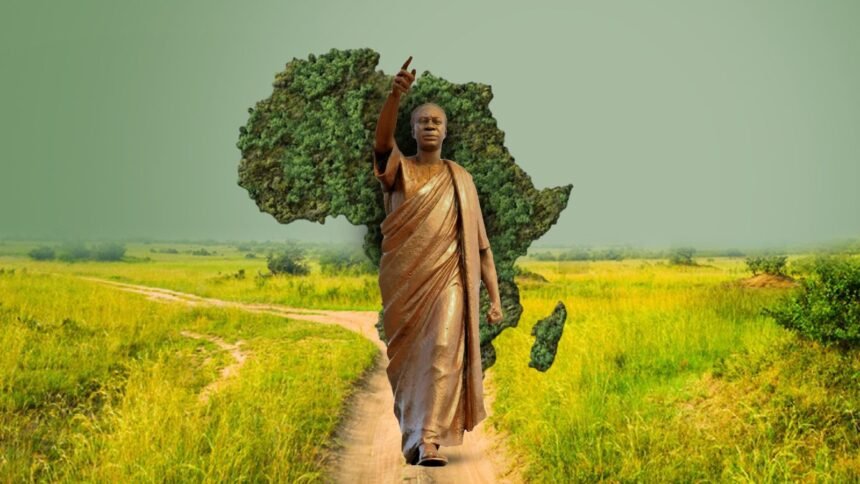
By chairing Africa’s main climate negotiating bloc, Ghana is betting that disciplined coordination—from village farms to AU summits—can turn lofty climate pledges into resilience and jobs across the continent.
On a sticky afternoon in Nairobi, as presidents and ministers filed into yet another high‑level meeting on climate adaptation, the statement from Ghana’s envoy cut through the usual diplomatic caution.
Africa’s resilience, he told the room, was “non‑negotiable.” It was not a line tucked away in a technical annex, but a message aimed squarely at leaders who have watched droughts, floods, and heat waves erode years of economic progress.
Speaking on behalf of President John Dramani Mahama at the African Leaders’ Meeting on Climate Adaptation, Minister of State for Climate Change and Sustainability Seidu Issifu warned that the continent could no longer afford delays as climate shocks intensified.
Climate action, he said, had to translate into “food security, water access and economic opportunities” for the hundreds of millions of Africans already living with the damage.
Behind the rhetoric lies a strategic calculation: if Africa is to demand fairer climate finance and push for policies that support development rather than constrain it, the continent needs a more unified voice. Ghana has positioned itself to provide exactly that.
Background and Stakes
In January, Ghana assumed one of the most consequential roles in global climate diplomacy: This bloc coordinates the positions of 54 African countries in UN climate talks. From 2026 to 2027, Ghana will help forge common African stances on adaptation, climate finance, loss and damage, technology transfer, and transparency rules.
The AGN was set up to strengthen Africa’s collective bargaining power in a process where decisions are often hammered out in late‑night sessions dominated by wealthier countries.
Ghana’s Antwi‑Boasiako Amoah, a senior official at the Environmental Protection Authority, now chairs the group at a moment when Africa’s demands for predictable finance, a fairer global financial system, and tangible follow‑through after COP30 are sharpening.
Kenneth Gilbert Adjei, Ghana’s Minister of Works, Housing and Water Resources, framed the challenge starkly at a recent meeting of the Committee of African Heads of State and Government on Climate Change (CAHOSCC) in Addis Ababa.
Sustained coordination and collective action, he argued, were “essential to shaping Africa’s future in an equitable, development‑oriented and just manner.” The AGN, he reminded leaders, is the vehicle through which Africa can insist that climate rules support, rather than undermine, its development ambitions.
Human Stories and Real‑World Examples
The stakes of this diplomacy are felt far from conference halls in Addis Ababa, Nairobi, or Bonn. Across northern Ghana, farmers have been grappling with erratic rainfall patterns that make planting seasons harder to predict, while floods and dry spells alternately wash away or wither crops—patterns echoed across the Sahel, East Africa, and southern Africa.
At the Nairobi meeting, Issifu described how Ghana is trying to embed climate resilience into its national development agenda despite global financing uncertainties. He pointed to the government’s 24‑hour economy plan, which prioritises green growth, renewable energy, and sustainable infrastructure, backed by investments in solar power, hydropower, and climate‑smart agriculture.
Yet he also acknowledged persistent obstacles: high financing costs, limited access to technology, and trade rules that can penalise African exports.
Ghanaian officials argue that such efforts are a microcosm of what Africa needs at scale: patient capital for adaptation, infrastructure that can withstand extreme weather, and industrial strategies built on renewables and critical minerals rather than fossil‑fuel dependence.
Issifu called for scaling up climate finance and strengthening partnerships with multilateral institutions and the private sector to unlock what he described as “high‑impact opportunities for resilience‑driven growth.”
Policy Debate and Expert Views
Ghana’s approach is as much about process as about policy. Adjei has emphasised the need for “continuous political leadership from this committee, disciplined coordination across our institutions and unwavering commitment to our common position” if Africa is to secure a climate future that is equitable and just.
In practice, that means regular briefings for African ministers and heads of state on negotiation outcomes, and closer alignment with African Union initiatives such as the Nairobi Declaration on Climate Change and Call to Action.
This is difficult work. Africa is not a monolith: fossil‑fuel‑exporting states, climate‑vulnerable small island and coastal countries, and rapidly industrialising economies often have different short‑term priorities. Some governments worry that aggressive decarbonisation timelines could strand vital assets or constrain industrialisation, while others want stricter global rules to protect them from escalating climate impacts.
Ghana’s leaders have responded by framing unity not as unanimity but as convergence around a few core principles: Africa’s resilience is “non‑negotiable,” climate finance must be fair and accessible rather than debt‑heavy, and the continent’s renewable resources and critical minerals should underpin a just and equitable energy transition.
“Africa contributes less than four per cent of global emissions yet bears a disproportionate share of climate impacts,” Issifu said in Nairobi, calling for finance “built on partnership, not debt or aid.”
International partners are watching closely. Kenyan President William Ruto has urged African states to leverage global shifts in climate investment, estimated at 2.3 trillion dollars in 2025, to position the continent as a leading destination for green industrialisation.
That will require predictable rules at home and a strong, coordinated voice abroad able to negotiate trade and finance frameworks that reward low‑carbon value chains rather than penalise them.
Climate experts say Ghana is well‑placed to play that role. With experience in carbon markets and Article 6 pilot projects, and a record of engaging in adaptation and methane initiatives, the country “is well‑positioned to amplify Africa’s voice on climate issues at the international level,” as one regional analysis put it.
Amoah has stressed that co‑creation, youth engagement, and cross‑continental collaboration will be central to his stewardship of the AGN, including efforts to strengthen an emerging African network of parliamentarians on climate change.
As Africa prepares to host COP31 in Addis Ababa in 2027, Ghana’s experiment in disciplined, development‑oriented climate diplomacy will face a decisive test.
If the country can turn its pledge to lead into tangible gains—more adaptation finance on fairer terms, clearer protections for vulnerable communities, and pathways to green jobs—the phrase often repeated by Ghanaian officials in recent months, “Africa is ready, and resilience cannot wait,” may sound less like a rallying cry and more like a negotiated reality.