





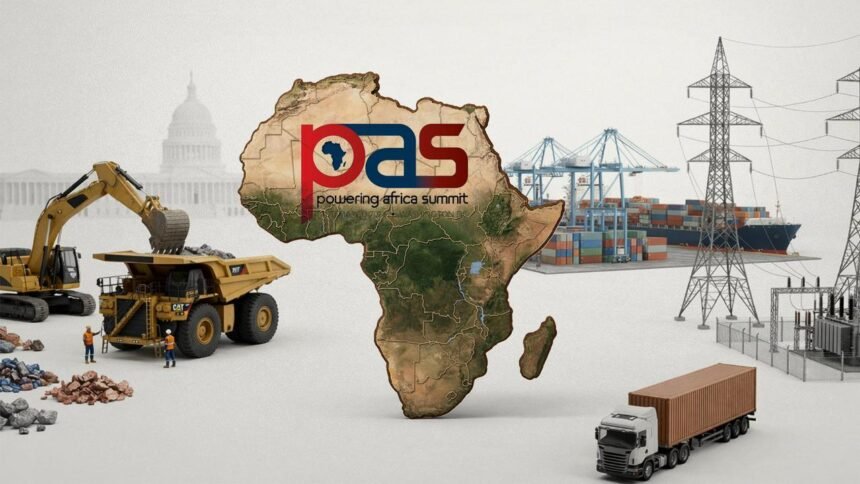
When the Powering Africa Summit opens in Washington this month, U.S. officials will pitch investment‑led energy diplomacy. African leaders will arrive with a clear demand: power at home, on fair terms.
On a chilly March morning later this month, staff at the JW Marriott in Washington, D.C., will wheel in mobile charging stations and translation booths as a different kind of power struggle gets underway.
Ministers from countries like Liberia, Ethiopia, and Ghana are expected to step out of black cars, flanked by aides carrying thick briefing folders that mention everything from grid bottlenecks to cobalt refining.
Nearby, American officials and bankers will be talking in the lobby about “de‑risking” and “deal pipelines,” using the language that now defines energy diplomacy between Washington and African capitals.
They will gather for the 11th Powering Africa Summit (PAS 2026), a two‑day meeting scheduled for March 19–20, under the theme “Powering the US‑Africa Partnership: Energy Infrastructure, Critical Minerals & Investment Strategies.”
The title itself signals what is at stake: who will finance Africa’s energy build‑out, who will control the minerals needed for the world’s clean‑energy transition, and how much of the value will stay on the continent.
For Washington, organizers and partners cast the summit as a showcase of investment‑led foreign policy at a time when Chinese and European firms have spent years building mines, grids, and ports across Africa.
For many African delegations, it is being framed as a chance to push back against a familiar pattern: exporting raw materials cheaply, importing expensive finished products, and living with the environmental fallout.
Background and Stakes
Africa holds a significant share of the world’s mineral reserves, including large deposits of cobalt, manganese, and platinum‑group metals used in batteries, solar panels, and fuel cells. Summit briefing materials note that meeting the expected global demand for these materials could require production from African deposits to rise sharply by mid‑century.
At the same time, hundreds of millions of Africans still lack reliable access to electricity, one of the starkest paradoxes of the energy transition.
The 2026 agenda reflects that double bind. Sessions are set to focus on bankable power projects, transmission corridors, and gas infrastructure, as well as on “Critical Minerals in Africa: Meeting Global Demand,” a discussion of how U.S. and African partners might expand supply while pushing more value‑added processing onto the continent.
Questions flagged in the draft program include how to build refining capacity, stabilize prices, and ensure that mining communities gain access to clean water, energy, and jobs, rather than being left with polluted rivers and unstable livelihoods.
U.S. agencies describe the summit as a move “firmly into execution,” highlighting export credit, loan guarantees, and risk‑mitigation tools as levers they plan to showcase to unlock large‑scale deals. The chair of the Export–Import Bank of the United States is slated to spotlight U.S. “financing firepower.”
At the same time, U.S. Secretary of Energy Chris Wright is scheduled to return after delivering a keynote at PAS 2025 to lead a fireside chat on energy access and clean cooking.
In promotional materials, organizers call PAS 2026 an “annual celebration of the US–Africa energy partnership,” but the language also points to sharpened geopolitical competition: a world in which control over lithium, cobalt, and copper is becoming as strategically significant as control over oil once was.
Human Stories and Real‑World Examples
Behind the acronyms and plenary panels, the summit program highlights concrete projects and communities that could be affected by the deals under discussion in Washington. One segment invites African stakeholders to explain how “abundant resources offer profitable investment opportunities for U.S.
companies who are not yet working in Africa,” citing efforts to improve governance frameworks and blended‑finance instruments to make projects more attractive. In practice, organizers suggest, that could translate into transmission lines that finally connect rural regions to the grid, or gas‑fired plants that replace diesel generators in industrial zones.
Summit documents also highlight emerging transport and energy corridors linking inland mineral deposits to ports, such as the Lobito Corridor, as test cases for a new model of partnership: infrastructure intended to support both exports and local development. For communities near mines, however, the stakes are more immediate.
The session on critical minerals explicitly proposes to examine how delivering clean water and modern energy services to mining areas can “increase productivity, health and wealth,” acknowledging a legacy in which extraction has often left behind environmental damage and limited durable prosperity.
On paper, organizers and partners say the next wave of investment should be tied to stronger environmental and social standards, encouraged by both African regulators and international financiers.
Yet civil‑society advocates in Africa have repeatedly warned, in commentary around similar conferences, that large projects risk bypassing local needs if they prioritize export corridors over domestic access. Those concerns are likely to shadow the conversations in Washington, even if they are not always center‑stage in the main ballroom.
Policy Debate and Expert Views
PAS 2026 is part of a broader U.S. strategy that leans on commercial diplomacy and infrastructure initiatives to counter rivals and secure supply chains.
Recent announcements around a U.S.–Africa Energy & Minerals Forum in Houston, relaunched with a dedicated focus on critical minerals and supply‑chain security, underscore how Washington is increasingly tying energy and minerals together in its engagement with the continent.
Organizers and corporate partners present this as a win‑win proposition. Placing critical minerals at the center of the agenda, while maintaining hydrocarbons engagement, they argue, can strengthen U.S.–Africa commercial ties and advance projects that deliver “long‑term shared value.”
Adam Cortese, chief executive of the solar developer Sun Africa, has described his company’s sponsorship of this year’s summit as a “pivotal moment for U.S.–Africa energy collaboration,” pointing to “actionable, investment‑focused solutions” aimed at broadening energy access and creating new opportunities along critical‑mineral and infrastructure value chains.
Critics, however, worry that a minerals‑and‑megaprojects frame could sideline climate‑justice and just‑transition concerns. Analysts and activists have warned that if investment chases export corridors and gas terminals without robust safeguards, Africa could be locked into carbon‑intensive infrastructure even as it supplies the materials for others’ clean‑energy transitions.
Questions also persist about how much decision‑making power African governments will really wield in structuring deals, particularly when financing and technology are anchored in northern capitals.
The summit’s own agenda hints at these tensions. Alongside panels on guarantees and returns, organizers emphasize “better governance frameworks” and “innovative financing mechanisms” that are supposed to reduce perceived risks for investors while, in theory, strengthening oversight and local benefit.
Whether that balance can be struck will depend less on the slogans used in Washington than on the contracts, regulations, and enforcement that follow once participants fly home.
What Will Count After Washington
By the evening of March 20, the last coffees will have been poured and the final business cards exchanged. The summit will likely produce closing photographs, joint statements, and promises of new deals. Organizers will count success in the number of projects advanced, memorandums signed, and panels filled.
For African governments, the ultimate metric will be more concrete: megawatts added to the grid, households connected, jobs created, royalties collected, and communities protected in the years after PAS 2026.
The summit’s theme, “Powering the US‑Africa Partnership: Energy Infrastructure, Critical Minerals & Investment Strategies”, suggests that the future of that partnership will hinge on who controls not just the flow of electrons, but the flow of metals and money.
The test, once delegates leave Washington, will be whether the deals that follow can light African homes and industries on a timetable set in African capitals, not only in foreign boardrooms.