





Pan-African: Resource Sovereignty and the Labor Question
Across the African landscape, the management of mineral wealth remains a central pillar of the struggle for economic sovereignty. For decades, the Pan-African discourse has focused on “local content”, the mandate that extractive industries must benefit domestic economies through local ownership and employment. However, as the continent’s leading gold producer, Ghana is currently navigating a complex “labor question”: how to ensure that the localization of the supply chain does not inadvertently erode the quality of employment. This challenge is a microcosm of a broader continental dilemma, where the drive for domestic participation must be balanced against the protection of workers’ rights and the maintenance of high-value industrial standards.
Ghana’s Mining Outlook: Sustaining Global Leadership
The mining outlook for Ghana in 2026 is defined by its status as Africa’s top gold producer, a position solidified by consistent institutional support and a stable regulatory environment. The sector remains the primary driver of the nation’s foreign exchange earnings and a major contributor to the national treasury. However, the 2026 outlook is increasingly focused on “operational efficiency” and cost-cutting measures. As global gold prices fluctuate and the costs of deep-level mining rise, both the state and private operators are looking toward structural reforms. The current landscape is one of transition, where the goal is to maintain high production volumes while navigating the social and economic pressures of a changing global energy and labor market.
Leading Gold Mines in Ghana: The Industrial Pillars
Ghana’s gold production is anchored by several world-class industrial pillars, including Newmont’s Ahafo and Akyem mines, Gold Fields’ Tarkwa operation, and AngloGold Ashanti’s storied Obuasi mine. A significant recent development in this landscape is the commencement of commercial gold production at the Newmont Ghana Gold Limited Ahafo North Mine in late 2025. These large-scale operations utilize sophisticated technology and direct employment models that have traditionally provided some of the highest-paying jobs in the Ghanaian economy. These mines are not just extraction sites; they are major hubs of technical expertise and logistical infrastructure that define the industrial character of regions like Ahafo and the Western Region.
Local Mineworkers & Foreign Companies: The Outsourcing Friction
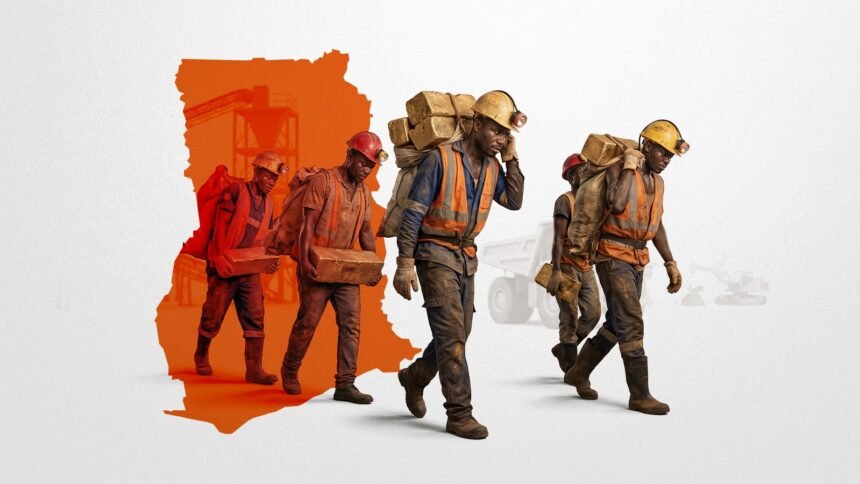
The relationship between local mineworkers and foreign-owned mining majors is currently strained by a significant shift in employment strategy. A growing trend toward “local outsourcing”, where mining companies hire local third-party contractors to provide labor, has created deep friction. The Ghana Mineworkers’ Union (GMWU) has warned that this rule, intended to promote local business, is being used to weaken collective bargaining. Reports indicate that local contractor staff often earn about half the basic pay of direct mine operator employees for the same work. This “labor tiering” creates a fractured workforce where local workers feel exploited by the very policies designed to include them, leading to a climate of industrial unrest and diminishing job security.
Investments & Trade: The Competitive Burden
From an investment and trade perspective, the move toward outsourcing is often framed as a necessity for maintaining Ghana’s competitive edge in the global gold trade. By utilizing local contractors, foreign companies seek to reduce their fixed labor costs and navigate the complexities of local content requirements. However, the GMWU argues that this “low-wage model” is short-sighted, as it erodes the domestic purchasing power that drives wider economic growth. For investors, the challenge is to find a balance where local participation generates genuine value without triggering the labor disputes that can disrupt production and damage the nation’s reputation as a stable trade partner.
Human Rights & Policy: The Mandate for Fair Treatment
The human rights and policy dimensions of the outsourcing rule are currently under intense scrutiny. The systematic reduction of wages and benefits through third-party contracting is viewed by labor advocates as a regression in worker welfare. In response to these concerns, the Minerals Commission, Ghana’s industry regulator, has signaled a shift toward stricter oversight. The regulator plans to support the unions’ push for better worker welfare by ensuring that local contractors adhere to fair labor standards. Effective policy in 2026 must ensure that “local content” is not synonymous with “cheap labor,” upholding the constitutional right of all Ghanaian workers to equal pay for equal work and safe, dignified working conditions.
Development: Reclaiming the Social Contract
The ultimate goal of Ghana’s mining sector must be the sustainable and inclusive development of the nation. For gold mining to contribute to long-term prosperity, the “social contract” between the state, the corporations, and the workers must be reclaimed. This requires a move away from extractive models that prioritize immediate cost-efficiency over human capital. The way forward involves a refined local content framework that prioritizes high-skilled direct employment and ensures that local contractors are capable of providing competitive wages. Only by protecting the livelihoods of those who extract the nation’s wealth can Ghana ensure that its status as a global gold leader translates into a stable and prosperous future for all its citizens.