





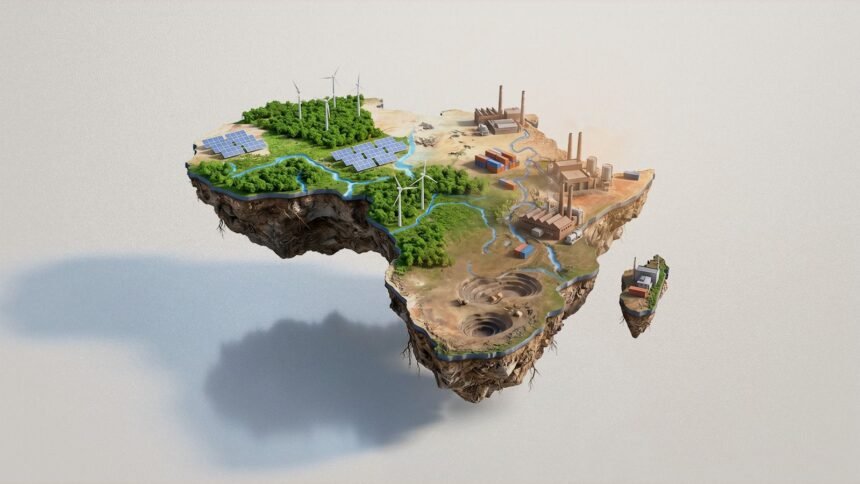
On a gray June morning in Cambridge, the lawns outside the conference hall are still damp when the first buses from African delegations pull up. Inside, banners for the International Conference on African Development, or iCAD 2026, share wall space with posters on “Green Transitions and Inclusive Industrialization,” while a cluster of African graduate students quietly wonder whether the next three days will offer genuinely new thinking or repackage familiar development arguments in climate‑friendly language.
Over three days, economists, trade negotiators, climate officials, and private‑sector executives will move between sessions on green hydrogen corridors, critical minerals, special economic zones, and just transition strategies.
The premise is simple enough: Africa’s industrialization push can no longer be separated from the climate crisis or from global efforts to decarbonize supply chains. The harder question, which hangs over the Cambridge halls, is who gets to decide what “green” and “inclusive” mean in practice for a continent whose development path has never fit inherited models.
This story matters now because iCAD 2026 convenes African and global actors at a moment when the continent must reconcile the pressure to decarbonize with the urgent need to industrialize, bargaining for a fair share of climate finance and value chains amid shifting geopolitical alignments.
Development Stakes and Context
Since its launch, the International Conference on African Development has marketed itself as a bridge between academic research and policy practice, using a European setting to focus squarely on African priorities.
This year’s theme—“Green Transitions and Inclusive Industrialization”- reflects a shift in how those priorities are framed. No longer is industrial policy discussed in isolation from climate commitments; instead, climate is treated as the terrain on which development will either be constrained or reimagined.
The stakes are unusually high. African governments have submitted long‑term strategies that blend net‑zero ambitions with growth plans, while regional bodies promote green industrial initiatives around energy, digital infrastructure, and value‑added manufacturing.
At the same time, the continent faces rising climate impacts and limited fiscal space, with debt servicing crowding out public investment. For many delegates, the core dilemma is straightforward: how to secure the infrastructure, technology, and skills needed for industrialization without locking into high‑carbon pathways that could trigger future trade penalties, stranded assets, or exclusion from emerging green markets.
Cambridge’s setting adds a layer. Panels on African industrial zones and green transitions take place a short walk from colleges that have benefited for centuries from global capital flows and intellectual prestige.
African participants are acutely aware of this history. Some see the location as a chance to speak directly into European and multilateral policy debates; others worry about reproducing a familiar pattern in which African development strategies are debated in Northern forums and then “brought back” to the continent.
The conference’s legitimacy, in their eyes, depends on whose analysis is centered—and whose proposals survive once the event ends.
Ground-Level Realities
For officials from African trade and industry ministries, the discussions in Cambridge are anything but abstract. A delegation from a coastal West African country arrives with a briefing on a planned green industrial park near a deep‑water port.
On paper, it will host assembly plants for electric buses, solar panel manufacturing, and agro‑processing facilities powered by renewables. In practice, the project must contend with unreliable grid capacity, water scarcity, and community concerns about land.
When such officials speak on panels, their questions are granular: who pays for grid upgrades, how to structure power‑purchase agreements, how to ensure local firms are not permanently relegated to low‑value segments of green value chains.
From Southern Africa, delegates bring experience with long‑standing heavy industry and coal‑dependent power systems. They talk about just transition plans that protect workers in mining regions while attracting investment into green hydrogen, battery materials, and new export corridors.
For them, “inclusive” industrialization is not a slogan; it is a matter of whether communities built on fossil‑fuel economies are offered real alternatives or left to absorb the social costs of decarbonization.
In breakout rooms, the texture of these realities becomes clear. Representatives of small and medium‑sized African enterprises explain the difficulty of meeting stringent environmental and social standards required by global buyers, even when their operations are relatively low‑emitting.
City officials from secondary urban centers describe the struggle to finance basic infrastructure, roads, water, waste systems, that any green industrial zone would require. Young researchers present work on informal economies that will not disappear simply because a country launches a national green industrial strategy.
Throughout, there are moments of quiet friction. When a European export credit agency outlines its criteria for supporting African green projects, an African economist asks why similar rigor was not applied to carbon‑heavy investments in previous decades.
A pan‑African development banker points out that concessional climate finance is still disproportionately channeled through intermediaries outside the continent, even when African institutions have the capacity to manage risk.
The quietly revelatory insight that emerges over coffee breaks is that, in practice, green transitions are not only about technology or emissions; they are about who controls the sequencing of investments and therefore the tempo of structural change.
Policy Fault Lines
Beneath the polished panels and keynote speeches, iCAD 2026 exposes three main fault lines in the debate over Africa’s green industrial future.
The first is about sequencing and space to grow. Many African policymakers argue that the continent needs policy space to use a mix of energy sources, including gas in the near term, to power industrial expansion and improve access.
Critics—often from climate advocacy groups —warn that this risks creating stranded assets and locking communities into polluting infrastructure. The tension surfaces in discussions over how African countries can use trade tools, such as the African Continental Free Trade Area, to develop regional value chains without falling afoul of emerging carbon border measures.
The second concerns ownership of technology and value. Green industrial strategies on the continent increasingly pivot around critical minerals, renewable energy components, and new manufacturing sectors.
Delegates from mineral‑rich countries raise the question of how to move beyond extraction toward local refining and manufacturing, especially as global powers vie for secure supplies of strategic inputs.
They ask whether international partnerships announced in the name of green transitions genuinely build African capabilities, or lock countries into supplying raw materials to decarbonization projects headquartered elsewhere.
The third fault line is distributional. Even when investment flows into green corridors and industrial parks, there is no automatic guarantee of inclusive outcomes. Labor unions worry about job quality and the risk that automation in new industries could limit employment gains.
Civil society voices stress that industrial zones can displace communities or deepen inequalities if not carefully planned. Women’s economic networks point out that many climate and industrial policies still treat care work and informal economies as peripheral, even though they underpin resilience.
The debate at iCAD, therefore, is not just about aggregate growth but about whose livelihoods are strengthened or undermined in the name of green transformation.
Across these fault lines, African agency remains the central experiment. Delegates from regional development banks, planning ministries, and research institutes present proposals for home‑grown financing instruments, industrial policies, and regional platforms to share lessons—from North African renewable manufacturing clusters to East African innovation hubs and West African agro‑processing corridors.
They aim to shift the narrative away from Africa as a testing ground for imported models toward Africa as a co‑author of global industrial and climate strategies.
As iCAD 2026 closes on June 19, no single blueprint for “green transitions and inclusive industrialization” will have emerged. The conversations in Cambridge will feed into national plans, regional strategies, and future negotiations. Still, the hard work will return to African capitals, industrial towns, and rural districts where policies meet everyday constraints.
The unresolved question, which follows delegates back across the Mediterranean and the Sahara, is whether the power to define and finance Africa’s green industrial future will truly migrate southwards—or whether the most important decisions will still be made in rooms that look more like this one than like the places the policies are meant to transform.