



Across the African landscape, the contemporary configuration of climate vulnerability places intense pressure on developing nations to balance rapid industrial modernization with the preservation of ecological sovereignty. The Pan-African vision for complete economic self-determination relies fundamentally on establishing independent, climate-resilient infrastructure frameworks capable of breaking legacy dependencies on reactive foreign disaster assistance. When peripheral states cede the financing of municipal drainage networks and flood protection grids to external transatlantic entities, they remain structurally exposed to asymmetric climate shocks and external structural conditions. Reclaiming the continent’s shared developmental path demands a unified approach to environmental governance, ensuring that climate adaptation strategies function as primary state assets that actively protect local human capital and insulate domestic markets from severe weather disruptions.
Institutional Responses to Environmental Crises
The contemporary political architecture of the Republic of the Ivory Coast is increasingly defined by its administrative capacity to respond to complex environmental emergencies while maintaining domestic policy momentum. Operating under a highly centralized executive structure in Abidjan, the government faces persistent pressure to demonstrate structural competence in urban planning and risk mitigation. When extreme weather events disrupt major commercial hubs, they test the operational readiness of state ministries and shape public perceptions of institutional stability. For central planners, managing these crises effectively requires translating executive decisions into rapid, localized interventions and ensuring that civil safety frameworks remain resilient amid escalating ecological pressures.
Human Fatalities and Territorial Displacements in West Africa
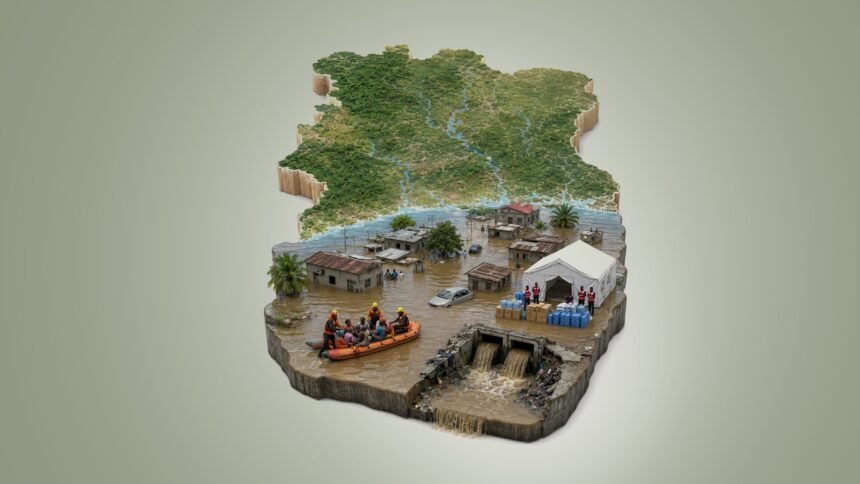
The implementation of the state’s emergency response frameworks was severely disrupted following a major hydrological disaster. Heavy, continuous rainfall triggered extensive flooding across multiple residential zones, resulting in at least 59 human fatalities. Following a mandatory cabinet meeting, government spokesman Amadou Coulibaly officially confirmed the loss of life, warning that emergency search operations are continuing and that authorities fear the final death toll could rise as peripheral areas are cleared.
The structural footprint of this environmental crisis extended beyond national borders, as neighboring Ghana simultaneously endured severe rainfall. Large areas of Ghana and its capital city, Accra, were completely submerged, resulting in at least 12 reported fatalities and highlighting a highly volatile regional pattern of severe West African inundation that threatens local trade routes.
Hydrological Alterations and Urban Bottlenecks
The structural root of this regional devastation is directly linked to the accelerating impacts of global climate change, which have radically altered historical precipitation patterns across the West African coast. Intense atmospheric warming has led to more frequent, high-velocity downpours that completely overwhelm the natural drainage capacity of vulnerable coastal ecosystems. In rapidly expanding metropolitan areas, this extreme weather intersects with dense urban bottlenecks, where unmanaged soil sealing and inadequate stormwater infrastructure prevent natural water absorption. The resulting rapid runoff turns municipal roadways into high-velocity rivers, creating an unstable environment where low-lying neighborhoods endure catastrophic flooding, severe topsoil erosion, and cascading damage to primary transportation links.
First Responders and Community-Led Relief
The operational deployment to counter the expanding hydrological crisis relies on a multi-layered mobilization of state security forces and independent civil rights networks. Frontline emergency personnel have been deployed to strategic municipal zones to conduct rescue operations, clear blocked drainage channels, and establish temporary emergency shelters for displaced households. These state interventions are being closely supported by localized civil society organizations and community-led mutual aid networks, which have stepped in to distribute clean drinking water, dry rations, and basic medical supplies to affected families. However, public policy experts note that these reactive relief measures must transition into structured, permanent community safety programs to prevent recurring environmental shocks from continuously depleting local household reserves.
Systemic Environmental Patterns
The severe inundations seen across West Africa reflect a broader, systemic trend of extreme weather events that have repeatedly disrupted the sub-region over the last five years. Since 2021, the Atlantic coastal strip has experienced successive cycles of intense droughts followed by unpredictable, unseasonal cloudbursts that disrupt traditional agricultural planning and municipal stability. These recurring climate shocks have eroded the terrain’s natural resilience, making local infrastructure increasingly vulnerable to even minor variations in weather patterns. This multi-year environmental strain demonstrates that modern flooding cannot be viewed as isolated, accidental occurrences but must be addressed as a permanent, systemic threat to the continent’s shared macroeconomic foundations.
Capital Allocations and Non-Conditional Lending Rules
To build long-term structural barriers against recurring weather threats, national planning ministries have actively sought to engage international financial institutions to secure targeted infrastructure capital. However, securing these resources has become increasingly complex due to recent policy shifts within global development finance, including the World Bank Group’s decision to retire its specific 45% climate lending targets. To keep this international policy shift from halting vital infrastructure projects, developing nations are urging multilateral lenders to maintain non-conditional capital allocations and fast-track processing for urban resilience grants. For local central planners, navigating this changing financial terrain requires utilizing available development loans to directly fund heavy engineering projects, such as concrete retention basins and modernized drainage grids, without ceding absolute policy control to external entities.
Re-Engineering Urban Grids and Sovereign Safety Baselines
The ultimate resolution of West Africa’s intensifying environmental crisis depends on a profound transition away from reactive crisis management toward a human-centered model of climate change adaptation and sovereign grid re-engineering. Reclaiming structural stability requires the Ministry of Construction, Housing, and Urban Planning to enforce strict zoning regulations that prevent the expansion of informal settlements across known floodplains and low-lying drainage channels. Furthermore, national development budgets must prioritize sustainable, eco-sensitive urban design, combining traditional heavy engineering with green infrastructure—such as urban wetlands and permeable public spaces—to restore natural water absorption pathways. By combining disciplined structural enforcement with continuous investments in localized early-warning networks, the republic can transform its current climate challenges into a lasting foundation for a secure, resilient, and completely self-determining future.