





The Historiographical De-Centering of Continental Heritage
Across the African landscape, archaeological inquiry serves as a profound methodology for reconstructing the continent’s multi-layered history, challenging long-standing Eurocentric narratives of isolation and underdevelopment. The Pan-African approach to antiquity emphasizes that localized historical contexts, from the kingdom of Aksum to the Nile Valley, were dynamic nodes in extensive intercontinental networks. By documenting the tangible material culture left behind, archaeological advancements provide African societies with the empirical tools necessary to reclaim their deep historical agency, demonstrating that the continent’s past was defined by highly complex urban systems, robust commercial strategies, and deep cross-cultural intellectual engagements.
The Multilayered Imperial Fabric
The historiography of Egypt has frequently been oversimplified into a monochromatic narrative centered exclusively on the Pharaonic dynasty. However, contemporary scholarship highlights Egypt’s historical past as a deeply complex, multilayered imperial fabric, where successive Greco-Roman, Byzantine, and Islamic eras integrated the Nile Valley into broader Mediterranean frameworks. The transition from late antiquity into the early Christian and Byzantine periods was characterized not by a decline in societal organization but by a sophisticated adaptation of urban spaces and administrative mechanisms, in which remote desert oases served as vibrant outposts of economic activity, domestic commerce, and religious development.
Unearthing Late Antiquity
The landscape of Egyptian field research has been significantly enriched by a series of high-integrity systematic excavations that illuminate the daily life and material culture of late antiquity. Moving beyond elite monumentality, contemporary archaeological missions emphasize the documenting of residential quarters, industrial areas, and public thoroughfares. These domestic spaces yield critical data regarding the socioeconomic realities of ordinary citizens, shifting the focus of antiquities management toward holistic preservation. By meticulously uncovering domestic architecture and public spaces, researchers are successfully reconstructing the architectural and civic planning strategies that allowed ancient populations to thrive in hyper-arid frontier zones.
The Geopolitics of Heritage Protection
The relationship between historical preservation and global heritage consumption is a vital pillar of Egypt’s contemporary administrative strategy. The Ministry of Tourism and Antiquities actively utilizes new archaeological breakthroughs as crucial tools for macroeconomic stabilization and international cultural diplomacy. However, this commercialization necessitates a delicate balance between infrastructure development and scientific conservation. Ensuring that tourist access does not compromise the structural integrity of delicate mud-brick or limestone ruins is an absolute prerequisite for sustainable preservation, forcing state agencies to implement strict zoning and site-management protocols across fragile desert archaeological zones.
The Adaptation of Desert Oases
Ancient urban development in Egypt’s harsh landscapes was intrinsically bound to environmental adaptation and innovative resource management. The survival of sizable communities in the western desert depended entirely on the strategic utilization of natural oases, which functioned as crucial hubs for agriculture, trade, and regional defense. The local economy was driven by the production of bulk agricultural goods and pottery, which were exported across long-distance desert caravan routes. This environmental adaptation required sophisticated water-conservation measures and robust administrative coordination, demonstrating that ancient societies possessed the advanced capability to engineer resilient economic networks in the face of geographic isolation and climatic precarity.
The Byzantine Quarters and Coastal Tombs
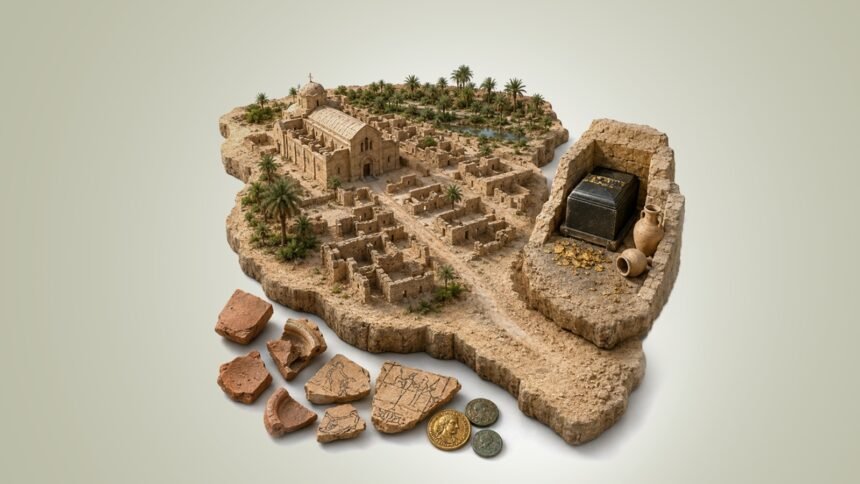
The most notable field research milestone occurred in July 2026, when an Egyptian archaeological mission uncovered a remarkably well-preserved fourth-century Byzantine city in the Dakhla Oasis, located in the New Valley province. This urban settlement features a systematic grid network composed of north-south thoroughfares and east-west streets forming public squares. The excavation successfully exposed an expansive basilica-style church from the mid-fourth century alongside heavily fortified defensive structures with thick mud-brick walls, vaulted roofs, and reception halls.
Among the residential structures, researchers identified the home of Tisous, a fourth-century church deacon, which housed a wealth of domestic artifacts, including bread ovens, kitchens, stone grinding tools, and 200 pottery fragments known as ostraca inscribed with commercial transactions and daily correspondence. The domestic quarters also yielded bronze and gold coins bearing the portraits of Byzantine emperors, including Roman Emperor Constantius II, who ruled between 337 and 361.
Separately, another archaeological mission on Egypt’s northern coast unearthed 18 ancient tombs at the Marina el-Alamein site, located approximately 62 miles west of Alexandria. Believed to be the ancient Greco-Roman port city of Leukaspis, the site yielded 11 rock-cut tombs and seven surface limestone-built tombs, pushing the total number of identified graves at the complex to 48. The coastal excavations revealed a highly valuable black granite sarcophagus containing skeletal remains, alongside altars, limestone basins, amphorae, and small gold leaves known as “golden tongues” placed inside the mouths of the deceased, a distinct funerary practice tied to ancient beliefs regarding afterlife communication. These dual discoveries provide an invaluable, empirically grounded look into the urban density, commercial ties, and funerary beliefs that defined Egypt’s diverse communities during late antiquity.