





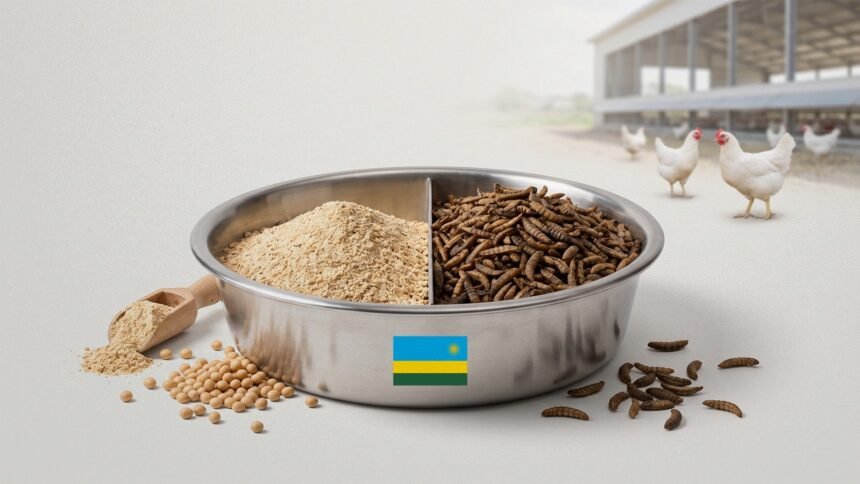
As African countries struggle with rising livestock feed prices and a heavy reliance on imported soybean meal and fish meal, Rwanda is betting on black soldier fly (BSF) larvae as a cheaper, locally sourced alternative for poultry, fish, and pig feed.
The country is now pushing to significantly expand production of BSF-based feed, with researchers and industry players arguing that scaling up the sector could lower feed costs, create jobs for youth and women, and turn organic waste into valuable agricultural inputs.
Experts say achieving that goal will require greater investment, improved access to finance, stronger waste-collection systems, greater technical skills, and wider adoption of the technology by farmers and feed manufacturers.
Animal feed made from BSF larvae uses the protein-rich insects as an ingredient for poultry, fish, pigs, and other livestock. The larvae are reared on organic waste, such as food scraps and agricultural by-products, before being harvested, dried, and processed into insect meal or incorporated into compound feeds.
Studies show that feed containing BSF larvae can cost about 40 percent less than feed made using soybean meal or fish meal, offering livestock farmers a cheaper alternative while reducing dependence on imported protein.
What Rwanda Needs To Scale Production
Mupenzi Mutimura, a Senior Research Fellow in Feed Resources and Animal Nutrition at the Rwanda Agriculture and Animal Resources Development Board (RAB), said scaling up production will require coordinated action from the government and the private sector.
He said priorities include expanding farmer training and demonstration sites, encouraging private investment in commercial BSF farming, and establishing multiplication centres to supply quality eggs and starter colonies.
Other interventions include promoting public-private partnerships for waste collection and insect production, improving access to affordable credit for youth- and women-led enterprises, developing quality standards and certification for BSF meal, and strengthening research on feed formulation and production systems.
“Technical training, business incubation, access to starter materials, research support, and integrating BSF farming into circular economy programs that convert organic waste into livestock feed and organic fertilizer are also important,” Mutimura said.
He noted that Rwanda’s agricultural transformation agenda and growing investment in livestock feed production provide favorable conditions for expanding the industry.
Although BSF farming remains an emerging sector, commercial production is already underway through a small number of private companies, cooperatives, and youth enterprises, many of which have received technical support from RAB, development partners, and private sector initiatives.
Adoption Is Growing, But The Gap Remains Huge
Mutimura said Rwanda has no official national registry indicating the number of animal feed manufacturers using BSF or their combined production capacity. However, he said adoption is increasing steadily as more producers embrace the technology.
The opportunity is significant. Existing animal feed manufacturers have a combined annual production capacity of about 163,000 tonnes, while national demand is estimated at 15.9 million tonnes.
The challenge is not unique to Rwanda. Across much of Africa, feed manufacturers rely heavily on imported protein ingredients, exposing farmers to currency fluctuations, global commodity price shocks, and supply disruptions. Rwanda’s attempt to build a domestic insect-protein industry is therefore being closely watched as a potential model for reducing feed import dependence in emerging livestock economies.
“As adoption increases, BSF is expected to contribute a growing share of locally produced protein ingredients for poultry, pig, and aquaculture feeds,” Mutimura said.
Why black soldier flies matter
Protein ingredients account for the largest share of livestock feed costs, with soybean meal and fish meal remaining expensive because they are largely imported and compete with human consumption.
Mutimura said BSF larvae offer several advantages: they can be produced locally from organic waste, require relatively little land and water, reduce reliance on imported protein ingredients, and convert waste into valuable livestock feed and organic fertilizer.
BSF larvae contain between 40 and 55 percent protein, depending on the substrate on which they are reared. By comparison, soybean meal contains 44–48 percent protein, while maize contains only 8–10 percent protein because it is primarily an energy source.
He stressed that BSF is not intended to replace maize but to partially substitute costly protein ingredients such as soybean meal and fish meal in balanced feed formulations.
What Producers Are Struggling With
Janvier Twambazimana, Manager of Abusol, one of Rwanda’s largest egg producers and a manufacturer of BSF-based animal feed, said access to finance, skills development, and a reliable supply of organic waste are critical for expanding production.
“The technology is still new, and there are very few players in the sector. We need trained technicians, specialized machinery, and financing from different sources,” he said.
The company currently produces 500 kilograms of dried BSF larvae per day. At a five per cent inclusion rate, 100 kilograms of dried larvae can produce two tonnes of animal feed, meaning the company’s current output can generate around 10 tonnes of feed daily.
Abusol plans to increase production to two tonnes of dried larvae per day in the near term, with a long-term target of 50 tonnes per day.
Twambazimana said achieving that goal will require financing from the government, commercial banks, and development partners.
“Commercial banks are still reluctant to finance BSF production, yet it is a strategic sector. More than 95 percent of the protein ingredients used in animal feed, such as soybean meal and fish meal, are imported. Increasing local production would reduce that dependence,” he said.
Analysts say this financing gap is one of the biggest barriers to the growth of insect-protein industries across Africa, where many banks still view BSF farming as unfamiliar and high-risk, despite growing demand for alternative feed ingredients.
The Waste Collection Challenge
Twambazimana said stronger collaboration with waste collection companies and agro-processing industries could significantly reduce production costs.
Rather than transporting organic waste over long distances, he said BSF production units should be located closer to where waste is generated. The larvae can then be harvested, with the remaining organic material used locally as fertilizer.
On average, one tonne of organic waste can produce about 200 kilograms of larvae.
Despite investing in processing equipment, Abusol is operating well below capacity.
“Our machines can produce up to four tonnes of dried larvae per day, but we are producing only 500 kilograms because of limited financing, inadequate waste supplies, and a shortage of transport trucks,” Twambazimana said.
He believes operating at full capacity could reduce animal feed prices by 40–50 percent compared with conventional feeds.
Training More Farmers May Matter More Than One Big Factory
Barthazar Masengesho, Production and Operations Manager at Maggot Farm, said demand for BSF-based products already exceeds supply.
Operating on between two and two-and-a-half hectares, the company produces between **six and 10 tonnes of organic fertilizer and six to 12 tonnes of protein-rich animal feed each month.
Rather than expanding production alone, Masengesho said training more farmers to produce BSF would have a greater impact.
“If this training center expands and attracts more people, farmers will no longer struggle to access these products,” he said.
“Instead of producing everything ourselves, we want to train people and provide them with starter stock at an affordable price so they can begin production on their own.”
Previous studies by Rwanda’s Ministry of Agriculture show that replacing part of soybean meal and fish meal with BSF larvae can reduce feed costs by about 40 percent while maintaining strong growth performance in broiler chickens.
RAB research has also found that BSF larvae can provide a substantial share of the protein required in feed for poultry, pigs, and fish, making them a promising locally produced alternative to imported protein sources. Standard operating procedures for BSF farming have also been developed to support wider adoption.
If Rwanda succeeds in scaling BSF production from a niche industry into a reliable source of livestock protein, it could offer lessons for other African countries seeking to lower feed costs, expand poultry and aquaculture production, reduce organic waste, and create new green enterprises. The outcome of Rwanda’s experiment may therefore have implications far beyond its borders.