





From Diamond Company to Gold Refiner
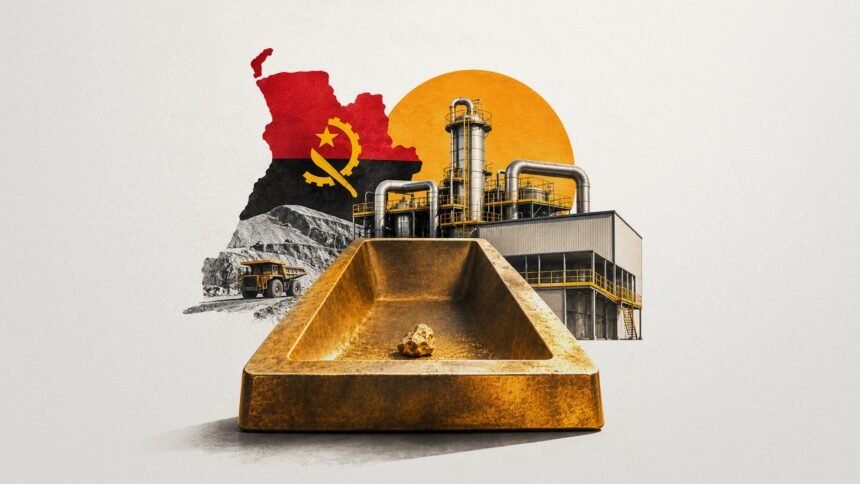
What does a country do with a gold refinery that can handle more metal in a few days than its mines officially produced in a whole year? That is the question hanging over the plant Angola inaugurated on Friday 20 November in the Viana Industrial Development Hub, outside Luanda. Built and fully financed by the state diamond company Endiama for 20.7 million US dollars, it is the country’s first gold refinery, and it brings refining, testing and certification of gold onto Angolan soil for the first time.
The project is part of a wider push across Africa to keep more value from minerals at home rather than exporting raw ore and buying back finished products. Liberia, among others, has announced plans for a refinery of its own. Angola’s version comes with an unusual twist: the refinery’s capacity is well ahead of the gold the country currently mines, so its success depends on supply that does not yet exist.
What Has Been Built
The plant combines a refining unit, a laboratory and the country’s first public assay and hallmarking office, which will check the purity of gold, silver and platinum and issue official marks of guarantee. Minister of Mineral Resources, Petroleum and Gas Diamantino Azevedo, who opened it, said the change marked a new stage for the mining industry. “The country now has its own capacity to refine and certify its gold on national territory, creating conditions to convert this resource into knowledge, economic activity, employment and added value,” he said, in remarks made in Portuguese.
Endiama says the money went on construction and equipment. Its chairman, José Ganga Júnior, said the plant would refine to a purity of 99.99 percent. “Diversification requires economically viable projects, investment discipline, and rigorous management of costs and risks,” he said, presenting the refinery as a way to reduce the company’s reliance on diamonds and strengthen its finances.
Reading the Capacity Figures
The capacity figures need care, because official descriptions differ. Endiama and the ministry have described the plant as able to process up to 25 kilograms of gold a day. At the inauguration, however, Azevedo said 25 kilograms was the capacity per shift, and that running three shifts would allow up to 75 kilograms a day. Ganga Júnior put installed capacity at 25 kilograms per eight-hour work cycle, equivalent to 550 kilograms a month. The minister also said current gold production did not justify running more than one shift.
Job figures vary too. Official announcements spoke of 35 direct jobs for young technicians in the first phase, while Endiama’s chairman said the project had created at least 70 direct jobs. Both may be right if they count different stages, but neither has been broken down publicly.
The Supply Gap
Angola’s latest official annual figure puts gold production at 99.5 kilograms in 2024. Even at one shift, the refinery could process that amount in about four working days. The ministry said in August that 49 gold exploration projects were under way and four were in production, with more than 120 million US dollars invested in the sector. Exploration projects, though, are not producing mines, and turning a pipeline of licenses into steady output usually takes years.
Officials are looking beyond Angola’s own mines. Azevedo said the refinery could process gold from other countries, depending on Angola’s tax and import rules and its ability to verify where the metal comes from. Ganga Júnior said producers in Congo and Ghana had expressed interest in sending gold to Luanda. Endiama is also prospecting four gold concessions as it moves into mining. The ministry has urged mining companies to step up exploration, and the minister said the central bank could buy locally refined gold for its reserves.
Traceability in a Trade Under Scrutiny
The government argues that refining and certifying gold at home will make Angolan metal more traceable and easier for buyers to trust. “When gold is refined and certified in the country, the state follows the value chain better, the traceability of the metal gains credibility and a larger part of the benefits of mining remains in Angola,” Azevedo said. That matters in a sector where illicit flows are a serious problem. The Swiss development organization SWISSAID has estimated that at least 453 tonnes of African gold not declared for export by producing countries reached the United Arab Emirates in 2024, based on comparisons of trade data.
Recognition is the other hurdle. The refinery is not yet accredited by the London Bullion Market Association, whose standards govern bars traded on major international markets. The ministry says it will seek international quality and laboratory certifications, including that accreditation, once operations begin. Without it, Angolan bars will struggle to reach the buyers that pay the best prices. Taking gold from neighboring countries would also test the refinery’s checks on origin, since a plant that cannot prove where its metal comes from risks becoming part of the problem it is meant to solve.
Value Kept at Home, If the Gold Arrives
Angola’s decision to refine its own gold is a sensible step for an economy long dependent on oil and diamonds, and the public assay office alone gives local jewelers and producers something they lacked. But a refinery is only as useful as the metal that passes through it. Whether the Viana plant becomes a regional hub or an underused showpiece will depend on new mines opening, on strict checks on any imported gold, and on international accreditation. If those come together, Angola will have taken a real step towards controlling the value of its own resources. If not, the 20.7 million dollars will mostly buy a symbol.